
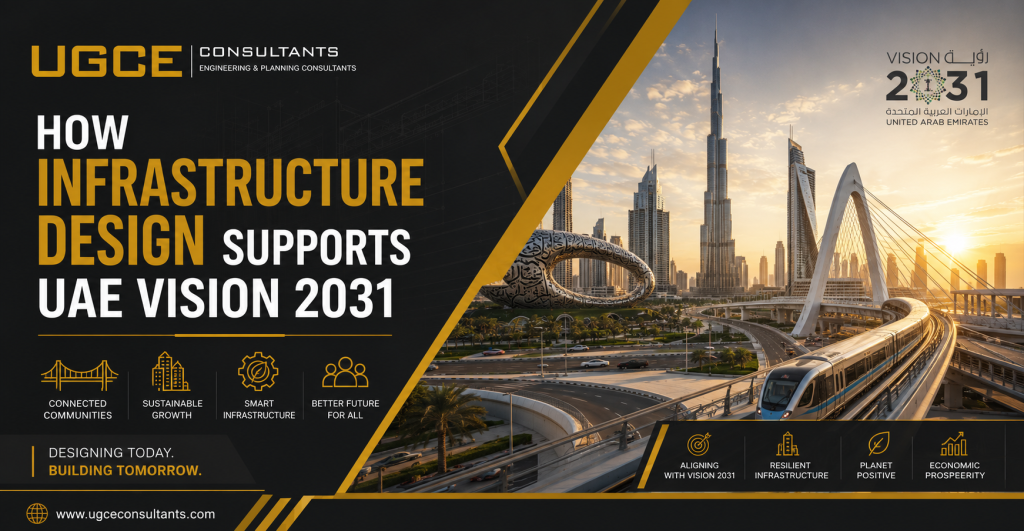
Infrastructure design in UAE has always been one of the strongest drivers of economic growth and urban transformation.It plays an even larger role by supporting national strategies aimed at creating sustainable cities, diversified economies, and connected communities. Roads, utilities, transportation networks, public facilities, and digital infrastructure are no longer viewed as isolated projects.
Engineering consultants and infrastructure planners therefore play an important role in translating national objectives into practical, resilient, and future-ready developments.
What Is the UAE Vision 2031 and Why Does Infrastructure Matter?
Understanding the role of infrastructure design in UAE begins with understanding the country’s long-term development strategy and why infrastructure is considered one of its most important foundations.
UAE Vision 2031 at a Glance
UAE Vision 2031 sets out a clear long-term path for where the country is headed — one that puts real weight behind economic diversification, more sustainable communities, better public services, and cementing the UAE’s standing on the world stage
The strategy places strong emphasis on:
- Sustainable economic growth
- High-quality public infrastructure
- Environmental responsibility
- Innovation and digital transformation
- Improved quality of life
- Efficient urban development
Achieving these objectives depends heavily on well-planned infrastructure systems capable of supporting future population growth and economic expansion.
Infrastructure as a Driver of National Development
Modern UAE infrastructure projects influence nearly every aspect of development.
They support:
- Transportation and logistics
- Residential and commercial expansion
- Industrial growth
- Tourism development
- Public health services
- Education and research facilities
Without continuous investment in infrastructure, many broader economic and social objectives would be difficult to achieve.
Supporting Sustainability and Economic Diversification
The UAE’s long-term vision extends beyond physical construction.
Infrastructure is expected to contribute toward:
- Lower carbon emissions
- Renewable energy integration
- Resource efficiency
- Economic diversification beyond oil
- Greater resilience against future challenges
These priorities continue shaping the future of Infrastructure development UAE initiatives.
How Does Infrastructure Design Support Sustainable Urban Growth?
A major focus of infrastructure design in UAE is making sure cities can continue to grow without putting unnecessary pressure on the environment or reducing the quality of public services
Sustainable urban growth depends on infrastructure being planned as one connected system, where transportation, utilities, public facilities, and digital networks all grow together instead of developing separately.
Effective Infrastructure planning UAE helps cities:
- Reduce traffic congestion
- Improve public transportation accessibility
- Support balanced residential and commercial development
- Optimize land use
- Increase infrastructure efficiency
Instead of waiting for cities to outgrow their infrastructure, engineers are putting more effort into planning ahead and designing systems that can continue meeting future needs for decades to come.
This long-term approach supports more resilient and better-connected communities.
Why Is Smart Infrastructure Essential for Future UAE Cities?
As cities become more connected, infrastructure design in UAE is increasingly incorporating digital technologies that improve operational efficiency and public services.
What Is Smart Infrastructure?
Smart infrastructure design is all about bringing engineering together with digital technology, sensors, automation, and data analytics to help infrastructure perform better and support smarter decision-making.
Traditional infrastructure usually keeps operating the same way regardless of what’s happening around it. Smart systems work differently, constantly tracking conditions and adjusting to changing operational demands as they happen.
Examples include:
- Intelligent traffic management
- Smart utility networks
- Automated street lighting
- Digital water management systems
- Connected public transportation
Improving Efficiency and Connectivity
Technology allows infrastructure to become more responsive by:
- Optimizing traffic flow
- Reducing utility losses
- Improving emergency response
- Monitoring infrastructure health
- Supporting predictive maintenance
These improvements reduce operating costs while enhancing public services.
Smart Cities and Infrastructure Design
The success of Smart city infrastructure depends on coordinated engineering rather than individual technologies.
Transportation, utilities, communication systems, and public facilities must operate as a connected network capable of sharing information in real time.
This integrated approach is becoming one of the defining characteristics of Future infrastructure UAE.
How Does Infrastructure Design Improve Transportation and Connectivity?
One of the clearest signs that infrastructure design in UAE is working is a transportation system that keeps pace with city growth without losing its ability to move people and goods where they need to go.
When transportation infrastructure is built right, it takes the friction out of how people, businesses, and goods get from one place to another — making cities run more smoothly and giving economic growth room to spread across both urban centers and wider regional areas.
Modern Transportation infrastructure UAE projects typically include:
- High-capacity road networks
- Metro systems
- Rail corridors
- Airports
- Ports and logistics facilities
- Pedestrian and cycling infrastructure
Good transportation design provides several long-term benefits:
- Shorter travel times
- Reduced congestion
- Improved public safety
- Greater economic productivity
- Better regional connectivity
As urban populations continue growing, transportation engineering will remain one of the country’s highest infrastructure priorities.
How Does Infrastructure Design Support Economic Diversification?
The UAE’s long-term economic strategy depends on creating industries that extend beyond traditional energy sectors.
This makes infrastructure design in UAE a critical enabler of economic diversification.
Well-designed infrastructure attracts investment by providing reliable access to:
- Industrial zones
- Technology parks
- Commercial developments
- Tourism destinations
- Logistics hubs
- Innovation districts
Strong infrastructure also supports sectors such as:
- Manufacturing
- Renewable energy
- Healthcare
- Education
- Digital technology
- Financial services
As these sectors continue expanding, infrastructure investment remains essential for sustaining long-term economic growth.
Why Is Sustainability a Core Element of Modern Infrastructure Design?
Sustainability has become one of the defining characteristics of infrastructure design in UAE, influencing how projects are planned, constructed, and operated throughout their lifecycle.
How Can Infrastructure Projects Reduce Environmental Impact?
Modern Sustainable infrastructure UAE initiatives aim to minimize environmental impact while improving long-term operational efficiency.
Common strategies include:
- Energy-efficient infrastructure systems
- Renewable energy integration
- Water conservation measures
- Reduced construction waste
- Low-carbon materials
- Improved stormwater management
These approaches help reduce resource consumption while supporting national environmental objectives.
Why Is Resilience Important for Future Infrastructure?
Infrastructure must remain reliable despite changing environmental conditions, population growth, and technological evolution.
Resilient infrastructure is designed to:
- Withstand extreme weather
- Adapt to future demand
- Minimize service disruptions
- Support long-term operational performance
This resilience is becoming increasingly important as cities continue expanding.
How Does Infrastructure Design Support Water, Energy, and Utility Networks?
Water, electricity, wastewater, telecommunications, and utility systems form the foundation of every modern city.
Successful infrastructure design in UAE requires these systems to be planned together rather than independently.
Integrated utility planning helps achieve:
- Reliable service delivery
- Greater energy efficiency
- Improved maintenance access
- Reduced operational costs
- Better resource management
As urban populations grow, demand for coordinated utility infrastructure will continue increasing.
This makes integrated planning an essential component of modern Civil engineering UAE practices.
What Challenges Must Engineers Overcome When Designing Infrastructure in the UAE?
Delivering world-class infrastructure has become something the UAE is genuinely known for — but behind that reputation, the engineering demands haven’t let up one bit.
Challenges that come with it include:
Climate Conditions
Extreme temperatures require specialized engineering solutions for transportation systems, utilities, and public infrastructure.
Rapid Urban Growth
Cities continue expanding quickly, requiring infrastructure that can accommodate future population increases without major reconstruction.
Sustainability Targets
Infrastructure projects must balance performance, cost, and environmental responsibility simultaneously.
Technological Integration
Digital infrastructure, automation, and smart city technologies require multidisciplinary coordination between engineering disciplines.
Long-Term Asset Performance
Modern infrastructure is expected to operate efficiently for decades while remaining adaptable to future technological developments.
Addressing these challenges requires strong Infrastructure project management and coordinated planning from the earliest project stages.
How Can Engineering Consultants Help Deliver Infrastructure Projects That Align With UAE Vision 2031?
Delivering infrastructure design in uae that supports national development objectives requires more than technical design. It requires strategic planning, multidisciplinary coordination, and a clear understanding of regulatory, environmental, and operational requirements.
Experienced Engineering consultancy UAE firms contribute throughout the project lifecycle by helping clients:
- Develop infrastructure master plans
- Conduct technical feasibility studies
- Coordinate multidisciplinary engineering teams
- Optimize infrastructure performance
- Improve sustainability outcomes
- Support regulatory compliance
- Reduce project risks
Good Infrastructure master planning is about making sure transportation networks, utilities, public facilities, and future development areas all grow as parts of the same city, rather than as separate projects that happen to sit next to each other.
As the UAE continues building the cities of the future, engineering consultants will keep playing a key role in turning national plans into infrastructure that can stand the test of time while remaining efficient and sustainable.
Conclusion
Strong infrastructure sits at the heart of everything the UAE is working toward in the long run. From transportation corridors and utility networks to public facilities and smart infrastructure systems, every investment plays a part in building cities that are better connected, more resilient, and ready for whatever comes next.
For engineering consultants, developers, and public authorities, the job goes well beyond delivering completed assets. The real challenge is creating infrastructure systems that will continue supporting the UAE’s growth and the people who live there for many years to come.