
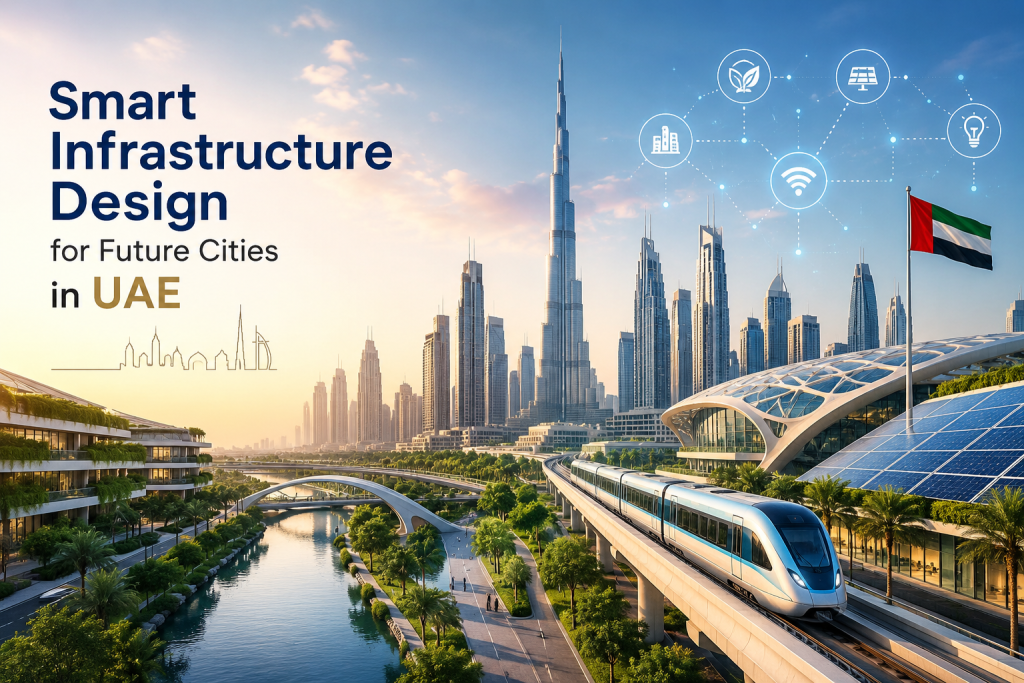
The UAE is rapidly transforming the way cities are planned, built, and operated. Across Dubai, Abu Dhabi, and other growing urban centers, infrastructure is no longer designed only to support transportation, utilities, or buildings. It is now expected to connect systems, process data in real time, improve sustainability, and respond intelligently to changing urban needs.
This shift has made smart infrastructure design in UAE one of the most important priorities in modern urban development.
What Is Smart Infrastructure in Modern Urban Development?
Understanding smart infrastructure design in UAE begins with defining what smart infrastructure actually means in the context of modern city development.
Defining Smart Infrastructure
Smart infrastructure is really about bringing engineering, digital technology, and real-time data together into one connected system that helps cities run more efficiently, operate more smoothly, and keep sustainability front and center instead of treating it like an afterthought
Older infrastructure setups were never really built to communicate with each other — each system mostly handled its own role without much interaction beyond that. Smart infrastructure changes that completely by connecting those systems together, allowing information to move automatically across the network so the city can react and operate in a far more coordinated and responsive way.
Examples include:
- Intelligent traffic management systems
- Smart utility networks
- Automated public transportation systems
- Connected energy grids
- Real-time environmental monitoring systems
Integration of Technology, Engineering, and Data
Modern smart city infrastructure projects rely on the integration of several components:
- Engineering systems that support physical infrastructure
- Digital platforms that process and analyze information
- Sensor networks that collect real-time operational data
This combination allows infrastructure to adapt dynamically to urban conditions rather than operating through fixed manual systems.
Traditional Infrastructure vs Smart Infrastructure
Traditional infrastructure is generally reactive. Problems are identified after they occur, and maintenance often depends on manual inspection.
Smart infrastructure, however, operates proactively by:
- Monitoring system performance continuously
- Predicting maintenance requirements
- Optimizing energy and resource usage automatically
This transition is transforming the future of infrastructure design across UAE future cities initiatives.
Why Is the UAE Investing Heavily in Smart Infrastructure?
The UAE’s focus on smart infrastructure design in UAE is driven by long-term national strategies aimed at improving sustainability, economic competitiveness, and urban quality of life.
UAE Vision 2040
Urban development strategies such as UAE Vision 2040 emphasize smarter, more connected cities capable of supporting future population and economic growth.
These plans prioritize:
- Efficient transportation systems
- Sustainable urban expansion
- Integrated infrastructure networks
- Smart public services
Sustainability Goals
The UAE is increasingly focused on reducing environmental impact through sustainable infrastructure in UAE initiatives that improve energy efficiency and reduce carbon emissions.
This includes:
- Renewable energy integration
- Water conservation systems
- Smart waste management infrastructure
Economic Diversification
Smart infrastructure supports economic diversification by attracting technology investment, innovation, and advanced industries beyond traditional sectors.
Smart City Leadership Ambitions
The UAE has been pushing hard to establish itself as a global leader in smart city development Dubai and next-generation urban planning. Across Dubai and Abu Dhabi, major projects are being built to highlight advances in mobility, sustainability, and digital infrastructure rather than relying on traditional city development models
Population Growth and Urban Expansion
Rapid urban growth creates increasing demand for efficient transportation, utilities, and housing systems. Smart infrastructure helps cities scale more effectively while maintaining operational efficiency.
What Technologies Are Driving Smart Infrastructure in UAE?
The evolution of smart infrastructure design in UAE is being driven by a combination of advanced engineering tools and digital technologies that improve planning, monitoring, and operational performance.
BIM (Building Information Modeling)
BIM allows engineers and designers to create detailed digital models of infrastructure systems before construction begins.
Benefits include:
- Improved coordination between disciplines
- Reduced design conflicts
- Better project visualization
AI in Construction Planning
Bringing AI in construction is changing how project teams handle planning and execution — from analyzing massive amounts of data to tightening schedules and making better use of resources across the project.
What makes these systems stand out is their ability to spot patterns and flag potential risks much faster and more accurately than the kind of manual analysis teams used to rely on.
Digital Twins of Cities
One of the things reshaping modern infrastructure right now is the growing dependence on digital twins in infrastructure and the role they’re starting to play in helping teams track performance, follow day-to-day operations, and catch potential issues early before they turn into larger
Digital twins are virtual replicas of physical infrastructure systems that allow cities to:
- Simulate operational performance
- Predict maintenance needs
- Test future urban scenarios
GIS Mapping Systems
Geographic Information Systems (GIS) help planners analyze land use, utilities, transportation routes, and environmental conditions within urban areas.
Cloud-Based Infrastructure Monitoring
Cloud platforms allow infrastructure systems to be monitored remotely in real time, improving operational visibility and maintenance response.
Smart Sensors and Automation
Modern IoT infrastructure systems use sensors to collect data from roads, utilities, buildings, and transportation systems. This information supports infrastructure automation and real-time decision-making.
How Does Smart Infrastructure Improve Urban Living in UAE?
The practical value of smart infrastructure design in UAE can be seen in how it improves everyday urban life, resource efficiency, and city operations.
Reduced Congestion
Smart traffic systems analyze traffic flow in real time and adjust signals dynamically to reduce congestion and improve mobility.
Energy Efficiency
Modern energy-efficient buildings use automated systems to optimize lighting, cooling, and power consumption based on occupancy and environmental conditions.
Better Safety Systems
Connected monitoring systems improve emergency response by identifying incidents faster and supporting coordinated action between authorities.
Optimized Resource Usage
Smart infrastructure improves the management of:
- Water distribution
- Electricity consumption
- Waste collection systems
This supports more efficient urban operations and reduces resource waste.
Improved Sustainability
The integration of green infrastructure and sustainable urban planning strategies helps reduce environmental impact while improving long-term city resilience.
Faster Emergency Response Systems
Real-time monitoring allows emergency services to respond more quickly to accidents, system failures, or environmental incidents.
How Do Engineering Consultants Design Smart Infrastructure in UAE?
Developing smart infrastructure design in UAE requires a structured engineering approach that combines planning, digital integration, and long-term operational analysis.
Step 1: Urban and Infrastructure Assessment
Consultants begin by analyzing:
- Existing infrastructure systems
- Population growth projections
- Transportation patterns
- Environmental conditions
Step 2: Technology Feasibility Analysis
Engineering teams evaluate which technologies are suitable for the project, including automation systems, sensor networks, and digital monitoring platforms.
Step 3: Integrated Engineering Design
Infrastructure systems are designed collaboratively across disciplines including:
- Transportation engineering
- Utility planning
- Structural engineering
- Digital infrastructure systems
Step 4: Data and System Integration
Consultants develop systems capable of sharing and processing real-time operational data through data-driven city planning frameworks.
Step 5: Long-Term Operational Planning
Smart infrastructure must remain adaptable over time. Engineers plan for maintenance, upgrades, scalability, and future urban expansion.
How Does UGCE Contribute to Smart Infrastructure Design in UAE?
As urban systems become more connected and technology starts sitting at the center of how cities operate, engineering consultants are being pushed to bring more than just technical expertise to the table — they also need strong digital planning capabilities to keep everything working together. Managing smart infrastructure design in UAE isn’t only about understanding engineering systems individually; it’s about understanding how those systems interact across an entire urban environment where everything is increasingly connected.
UGCE approaches smart infrastructure through coordinated multidisciplinary planning that considers:
- Infrastructure integration
- Sustainability objectives
- Digital system compatibility
- Operational efficiency
- Long-term scalability
This approach supports future-ready infrastructure solutions aligned with evolving UAE development strategies.
What Are Future Trends in Smart Infrastructure in UAE?
The future of smart infrastructure design in UAE will likely be shaped by deeper integration between engineering systems, artificial intelligence, automation, and sustainability technologies.
AI-Driven City Management
AI platforms are expected to manage transportation, utilities, energy systems, and emergency services through centralized data analysis.
Autonomous Transportation
Future cities may increasingly rely on autonomous public transportation systems and connected mobility infrastructure.
Carbon-Neutral Cities
Sustainability initiatives are pushing cities toward lower carbon emissions through renewable energy systems and more efficient urban operations.
Fully Integrated Digital Infrastructure
Cities are moving toward interconnected digital ecosystems where transportation, utilities, buildings, and public services operate through shared data platforms.
Predictive Maintenance Systems
Advanced monitoring systems will allow infrastructure components to be repaired before failures occur, reducing downtime and maintenance costs.
How Can You Start a Smart Infrastructure Project in UAE?
Starting a successful smart infrastructure design in UAE project requires careful planning from the earliest stages of development.
Early Planning Importance
Technology integration should begin during conceptual planning rather than being added later as a separate component.
Technology Feasibility Study
A detailed feasibility assessment helps determine which systems and technologies align with project goals, operational needs, and budget constraints.
Engineering Consultancy Involvement
Engineering consultants are often the link holding all the moving pieces together — coordinating technical systems, infrastructure planning, regulatory requirements, and the long-term operational strategies that keep projects functioning well beyond the construction phase.
For developers planning future-ready infrastructure projects, early consultation with experienced engineering teams can significantly improve project efficiency and scalability.
Read also about the future of smart infrastructure in Egypt.
FAQs
How does smart city infrastructure work?
Smart city infrastructure uses connected technologies, sensors, digital platforms, and automated systems to improve urban operations, resource management, and public services in real time.
What technologies are used in smart cities UAE?
Smart cities in the UAE commonly use technologies such as BIM, AI systems, IoT sensor networks, GIS mapping, digital twins, automation systems, and cloud-based infrastructure monitoring platforms.
Conclusion
Smart infrastructure design in uae is quickly turning into the backbone of future urban development.
Cities are getting bigger, more connected, and far more dependent on technology than they used to be, and that shift is putting serious pressure on infrastructure systems that were originally designed for a very different kind of urban environment.
Relying on traditional engineering approaches alone just isn’t enough anymore — modern cities need infrastructure that can handle growing demand, support sustainability efforts, and keep functioning reliably as urban expansion continues year after year.