
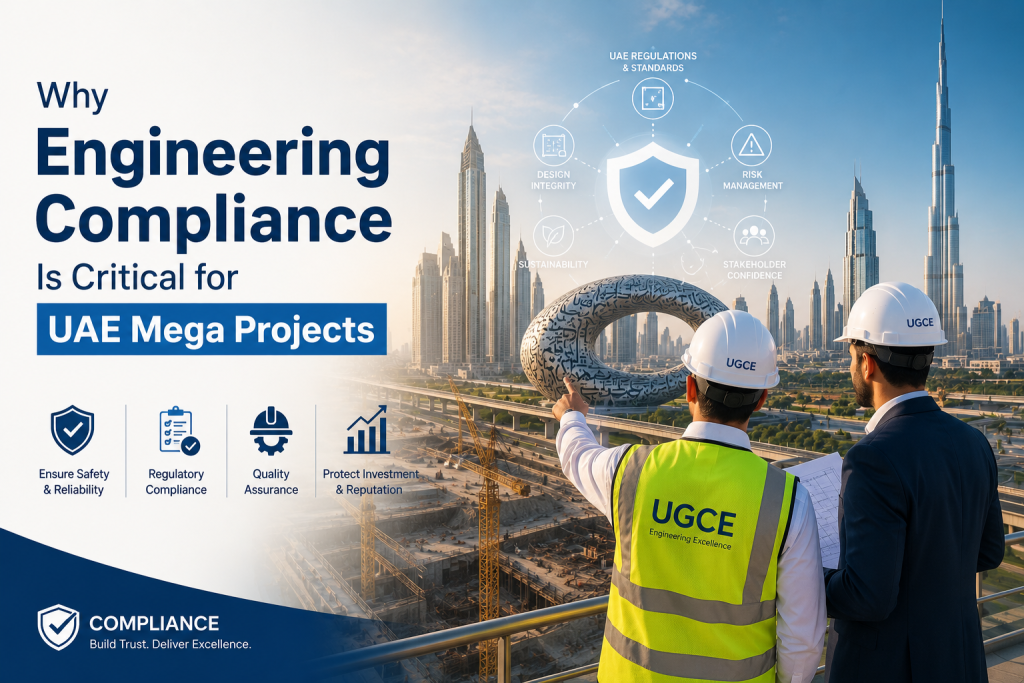
Engineering compliance UAE is not treated as a routine administrative requirement. It sits at the core of how projects get planned, executed, and kept running well over the long term.
Compliance is what makes sure a project is hitting the right technical standards, holding up on safety regulations, meeting environmental requirements, and satisfying what the authorities expect — all before construction is allowed to push from one stage into the next.
What Does Engineering Compliance Mean in UAE Construction Projects?
Understanding engineering compliance UAE begins with defining what compliance actually means in the context of construction and infrastructure development.
Defining Engineering Compliance
Engineering compliance refers to the process of ensuring that all project designs, construction activities, materials, and systems align with applicable technical regulations, safety requirements, and authority standards.
In practical terms, compliance ensures that a project is:
- Structurally safe
- Technically accurate
- Environmentally responsible
- Legally approved for construction and operation
Compliance affects every stage of project development, from concept design and permitting to execution and final handover.
Regulatory, Safety, and Technical Alignment
Engineering compliance is not limited to one area of project delivery. It combines several interconnected requirements:
- Regulatory alignment: Projects must follow local authority requirements, including Dubai Municipality regulations and other emirate-specific frameworks.
- Safety alignment: Buildings and infrastructure must comply with safety standards construction UAE to protect occupants, workers, and surrounding communities.
- Technical alignment: Engineering systems, materials, and designs must satisfy approved technical standards and performance requirements.
Together, these elements form the foundation of construction compliance UAE.
Compliance vs Approvals
Although the terms are often used together, compliance and approvals are not the same.
- Compliance means the project meets required standards and regulations.
- Authority approvals UAE are the official permissions issued after authorities verify that compliance has been achieved.
A project cannot receive approvals without first meeting compliance requirements.
The UAE’s Multi-Authority System
One of the reasons compliance is particularly complex in the UAE is the involvement of multiple authorities. Depending on the project scope, approvals may involve:
- Municipal authorities
- Civil defense departments
- Utility providers
- Environmental agencies
- Transportation authorities
This multi-layered system requires careful coordination between all project stakeholders.
Why Is Engineering Compliance So Strict in UAE Mega Projects?
The strict approach to engineering compliance UAE is closely connected to the scale, speed, and strategic importance of modern development across the country.
Rapid Urban Development
The UAE continues to invest heavily in urban expansion and infrastructure modernization under long-term national development strategies such as Dubai Vision 2040. Projects at that scale don’t leave much room for loose oversight — getting new developments to slot safely and efficiently into existing infrastructure systems demands tight control at every step.
Safety Requirements for High-Rise Structures
Many mega projects UAE construction involve complex high-rise structures, mixed-use developments, and public facilities with large occupancy capacities. These projects must comply with rigorous fire safety, structural stability, and evacuation standards.
Even small design errors in large towers or infrastructure systems can create major risks, which is why compliance requirements are heavily enforced.
Environmental Sustainability Goals
Modern UAE projects are increasingly expected to align with environmental regulations in UAE, including sustainability requirements related to energy efficiency, water conservation, and carbon reduction.
Authorities now place stronger emphasis on environmentally responsible design and operational performance.
Infrastructure Complexity
Large developments involve interconnected systems including transportation, drainage, utilities, telecommunications, and district cooling networks. Managing this level of complexity requires strict UAE infrastructure compliance standards to ensure system coordination and long-term reliability.
Government Quality Standards
The UAE has established internationally recognized construction and engineering benchmarks. Authorities expect projects to maintain high technical standards throughout design and execution, particularly in projects that support national infrastructure or public investment.
What Are the Key Engineering Compliance Areas in UAE Mega Projects?
Maintaining engineering compliance in UAE requires coordination across multiple technical disciplines and regulatory frameworks.
Structural Compliance
Structural systems have to hold up against load requirements, hit the right stability standards, and satisfy whatever seismic safety regulations apply to the site.
Architectural Compliance
Architectural designs must align with zoning regulations, accessibility requirements, fire safety codes, and occupancy standards.
MEP Compliance
Mechanical, electrical, and plumbing systems must satisfy performance standards related to ventilation, energy efficiency, power distribution, and water systems.
Infrastructure Compliance
Infrastructure systems such as roads, drainage, utilities, and transportation networks must comply with broader infrastructure governance UAE frameworks to ensure integration with public systems.
Environmental Compliance
Projects must meet environmental impact standards related to emissions, waste management, sustainability, and site protection.
Construction Execution Compliance
Compliance continues during construction through inspections, quality verification, and site safety monitoring.
These combined requirements form the technical backbone of engineering standards in UAE.
What Happens If Engineering Compliance Is Not Followed in UAE Projects?
Failure to maintain engineering compliance in the UAE can create severe consequences that affect project timelines, finances, legal standing, and long-term operational performance.
Project Delays
Non-compliant submissions often result in repeated reviews and redesign requests, delaying approvals and construction schedules.
Heavy Fines
Authorities may impose significant financial penalties when projects violate safety or regulatory standards.
Design Rejection
Incomplete or non-compliant designs may be rejected entirely, requiring major revisions before resubmission.
Construction Stoppage
Authorities have the power to suspend on-site activities until compliance issues are resolved.
Legal Liability
Developers, contractors, and consultants may face legal consequences if non-compliance leads to structural failure, safety incidents, or environmental damage.
Reputational Damage
For developers and investors, compliance failures can damage credibility and reduce confidence among stakeholders, buyers, and authorities.
These risks highlight why project risk management and compliance planning must begin early in the project lifecycle rather than after construction has already started.
How Does Engineering Compliance Impact Mega Project Success in UAE?
Strong engineering compliance in UAE practices contribute directly to project performance, operational efficiency, and long-term asset value.
Improves Safety and Durability
Compliance ensures that structures and infrastructure systems meet technical performance requirements, reducing long-term operational risks.
Ensures Smooth Approvals
Projects that are properly coordinated and documented typically move through authority review stages more efficiently.
Reduces Long-Term Maintenance Costs
Well-designed and compliant systems generally require fewer corrective repairs and operational modifications over time.
Builds Investor Confidence
Investors are more likely to support projects that demonstrate strong governance, technical reliability, and regulatory alignment.
Enables Faster Project Handover
Projects with fewer compliance issues experience smoother inspections and faster completion certification.
In large developments, compliance is not simply about satisfying regulations—it directly affects project profitability and long-term performance.
How Does UGCE Ensure Engineering Compliance in UAE Mega Projects?
Managing engineering compliance in UAE effectively requires technical expertise, multidisciplinary coordination, and professional engineering technical support throughout the project lifecycle.
UGCE approaches compliance as an integrated part of project delivery rather than a separate approval stage. The focus begins during early planning and continues through design development, authority coordination, construction review, and final handover.
This process typically involves:
- Coordinated multidisciplinary engineering reviews
- Internal compliance checks before submissions
- Alignment with local authority standards
- Continuous communication with project stakeholders
- Technical risk identification during design stages
By addressing compliance requirements early, project teams can reduce delays, minimize redesign, and improve construction efficiency.
Why Partnering with an Experienced Engineering Consultant Matters in UAE
The complexity of engineering compliance in UAE makes experienced engineering support increasingly important, particularly in large infrastructure and high-value developments.
Experienced consultants help projects by:
- Identifying compliance risks early
- Preparing accurate technical documentation
- Coordinating between authorities and contractors
- Improving approval efficiency
- Supporting smoother project execution
In large-scale developments, technical expertise alone is not enough. Getting a project across the finish line also comes down to understanding how regulations, approvals, engineering systems, and construction activities all feed into each other as the project moves through each stage.
FAQs
Why Is Compliance More Complex in Mega Projects Than Standard Projects?
Mega projects involve larger teams, multiple authorities, complex infrastructure systems, and stricter safety requirements. The increased scale creates more coordination challenges and higher regulatory expectations.
What happens if compliance is not followed in UAE?
Projects may face delays, fines, approval rejection, construction stoppage, legal consequences, and reputational damage.
Who regulates engineering compliance in UAE?
Engineering compliance doesn’t run through a single authority — depending on what’s being built and where, it can involve municipalities, civil defense departments, utility providers, and environmental agencies all at once.
Conclusion
Engineering compliance UAE has worked its way to the top of the priority list in construction and infrastructure development — and as projects keep getting bigger and more technically demanding, the pressure to stay aligned with regulations, hit safety standards, and maintain coordinated engineering oversight only grows stronger.
The projects that treat compliance as something worth building a real strategy around — rather than just a box to check — are the ones that sidestep delays, keep risk from piling up, and move through delivery without constantly hitting walls. In a construction environment that moves as fast as the UAE’s, treating compliance management as optional isn’t really an option anymore — it’s a non-negotiable part of getting a mega project done right.