
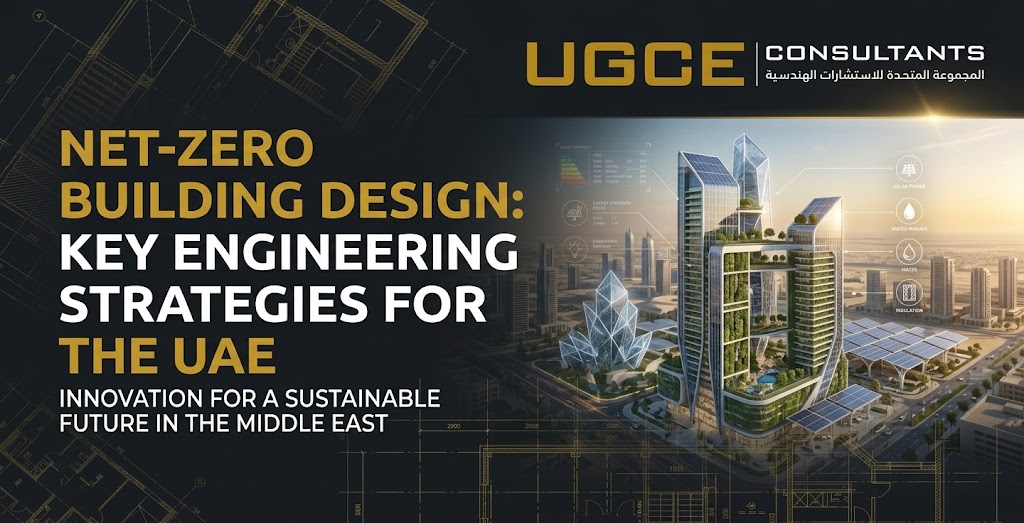
The UAE’s building sector faces a unique engineering challenge: how to deliver comfortable, high-performing buildings in one of the world’s hottest climates while reducing energy consumption and carbon emissions.
This is where net zero building design becomes increasingly important.
What Is Net-Zero Building Design?
Net-zero building design is an approach built around two things — cutting a building’s energy consumption and carbon emissions as far down as possible, then using renewable energy and other measures to balance out whatever impact remains.
It’s worth noting that what exactly counts as “net zero” can shift depending on how the project boundary is drawn and which accounting methodology is being used.
Reduce demand first, improve efficiency second, and use renewable energy to address the remaining energy demand.
This distinction is important.
A building that consumes large amounts of electricity but purchases offsets is fundamentally different from a building that has been designed to require much less energy in the first place.
A strong net-zero strategy therefore considers three interconnected areas:
- Operational energy: Energy used for cooling, lighting, ventilation, equipment, hot water, and other building operations.
- Renewable energy: Electricity generated from sources such as solar PV to meet part or all of the building’s remaining energy demand.
- Carbon emissions: Emissions associated with both building operation and, increasingly, materials and construction.
This is why net-zero should be considered during the earliest stages of a project. Decisions about orientation, building form, glazing, shading, envelope performance, and mechanical systems can influence energy demand for decades.
Why Is Net-Zero Building Design Important in the UAE?
The UAE’s climate makes energy performance particularly important.
The heat and intensity of solar exposure in the UAE create serious cooling demands across residential, commercial, hospitality, retail, and other building types. In that context, cooling quickly becomes one of the most critical energy considerations any project team has to work through when developing energy efficient buildings in the UAE.
This makes the UAE different from many markets where heating represents a major building energy load.
For developers, the benefits of sustainable building design in the UAE go beyond environmental performance.
A well-designed building can potentially:
- Reduce operational energy consumption.
- Lower long-term utility costs.
- Improve thermal comfort.
- Improve HVAC performance.
- Reduce maintenance requirements.
- Improve building performance and operational visibility.
- Support compliance with applicable green building requirements.
- Strengthen the long-term value and resilience of the asset.
In other words, green building design in the UAE is increasingly an engineering and commercial consideration, not simply an environmental objective.
Key Engineering Strategies for Net-Zero Buildings in the UAE
Achieving a high-performance building requires multiple engineering strategies working together.
There is no single technology that can make a building net zero. The most effective approach combines passive design, efficient MEP systems, renewable energy, smart controls, water efficiency, modeling, and material selection.
1. Optimize Building Orientation and Form
The first opportunity to reduce energy demand comes before mechanical systems are even selected.
Building orientation influences how much solar radiation reaches the building envelope and therefore affects internal heat gain and cooling demand.
Building form also plays an important role. The relationship between floor area, external surface area, glazing, shading, and building mass can influence thermal performance.
For UAE projects, early architectural decisions should therefore consider:
- Solar exposure.
- Building orientation.
- Window-to-wall ratios.
- Shading opportunities.
- Building massing.
- External heat gain.
- Relationship between form and cooling loads.
These decisions can reduce the amount of energy required by mechanical systems later.
This is one of the most important principles of net zero architecture: the building should work with its climate before engineering systems are asked to compensate for it.
2. Improve the Building Envelope
The building envelope separates conditioned indoor spaces from the UAE’s external environment.
Because of the country’s high temperatures and strong solar exposure, envelope performance is a major component of sustainable building design UAE projects.
Key considerations include:
High-performance glazing
Glass selection affects solar heat gain, thermal transfer, daylight, and occupant comfort. Appropriate glazing specifications can help reduce unwanted heat entering the building.
Insulation
Effective insulation reduces unwanted heat transfer through walls, roofs, and other parts of the envelope.
External shading
Shading devices can reduce direct solar radiation before it reaches the glazing. Depending on the building orientation and design, this can be an important strategy for controlling cooling loads.
Airtightness
Uncontrolled air leakage can reduce HVAC efficiency and affect indoor comfort. Appropriate detailing and construction quality are therefore important.
Thermal bridges
Thermal bridges can create localized areas of increased heat transfer. Identifying and addressing them during design can improve overall envelope performance.
Solar heat gain control
In the UAE, controlling solar heat gain should be treated as a fundamental design consideration rather than an optional sustainability feature.
A high-performance envelope reduces the cooling demand that HVAC systems need to meet, supporting better building energy efficiency.
3. Use Energy-Efficient HVAC Systems
HVAC systems are one of the most important engineering considerations in UAE buildings because of the country’s cooling requirements.
Selecting energy efficient HVAC systems involves more than choosing equipment with a high efficiency rating.
Important strategies include:
- High-efficiency chillers and cooling equipment.
- Variable-speed drives.
- Efficient pumps and fans.
- Smart HVAC controls.
- Proper equipment sizing.
- Thermal zoning.
- Demand-based operation.
- Efficient ventilation strategies.
- Regular commissioning and performance verification.
Oversized equipment can operate inefficiently, particularly when loads are below design conditions. Proper sizing therefore matters.
For net zero construction UAE projects, HVAC performance should therefore be considered across design, installation, commissioning, and operation.
4. Integrate Renewable Energy
Once energy demand has been reduced, renewable energy can help meet the remaining electricity requirements.
For many UAE projects, solar PV is an obvious technology to evaluate because of the country’s strong solar resource.
Depending on the building, this could include:
- Rooftop solar PV.
- Building-integrated photovoltaic systems.
- Other appropriate on-site renewable energy solutions.
However, renewable energy should not be treated as an automatic solution.
Engineering teams need to evaluate:
- Available roof area.
- Roof orientation.
- Shading.
- Structural requirements.
- Available installation area.
- Building energy demand.
- Electrical requirements.
- Expected renewable generation profile.
The goal is to get a clear picture of how much of the building’s actual demand can realistically be covered through renewable energy.
5. Implement Smart Building Controls
Energy efficiency does not end when a building is constructed.
Buildings change throughout the day depending on occupancy, weather, equipment use, and operational requirements.
Smart controls can help buildings respond to these changes.
A Building Management System (BMS), for example, can integrate information from sensors and building systems to monitor and control equipment.
Applications can include:
- Occupancy-based HVAC control.
- Automated lighting.
- Temperature control.
- Demand-based ventilation.
- Scheduling of equipment.
- Real-time energy monitoring.
- Fault detection.
- Performance reporting.
Instead of operating systems continuously at a fixed level, smart controls can allow the building to respond to actual demand.
Real-time monitoring can also help facility teams identify inefficiencies that may otherwise remain unnoticed.
This makes building data an important part of long-term building energy efficiency.
6. Design for Water Efficiency
Water efficiency is particularly important in the UAE because of the country’s arid climate and the resources required to produce, treat, pump, and distribute water.
A sustainable building design approach should therefore consider water alongside energy.
Strategies can include:
- Low-flow fixtures.
- Water-efficient equipment.
- Leak detection systems.
- Efficient irrigation.
- Smart irrigation controls.
- Greywater or water-reuse systems where appropriate.
- Efficient water pumping systems.
The connection between water and energy is often overlooked.
Water treatment, pumping, distribution, and cooling processes all require energy.
7. Use Energy and Environmental Modeling
Design decisions should be tested before they become expensive construction decisions.
This is where building energy modeling becomes valuable.
Engineering teams can use energy modeling and other computational methods to compare different design options and understand their potential impact on building performance.
Depending on the project, analysis can include:
- Whole-building energy modeling.
- Thermal simulations.
- Daylight analysis.
- Solar studies.
- Computational analysis of building performance.
- HVAC load calculations.
- Renewable-energy assessments.
For example, a design team may compare different glazing specifications, shading strategies, insulation levels, HVAC configurations, or orientations.
Rather than discovering performance problems after construction, teams can identify potential issues during design and adjust the project while changes are still practical.
8. Consider Low-Carbon Materials and Construction
Net-zero discussions often focus heavily on electricity consumption.
But a building’s carbon footprint can also include embodied carbon — the emissions associated with extracting, manufacturing, transporting, installing, maintaining, and eventually replacing building materials.
This means developers should consider both:
Operational carbon
Emissions associated with operating the building.
Embodied carbon
Emissions associated with materials and construction throughout their lifecycle.
Strategies for reducing embodied carbon may include:
- Optimizing concrete quantities.
- Optimizing structural steel.
- Selecting lower-carbon materials where appropriate.
- Using recycled or reused materials where suitable.
- Reducing construction waste.
- Designing for durability.
- Extending the useful life of building components.
The goal is not simply to select the “greenest” material available.
Material decisions should consider structural performance, durability, availability, cost, constructability, maintenance, and lifecycle impact.
This is why low carbon building design requires coordination between architecture, structural engineering, MEP engineering, procurement, and construction teams.
UAE Regulations and Green Building Standards to Consider
Net-zero projects in the UAE should be developed with the applicable federal and local requirements in mind.
At the national level, the UAE Net Zero 2050 Strategy includes buildings as a priority sector and focuses on efficiency, renewable energy, and green building practices.
At the emirate level, requirements can differ.
Abu Dhabi — Estidama Pearl Rating System
In Abu Dhabi, the Estidama Pearl Rating System is the framework used to measure and guide sustainable building development.
The system looks at a range of areas — energy, water, materials, natural systems, and both indoor and outdoor livability. According to Abu Dhabi City Municipality, meeting the applicable Estidama requirements is tied directly to the building permit process, with the minimum standards varying depending on how the project is funded.
Dubai — Al Sa’fat
Dubai operates under its own framework for green building — the Al Sa’fat – Dubai Green Building System, which sets out the current requirements for sustainable development across the emirate.
Dubai Municipality sets the Silver Sa’fat rating as the floor for all new buildings in Dubai — anything higher comes with its own additional requirements. The system covers a broad range of areas, including energy, water, materials, waste, the building environment, and other sustainability factors that feed into how a project is assessed.
How Engineering Consultants Support Net-Zero Building Projects
Getting a building to net-zero performance isn’t something one discipline can deliver on its own — it takes coordination across multiple engineering teams working toward the same target.
This is where an experienced engineering consultant can provide significant value.
A multidisciplinary consultant can support developers through:
Early-stage sustainability assessments
Establishing realistic performance objectives before major architectural and engineering decisions are finalized.
Energy and thermal modeling
Testing design options and estimating energy performance before construction.
Building envelope analysis
Evaluating glazing, insulation, shading, thermal bridges, and solar heat gain.
HVAC optimization
Developing efficient cooling and ventilation systems based on actual building requirements.
MEP system design
Coordinating mechanical, electrical, plumbing, and other building systems around the project’s performance objectives.
Renewable-energy integration
Assessing the technical feasibility and potential contribution of solar PV and other renewable technologies.
Water-efficiency strategies
Reducing water demand while considering the associated energy implications.
Building performance analysis
Using simulations, calculations, and operational data to evaluate performance against project targets.
Multidisciplinary design coordination
Ensuring architectural, structural, mechanical, electrical, and sustainability decisions support the same objectives.
Commissioning and performance verification
Helping ensure that systems operate according to their design intent once the building is constructed.
The role of an engineering consultant is therefore not simply to add sustainability technologies.
It is to help the developer balance sustainability, performance, cost, constructability, occupant comfort, regulatory requirements, and long-term operation.
Challenges of Achieving Net-Zero Buildings in the UAE
Although the technologies for high-performance buildings are increasingly available, achieving net-zero performance is not simply a checklist exercise.
UAE projects can face several practical challenges.
High cooling loads
The hot climate can create substantial cooling requirements, particularly for buildings with large glazed areas or inefficient envelopes.
Limited renewable-energy space
Not every building has enough suitable roof or façade area to generate all of its required electricity on-site.
Existing buildings
Buildings designed under older standards may have inefficient envelopes, HVAC systems, controls, or electrical infrastructure.
Retrofitting these buildings can be significantly more complex than designing a new project from the beginning.
Higher upfront investment
Some high-performance technologies and systems can increase initial capital costs, although the lifecycle economics may be favorable depending on the project.
System integration
HVAC, lighting, controls, renewable energy, electrical systems, and water systems must work together. Poor coordination can reduce the expected benefits of individual technologies.
Maintaining performance after occupancy
What a building achieves in design simulations doesn’t always carry over once it’s actually up and running.
How a building actually performs can be shaped by a lot of factors — occupancy patterns, how equipment gets used, maintenance practices, system controls, and the day-to-day behavior of the people inside it.
The performance gap
One of the most important challenges is the difference between design intent and actual building performance.
This is why commissioning, monitoring, measurement, and verification should be considered from the beginning of the project.
What Should Developers Consider Before Starting a Net-Zero Building Project?
Before starting a net zero building UAE project, developers should establish the technical strategy early.
A practical checklist includes:
- Define the net-zero target. Clarify what “net zero” means for the project and what boundaries will be used.
- Establish performance targets early. Set measurable energy, water, and carbon objectives.
- Conduct climate and site analysis. Understand solar exposure, orientation, shading, and local conditions.
- Assess energy demand. Establish realistic energy-use targets before selecting technologies.
- Optimize the building envelope. Address glazing, insulation, shading, airtightness, and thermal bridging.
- Evaluate HVAC options. Compare efficient systems based on actual loads and operating requirements.
- Assess renewable-energy potential. Evaluate roof area, orientation, shading, and expected generation.
- Consider water efficiency. Reduce consumption and consider the energy implications of water systems.
- Evaluate embodied carbon. Consider materials and construction alongside operational energy.
- Plan for monitoring and verification. Determine how performance will be measured after occupancy.
- Coordinate disciplines early. Sustainability decisions should be integrated with architecture, structure, MEP, and construction.
- Select an experienced multidisciplinary engineering consultant. Net-zero performance requires coordinated technical decision-making rather than isolated sustainability measures.
Conclusion
Net zero building design in the UAE only works when the whole building is treated as a single system.
The projects that get there don’t rely on one technology to carry the load. They bring together climate-responsive architecture, high-performance envelopes, efficient HVAC systems, smart controls, renewable energy, water efficiency, energy modeling, and lower-carbon materials — and make all of it work together.
UGCE works with developers and project teams on sustainable building design, engineering consultancy, energy analysis, MEP optimization, and building performance strategies built around the realities of UAE projects.
If you’re planning a new development or trying to improve how an existing building performs on energy, get in touch with UGCE to talk through the engineering strategies that can take your sustainability targets from a goal on paper to a building that actually delivers.