
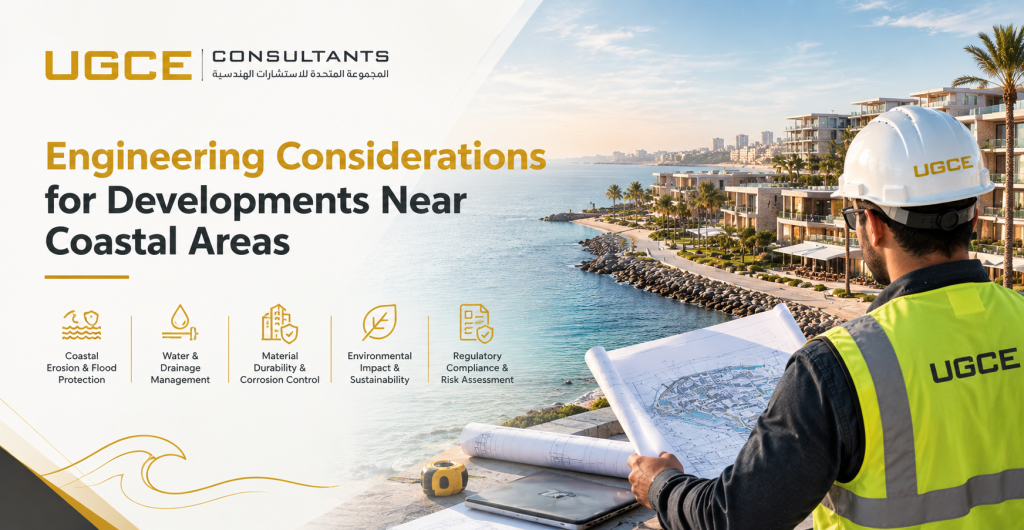
Developments near the coast require specialized engineering because coastal sites can be exposed to environmental conditions that differ significantly from inland locations.
Salt-laden air, high humidity, groundwater, coastal flooding, erosion, strong winds, variable soil conditions, and marine exposure can all influence how a project should be designed and constructed.
Why Do Coastal Developments Require Special Engineering Considerations?
Coastal developments can face a combination of environmental conditions that may not be present, or may be less significant, on inland sites.
These can include:
- Salt-laden air
- High humidity
- Groundwater
- Coastal flooding
- Erosion
- Strong winds
- Variable soil conditions
- Marine exposure
These conditions can influence foundations, structural systems, façades, building services, drainage, material durability, and maintenance requirements.
For this reason, engineering for coastal developments should begin with an understanding of actual site conditions.
Key Engineering Challenges for Coastal Developments
Understanding Coastal Site and Soil Conditions
Soil conditions on coastal sites can vary significantly from one plot to the next, and assuming that what worked on a nearby project will apply here is a risk that can lead engineers in the wrong direction.
A geotechnical investigation may evaluate:
- Soil bearing capacity
- Groundwater levels
- Soil settlement
- Soft or loose soils
- Ground improvement requirements
- Potential changes in groundwater conditions
- Site-specific geotechnical risks
Foundation solutions should therefore be based on actual site investigation and geotechnical assessment rather than assumptions about typical coastal ground conditions.
Designing Foundations for Coastal Sites
Coastal soil and groundwater conditions can have a direct influence on coastal foundation design.
Depending on the project and geotechnical conditions, engineers may evaluate:
- Shallow versus deep foundations
- Piles where appropriate
- Settlement considerations
- Groundwater interaction
- Foundation durability
- Waterproofing
- Construction challenges below groundwater level
Effective coastal building foundations should therefore be developed through coordination between geotechnical and structural engineering teams.
Protecting Structures From Saltwater and Corrosion
Salt exposure is one of the key coastal engineering considerations because marine environments can accelerate deterioration of certain materials and components.
Particular attention may be required for:
- Reinforced concrete durability
- Reinforcement corrosion
- Steel protection
- Protective coatings
- Material selection
- Concrete mix and durability considerations
- Regular inspection and maintenance
The appropriate protection strategy depends on the project’s exposure conditions and the materials being used. Rather than applying one universal solution, engineers should evaluate environmental exposure, expected service life, construction quality, protection systems, inspection requirements, and maintenance together.
Managing Coastal Flood and Water Risks
Water-related risks should be assessed as part of the broader coastal development challenges.
Depending on the location, project teams may need to consider:
- Coastal flooding
- Storm events
- High water levels
- Surface water management
- Groundwater
- Drainage capacity
- Finished floor levels
- Flood-resistant design strategies
Drainage systems should be developed based on the site’s topography, hydrology, groundwater conditions, rainfall characteristics, discharge constraints, and applicable requirements.
Structural Engineering Considerations in Coastal Areas
Coastal structural engineering needs to account for both structural loads and the environmental conditions that may affect long-term performance.
Depending on the development, engineers may consider:
- Wind loads
- Structural durability
- Lateral stability
- Water-related loads where applicable
- Material degradation
- Building movement
- Structural connections
- Long-term performance
Structural design should be integrated with geotechnical and environmental assessments. For example, foundation conditions can affect structural behavior, while material exposure can influence durability requirements.
Coastal Erosion and Site Stability
For developments sitting close to the shoreline, erosion is something that can’t be treated as an afterthought — it’s a real and ongoing consideration that needs to be built into how the site is engineered.
The issues that can arise include:
- Shoreline changes
- Soil loss
- Foundation exposure
- Site stability
- Protection measures
- Drainage and runoff
- Monitoring and maintenance
The significance of erosion varies substantially between coastal environments. Shoreline characteristics, wave conditions, sediment movement, site geometry, existing protection, and project location can all influence the assessment.
Wind and Environmental Loads
Coastal developments can have greater exposure to wind and other environmental conditions, making environmental loads an important part of the design process.
Engineering considerations may include:
- Wind-resistant structural design
- Building orientation
- Façade considerations
- Roof systems
- External equipment
- Signage and lightweight elements
- Temporary construction conditions
These considerations connect structural engineering with architectural and façade design decisions.
MEP Engineering Considerations for Coastal Developments
Coastal exposure does not only affect foundations and structural systems. Mechanical, electrical, and plumbing systems can also be exposed to humidity, salt-laden air, groundwater, and water-related risks.
HVAC Systems
Coastal MEP design should consider environmental exposure when selecting and locating mechanical equipment.
Relevant considerations include:
- High humidity
- Corrosive marine air
- Outdoor equipment
- Air filtration
- Equipment location
- Maintenance requirements
Outdoor mechanical equipment may require appropriate protection based on the environmental exposure and equipment manufacturer’s requirements.
Electrical Systems
Electrical infrastructure may require additional consideration in coastal environments.
Design teams may evaluate:
- Corrosion protection
- Equipment enclosures
- Cable systems
- Backup power
- Equipment placement
- Protection from water exposure
Electrical equipment located outdoors or in potentially exposed areas should be selected and protected according to the relevant environmental conditions and design requirements.
Plumbing and Drainage
Water management is another important part of coastal infrastructure design.
Considerations may include:
- Groundwater
- Stormwater
- Drainage capacity
- Waterproofing
- Backflow protection
- Pumping requirements where appropriate
Drainage and plumbing systems should be coordinated with site levels, building foundations, waterproofing systems, and potential water exposure.
Choosing Materials for Coastal Developments
Material selection can significantly influence the durability and maintenance requirements of a coastal development.
Potential materials and systems requiring evaluation include:
- Concrete
- Reinforcement
- Structural steel
- Aluminum
- Glass
- Coatings
- Waterproofing materials
- External fixtures and equipment
Material selection needs to be guided by the actual exposure conditions the project will face and how long it’s expected to remain in service.
How Coastal Conditions Affect Building Maintenance
Engineering decisions made during design can have a significant effect on future inspection and maintenance requirements.
A coastal development may require consideration of:
- Corrosion inspections
- Façade maintenance
- Waterproofing inspections
- Structural assessments
- MEP equipment maintenance
- Drainage maintenance
- Protective coating renewal
For example, selecting an inaccessible location for critical equipment may make routine inspection or replacement more difficult. Similarly, protective systems need to be considered alongside future inspection and renewal requirements.
The Role of Multidisciplinary Engineering in Coastal Projects
Coastal projects benefit from close coordination between several engineering and design disciplines, including:
- Geotechnical engineers
- Structural engineers
- Civil engineers
- MEP engineers
- Architects
- Environmental specialists
- Infrastructure engineers
- Contractors
Each discipline contributes to understanding a different part of the site’s technical requirements.
Effective coordination can connect:
Site conditions → Engineering criteria → Structural systems → Drainage → Materials → MEP → Long-term performance
How Engineering Consultants Can Reduce Coastal Development Risks
An experienced engineering consultancy can support developers throughout the design process by translating site conditions and project objectives into coordinated technical solutions.
Support may include:
- Site and technical assessment
- Engineering design criteria
- Geotechnical coordination
- Structural design
- Civil and drainage design
- MEP design
- Material and durability considerations
- Multidisciplinary coordination
- Design reviews
- Construction-stage technical support
An engineering consultant‘s role goes beyond designing individual systems. It’s also about making sure those systems work together within the wider project and catching potential technical conflicts before they have a chance to turn into problems on site or during operation.
Common Mistakes to Avoid in Coastal Development Projects
Several common approaches can create unnecessary challenges in coastal projects:
- Treating a coastal site like an inland site
Marine exposure, groundwater, wind, flooding, and erosion should be considered from the beginning. - Insufficient geotechnical investigation
Foundation design should be based on actual site conditions. - Underestimating groundwater conditions
Groundwater can affect excavation, foundations, waterproofing, and drainage. - Ignoring corrosion exposure
Materials and equipment should be evaluated according to their environmental exposure. - Inadequate drainage planning
Drainage capacity and site levels should be considered early. - Failing to consider flood risk
Current and relevant future water-related risks should be incorporated into project assessment. - Selecting materials without considering marine exposure
Initial cost alone may not reflect long-term durability and maintenance requirements. - Poor coordination between structural and MEP systems
Foundations, structural elements, equipment, penetrations, and service routes need coordinated design. - Focusing only on initial construction costs
Long-term inspection, maintenance, repair, and replacement should also influence engineering decisions. - Underestimating long-term maintenance requirements
Coastal exposure can make inspection and maintenance particularly important throughout the building’s service life.
Coastal Development Engineering Checklist
Before progressing toward construction, project teams can review:
- ☐ Geotechnical investigation completed
- ☐ Groundwater conditions assessed
- ☐ Foundation requirements evaluated
- ☐ Flood and water risks assessed
- ☐ Erosion risks considered
- ☐ Wind loads evaluated
- ☐ Structural durability addressed
- ☐ Corrosion protection considered
- ☐ Appropriate materials selected
- ☐ Drainage strategy developed
- ☐ MEP equipment exposure reviewed
- ☐ Waterproofing strategy coordinated
- ☐ Maintenance requirements considered
- ☐ Multidisciplinary design coordination completed
This checklist should be adapted to the specific site, development type, environmental conditions, applicable regulations, and project requirements.
Conclusion
Coastal development is not simply a matter of building closer to the water. The engineering challenge lies in understanding how the site’s environmental conditions interact with the building throughout its lifecycle.
Long-term project performance depends on the relationship between:
- Site conditions
- Water
- Wind
- Soil
- Materials
- Structural systems
- Building services
- Maintenance
Getting coastal development engineering right starts with thorough early investigation and carries through multidisciplinary design, construction coordination, and thinking ahead to long-term performance.
UGCE provides multidisciplinary engineering consultancy services that bring together structural, civil, MEP, geotechnical coordination, and technical design considerations — supporting complex developments from the earliest planning stages right through to construction.