
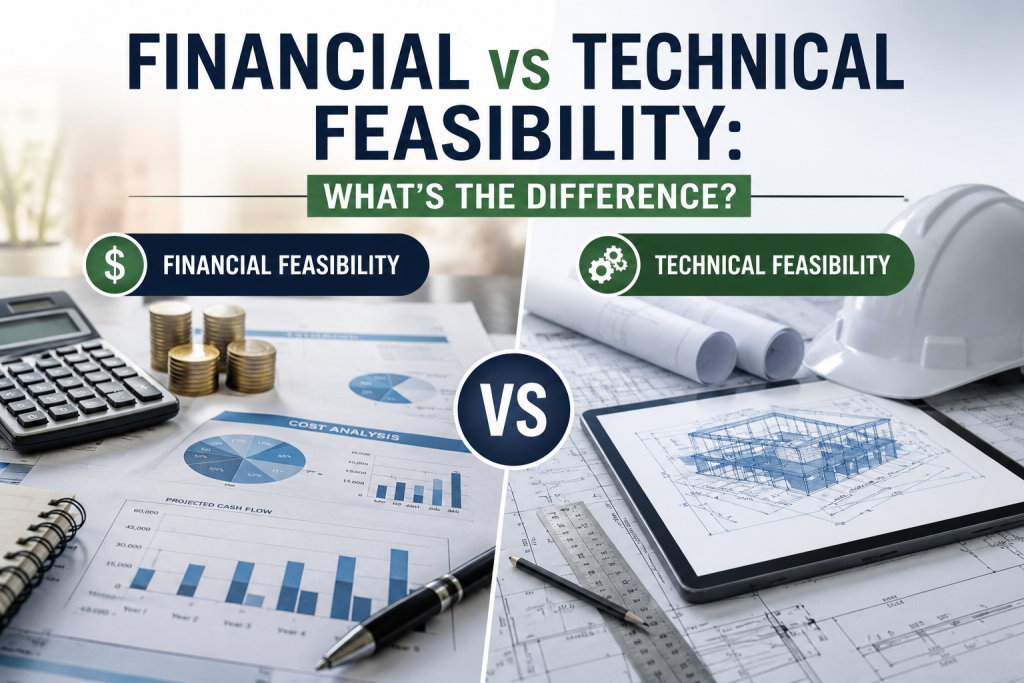
Before launching any major development, investors and project owners need to answer a simple but critical question: Is this project actually possible and worth pursuing?
The answer typically comes from a structured evaluation process known as a feasibility study. In large-scale infrastructure and construction environments, understanding the distinction between financial vs technical feasibility is essential because a project can be technically achievable but financially unrealistic, or financially attractive but technically impractical.
What Is a Feasibility Study?
Understanding the concept of a project feasibility study is the foundation for evaluating project viability and comparing financial vs technical feasibility before committing to construction or infrastructure development.
Simple Definition
The whole point is to get a clear, honest picture of what the risks are, what it’s going to cost, and what the realistic outcomes look like before anyone starts putting serious money on the table.
Why It’s Critical Before Starting Any Project
A feasibility study gives everyone with a stake in the project something solid to base their decisions on — real data rather than gut feelings or assumptions. Skip that evaluation, and the project is basically flying blind, leaving it wide open to technical problems, costs that spiral past what anyone planned for, and delays that could have been caught and dealt with long before construction ever started.
Role in Infrastructure & Construction
In infrastructure and building projects, a feasibility study is often what determines whether the land can actually support what’s being planned, whether the design requirements are realistic, and whether the resources needed are genuinely available. Getting that study right from the start means project teams go into development with their eyes open — fully aware of the technical limitations, what they’re financially on the hook for, and what the regulatory landscape looks like, rather than running into those walls halfway through.
Types of Feasibility Studies
To properly evaluate financial vs technical feasibility, project teams typically conduct several complementary analyses that address different feasibility study types.
Financial Feasibility
Focuses on the economic viability of a project, assessing whether the expected benefits justify the required investment and operational costs.
Technical Feasibility
Evaluates whether the project can be successfully designed, constructed, and operated using available technology, engineering expertise, and physical resources.
Operational Feasibility
Examines whether the organization has the capability to manage and maintain the project after completion.
Legal Feasibility
Ensures that the project complies with regulatory requirements, zoning regulations, and environmental standards.
Taken together, these types of feasibility studies build out a full picture of whether a project can actually work — and that’s what keeps decision-makers from walking into mistakes that end up costing far more than the study ever would have.
What Is Financial Feasibility?
When weighing financial vs technical feasibility early in the planning process, a thorough financial feasibility analysis is what tells you whether a project can actually sustain itself economically and whether it lines up with what the investment is supposed to achieve
Definition
Assesses whether a project can generate sufficient revenue or value to cover costs, repay investments, and provide acceptable returns over time.
Key Components
Typically includes several critical financial assessments:
- Cost estimation: Accurate cost estimation identifies capital expenditures, operational expenses, and maintenance costs throughout the project lifecycle. Reliable cost projections are essential for preventing budget overruns.
- Return on investment (ROI): ROI analysis measures the financial benefits expected from the project compared to the initial investment.
- Cash flow analysis: Cash flow projections evaluate how money will be received and spent over time, ensuring that sufficient funds are available to support construction and operations.
- Funding sources: Identifying funding sources such as loans, private investment, or government financing helps ensure financial stability and reduces the risk of project delays.
A comprehensive construction feasibility study always includes financial evaluation because financial sustainability is a fundamental requirement for project success.
What Is Technical Feasibility?
When it comes to comparing financial vs technical feasibility in infrastructure development, a structured technical feasibility analysis gets into the nuts and bolts of whether the engineering solutions, materials, and construction methods being proposed can actually hold up the project design in the real world.
Definition
The real question being answered here is whether what’s being proposed can be built and operated with what’s actually on hand — the technology, the equipment, and the engineering know-how to back it up.
Key Components
Involves evaluating several engineering and operational factors:
- Design viability: Engineers assess whether the proposed design meets structural, environmental, and safety requirements while remaining practical to construct.
- Technology requirements: Projects often rely on specialized equipment or advanced systems, and ensure that these technologies are available and reliable.
- Resource availability: Evaluates whether materials, labor, and equipment are accessible within the required timeframe.
- Engineering constraints: Site conditions such as soil stability, terrain, or climate can significantly affect project design and construction methods.
On large infrastructure developments, a thorough infrastructure feasibility study is what makes sure technical risks don’t stay hidden until construction is already underway — they get surfaced and dealt with long before that point
Financial vs Technical Feasibility: Key Differences
When comparing financial vs technical feasibility in project planning, knowing where one ends and the other begins is what gives project teams a clearer read on where the real risks lie and where investment should actually be focused.
This Comparison Table show the difference between financial and technical feasibility
| Factor | Financial Feasibility | Technical Feasibility |
| Primary Focus | Economic viability and profitability | Engineering and operational feasibility |
| Key Objective | Ensure project affordability and return on investment | Ensure project can be built safely and efficiently |
| Main Data Sources | Cost estimates, revenue projections, funding analysis | Design drawings, site surveys, engineering studies |
| Risk Type | Financial risk and investment loss | Technical risk and construction failure |
| Typical Output | Financial model and budget forecast | Engineering design validation and technical report |
This comparison highlights why both financial and technical evaluations must be conducted together to ensure realistic project planning.
Why Both Are Critical for Project Success
Projects often fail when decision-makers focus on only one aspect of feasibility without considering the full relationship between economic feasibility vs technical feasibility and the broader concept of financial vs technical feasibility.
Financial Without Technical = Unrealistic
Numbers that look great on paper don’t mean much if the design can’t actually be built safely or efficiently — that disconnect is usually where projects start to unravel.
A development might be projecting strong returns, but if the ground it’s sitting on is unstable or the surrounding infrastructure simply can’t handle what’s being planned, no amount of financial upside changes the fact that it can’t be built.
Technical Without Financial = Unprofitable
Similarly, a project may be technically feasible but financially unsustainable if construction costs exceed expected revenue or funding capacity.
Successful projects require both technical reliability and financial stability to ensure long-term performance and profitability.
How to Conduct a Feasibility Study (Step-by-Step)
A structured process helps project teams perform accurate evaluations and balance financial vs technical feasibility when planning complex developments.
Step 1: Define Project Scope
The first step is to clearly define project objectives, location, scale, and functional requirements. This information establishes the foundation for all subsequent feasibility analysis.
Step 2: Perform Technical Analysis
Engineers evaluate site conditions, infrastructure requirements, and design constraints to determine whether the project can be built safely and efficiently.
Step 3: Conduct Financial Analysis
Financial specialists estimate project costs, revenue potential, and funding requirements to assess economic viability.
Step 4: Risk Assessment
Risk analysis identifies potential technical, financial, and environmental challenges that could affect project performance.
Step 5: Final Evaluation
At the end of the process, the technical and financial findings get pulled together to answer the one question that actually matters — whether the project moves forward, needs to be reworked, or should be walked away from entirely.
Taken together, these project feasibility analysis methods give decision-makers a structured way to approach investment decisions rather than relying on guesswork
Role of Engineering Consultants in Feasibility Studies
Engineering consultants play a critical role in evaluating financial vs technical feasibility, particularly in large infrastructure and construction projects where technical complexity and financial risk are closely connected.
Accurate Technical Evaluation
Engineering consultants conduct detailed site investigations and design reviews to ensure that project concepts are technically realistic.
Realistic Cost Estimation
Experienced consultants provide reliable cost estimates based on engineering data, market conditions, and construction methods.
Risk Identification
Professional feasibility studies identify technical and financial risks early, allowing project teams to develop effective mitigation strategies.
Strategic Planning
Consultants keep both sides honest — when technical ambitions start outpacing financial reality, or the other way around, they’re the ones pulling things back into alignment before the project loses its footing.
FAQs
Which feasibility study is more important?
Financial and technical feasibility aren’t competing priorities — they each cover a different side of what makes a project succeed, which is exactly why neither one can be shortchanged. A project must be both economically viable and technically achievable to proceed safely and profitably.
How long does a feasibility study take?
The duration of a feasibility study depends on project size and complexity. A smaller development might wrap up its feasibility process in a few weeks, while a large infrastructure project can easily stretch that out to several months.
Conclusion
Getting a real grip on how financial and technical feasibility connect and influence each other is what separates projects that are well-planned from those that run into trouble down the line. Many project failures can be traced back to incomplete feasibility assessments rather than poor execution during construction. When feasibility is evaluated carefully, project teams can identify risks early, allocate resources efficiently, and make informed decisions that support long-term success.
In modern construction and infrastructure development, feasibility studies are no longer optional planning tools. More than anything, they’re strategic tools that put a protective layer around investments, take the guesswork out of the equation, and make sure projects move forward with a clear head rather than a leap of faith.