
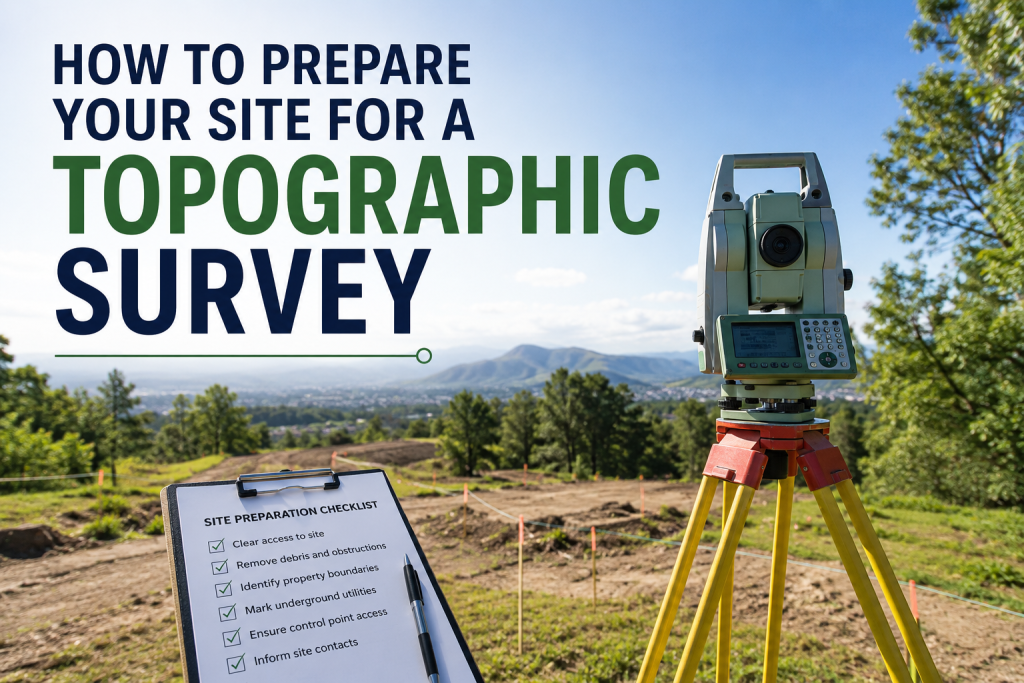
Many project delays and design revisions occur not because the survey itself was inaccurate, but because the site conditions were not properly organized beforehand.
Understanding how to prepare for a topographic survey ensures that surveyors can work efficiently, collect reliable measurements, and deliver data that supports accurate engineering decisions from the very beginning of the project lifecycle.
What Is a Topographic Survey?
Understanding the topographic survey meaning is essential for project owners and contractors who want to plan construction effectively and know how to prepare for a topographic survey before design work begins.
Simple Definition
A topographic survey gets into the details of what a piece of land actually looks like — measuring and recording its shape, elevation, and physical characteristics so there’s a clear picture of what’s really there. For engineers, it’s what translates the terrain into something workable, laying out everything from slopes and boundaries to existing structures that are already sitting on the site.
What It Measures (Elevation, Terrain, Features)
A topographic survey typically measures several key elements that influence construction planning:
- Elevation levels: Surveyors record height differences across the site to determine slopes, drainage patterns, and structural foundation requirements.
- Terrain and land contours: The survey maps the natural shape of the land, allowing engineers to identify areas that may require grading or soil stabilization.
- Existing features and utilities: Buildings, roads, trees, and underground utilities are documented to prevent conflicts during construction.
Why It Is Essential in Construction and Infrastructure
When that survey information isn’t reliable, engineers start working with numbers that don’t reflect reality, and that’s when miscalculations in earthwork volumes, drainage systems, or building elevations start creeping in — the kind that end up showing up as delays on the schedule or extra zeros on the budget. For this reason, topographic surveys are considered a fundamental step in the construction site survey process.
Why Proper Site Preparation Matters Before a Survey
Proper planning and organization play a significant role in determining survey accuracy and efficiency. Knowing how to prepare for a topographic survey allows project teams to minimize errors and ensure that survey results support reliable engineering decisions.
Improves Accuracy
When a site is easy to access and its boundaries are clearly defined, surveyors can move through the measurement process without running into obstacles or ambiguity
Reduces Delays
Proper topographic survey preparation ensures that all necessary conditions are in place before the survey begins.
Prevents Rework in Design
Incorrect or incomplete survey data can lead to design revisions during construction. Preparing the site carefully helps engineers produce accurate drawings from the start.
Ensures Better Project Planning
Well-prepared survey data supports realistic scheduling, budgeting, and resource allocation.
Step-by-Step Guide to Preparing Your Site for a Topographic Survey
A structured approach helps project teams understand what to do before a topographic survey and ensures that the survey process runs smoothly without interruptions.
Step 1: Clear Site Access
Surveyors need safe and unobstructed access to all areas of the site.
- Remove obstacles: Construction materials, equipment, and temporary structures should be relocated to prevent interference with measurements.
- Ensure entry for survey team: Access roads and entry points should be open and clearly marked to allow survey vehicles to reach the site safely.
Providing clear access is one of the most important elements of land surveying preparation, as it directly affects survey efficiency.
Step 2: Identify Site Boundaries
Accurate boundary identification ensures that survey measurements are taken within the correct legal limits.
- Mark property limits: Boundary markers or flags should be placed at key points to help surveyors identify the exact perimeter of the site.
- Confirm legal boundaries: Property documents should be reviewed to verify ownership lines and prevent disputes during construction.
This step is essential in site layout survey preparation, particularly for projects located near neighboring properties.
Step 3: Remove Temporary Obstructions
Temporary items on the site can interfere with measurement equipment and reduce data accuracy.
- Construction materials: Stored materials such as pipes, steel, or concrete blocks should be moved away from survey points.
- Vegetation or debris: Excess vegetation and loose debris should be cleared to allow clear visibility of terrain features.
Removing obstructions helps surveyors collect consistent data during the surveying in construction steps.
Step 4: Provide Existing Site Information
Survey teams rely on existing documentation to understand site conditions and plan measurement strategies.
- Old drawings: Previous design or survey drawings provide valuable reference information.
- Previous survey data: Historical measurements help identify changes in land conditions.
- Utility maps: Underground utility information prevents accidental damage during fieldwork.
Providing documentation supports efficient coordination and improves the reliability of survey results.
Step 5: Ensure Safety Conditions
Safety preparation protects both survey teams and construction workers.
- Secure hazardous areas: Dangerous zones such as excavation pits or unstable ground should be clearly marked.
- Provide site supervision: A responsible site representative should be available to guide survey teams and address safety concerns.
Meeting engineering survey requirements ensures that the survey process complies with safety regulations.
Step 6: Coordinate With Survey Team
Effective communication between project teams and surveyors prevents scheduling conflicts and delays.
- Schedule timing: Survey activities should be planned during suitable weather and working conditions.
- Assign contact person: A designated representative should coordinate communication between contractors and surveyors.
Strong coordination improves efficiency and ensures successful survey completion.
What Surveyors Need on Site
Understanding the land survey checklist helps project teams prepare the site properly and ensure that surveyors can complete their work efficiently when learning how to prepare for a topographic survey.
Essential Site Requirements
- Clear access routes: Survey equipment requires stable paths to reach measurement locations without obstacles.
- Reference points: Fixed markers help surveyors establish accurate coordinates for mapping the site.
- Site drawings: Existing plans provide context for measurement and design alignment.
- Permissions: Legal authorization ensures that survey teams can access restricted areas.
- Stable ground conditions: Firm surfaces are necessary for accurate measurement equipment setup.
Following a reliable land survey checklist for construction reduces the risk of incomplete data collection.
Common Mistakes That Affect Topographic Survey Accuracy
Knowing what those issues are is half the battle — it’s what puts teams in a better position to understand how to prepare for a topographic survey the right way before anyone sets foot on site.
Typical Mistakes
- Blocked access to site areas: Surveyors may be unable to measure certain locations if access is restricted.
- Missing boundary markers: Unclear property lines can lead to inaccurate mapping.
- Incomplete documentation: Lack of supporting information delays survey analysis.
- Poor coordination with survey team: Communication gaps often result in scheduling conflicts.
- Ignoring underground utilities: Failure to identify utilities increases safety risks and potential damage.
Avoiding these mistakes improves survey reliability and supports accurate engineering design.
Tools and Technology Used in Topographic Surveys
Modern surveyors rely on advanced equipment to collect accurate measurements and improve efficiency during the construction site survey process, which is a critical component of understanding how to prepare for a topographic survey.
Common Surveying Technologies
- GPS surveying tools: Global positioning systems provide precise location data across large sites.
- Total stations: These instruments measure angles and distances to create detailed maps.
- Drones (UAV mapping): Unmanned aerial vehicles capture high-resolution images and terrain data quickly.
- Laser scanning: Laser technology creates detailed three-dimensional models of the site.
These technologies allow surveyors to produce accurate results even in complex terrain conditions.
How Survey Results Impact Engineering Design
Taking the time to understand how to prepare for a topographic survey properly is what makes the difference between data that teams can actually rely on and data that creates more questions than it answers when design work begins
Influences Design Accuracy
Accurate survey data allows engineers to position structures correctly and calculate foundation requirements.
Affects Structural Planning
Topographic measurements help determine load distribution, drainage systems, and earthwork requirements.
Reduces Construction Risks
Reliable survey information helps identify hazards such as unstable soil or steep slopes before construction begins.
Improves Cost Estimation
When terrain data is accurate, budgeting gets a lot more grounded — the material and labor requirements that come out of it actually reflect what the site demands rather than what someone estimated from a desk.
Engineering consultants lean on survey results to make sure the design decisions being made are actually grounded in what the site is telling them, not assumptions.
FAQs
How long does a land survey take?
The duration of a land survey depends on site size, terrain complexity, and accessibility. Small sites may require one day, while large infrastructure projects may take several days or weeks to complete.
Why is a topographic survey important before construction?
A topographic survey provides accurate information about land conditions, allowing engineers to design safe structures, estimate costs, and plan construction activities effectively.
Conclusion
Preparing a site properly before a topographic survey is one of the simplest ways to improve project efficiency and reduce risk.
When survey teams can get where they need to go, know exactly where the boundaries sit, and have the right documentation in hand, the data they collect is the kind that engineers can actually make solid decisions from.