
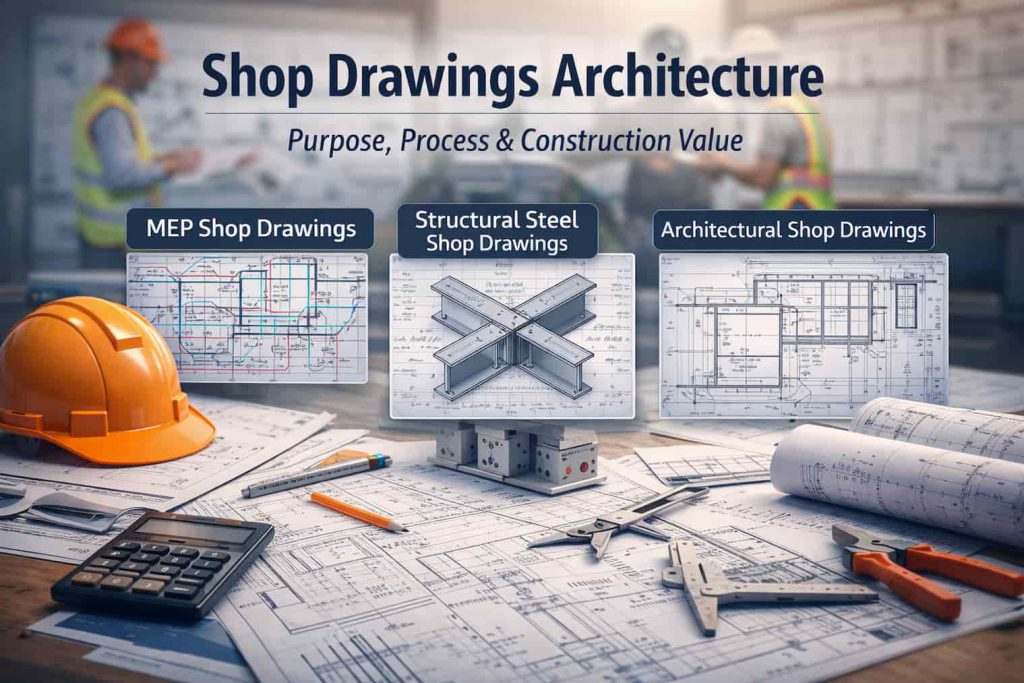
Shop drawings are the detailed technical documents that translate design intent into fabrication and installation instructions for the site and workshop. They capture dimensions, connections, material grades, and installation sequences that are not always shown at the level of detail in design drawings.
For engineering consultancies and contractors, the production, review, and controlled approval of shop drawings form a pre-construction control point that reduces ambiguity, prevents unnecessary rework and supports procurement decisions.
UGCE Consultants public materials indicate a structured, multidisciplinary service offering and emphasis on modern technology that frames their delivery of technical support and documentation, including discipline-specific drawing packages.
What are the shop drawings?
A shop drawings set is prepared by contractors, fabricators, suppliers or specialist subconsultants and presents how particular components and assemblies will be fabricated and installed.
Shop drawing:
- Presents fabrication details (cut patterns, hole locations, welds) used directly by fabricators.
- Shows installation and erection notes used by site teams.
- Lists materials, finishes, and part numbers for procurement.
Typical deliverables include fabrication drawings, erection/installation drawings, bills of materials, and annotated schedules; these are commonly required for prefabricated elements such as steel members, precast concrete units, curtain wall units, and complex millwork. The role and scope of a shop-drawing submittal are well documented in industry guidance and standards for fabricated products.
Design Drawings:
Created by an engineering consultancy firm, these convey the overall design intent, establish dimensions, and outline compliance requirements for the entire project
The Importance of Shop Drawings in Project Execution
Accurate shop drawings materially reduce three frequent execution risks:
- Errors arising from ambiguous details or unspecified tolerances.
- Delays produced by unresolved coordination issues between trades.
- Material waste caused by incorrect fabrication quantities or mismatched interfaces.
Coordination is especially critical where multiple systems intersect. For example:
- MEP shop drawings define routing and clearances for mechanical, electrical and plumbing systems.
- structural shop drawings and structural steel shop drawings specify member connection details and erection sequences that must align with openings and penetrations for MEP systems.
- Architectural shop drawing packages translate architectural tolerances into details for façades, finishes and joinery.
Resolving these intersections in the drawing stage prevents changes once fabrication or installation has begun. Industry guides emphasize methodical review and verification of structural and MEP shop details to avoid on-site clashes and unplanned change orders.
Key Elements of Effective shop drawings
To fulfill the purpose of these drawings, they must embody several core elements of quality and clarity.
Accuracy and Detailing
Accuracy is fundamental and typically includes:
- Precise dimensions and tolerance statements.
- Material specifications and surface treatment notes.
- Connection and welding details for steel shop drawings and structural steel shop drawings.
Deliverables that demonstrate detailed quality:
- Part lists and cut sheets.
- Connection detail sheets and weld legends.
- Erection/installation sequencing notes.
Compliance with Design Standards
An effective submittal cross-references the governing design drawings, contract specifications and applicable codes. This traceability allows reviewers to verify compliance quickly and to document the basis for approvals or required revisions.
Coordination Between Disciplines
Coordination practices that support integrated shop packages:
- Shared 3D reference models and exchange of IFC/DWG files.
- Clash detection cycles and consolidated coordination reports.
- Multidisciplinary review meetings with annotated, reconciled drawings.
Such coordination transforms separate MEP shop drawings, structural shop packages and architectural details into an integrated, constructible set and is widely recommended as a best practice in BIM-enabled projects.
Revision and Approval Process
A robust approval workflow contains:
- Version control and a clear revision log.
- Documented reviewer comments and required corrective actions.
- Controlled distribution lists so fabricators, procurement and site teams act from the approved set.
Traceable revision control prevents fabrication from starting on outdated information and forms a contractual record when disputes or variations arise.
How Shop Drawings Improve Construction Efficiency
Clear shop documentation supports efficiency through multiple mechanisms:
- Faster procurement and fabrication: suppliers can order and cut materials from approved drawings.
- Less rework: spatial conflicts are resolved in drawings, not on site.
- Predictable sequencing: erection and installation notes align site workflow with deliveries.
Model-based workflows (BIM) enhance these advantages by linking coordinated models to quantity takeoffs and automated clash checks, shortening review cycles and aligning the shop drawings with the construction model used for execution. Practical adoption of BIM coordination is a recognized way to reduce review time and increase constructability certainty.
UGCE Consultants Approach to Professional Shop Drawings
UGCE Consultants positions shop-drawing work within its broader engineering technical support and project delivery framework. Key process steps observable in UGCE Consultants service descriptions and project summaries include:
- Data gathering: verify design inputs and as-built/site constraints.
- Drafting: produce discipline-specific packages (structural, MEP, architectural) with explicit cross-references.
- Coordination: perform clash detection and multidisciplinary reconciliation.
- Review & approval: manage revisions, document reviewer responses and issue controlled approved sets.
UGCE project listings and service pages demonstrate the application of our workflow across building, infrastructure, and industrial projects. This end to end approach ensures reliable fabrication and erection documentation, matching standard industry practice.
Crucially, UGCE delivers a wide range of direct execution services, moving beyond a consultant-only role to provide practical, results-driven support.
Practical shop drawings examples and typical deliverables
Common submittals and illustrative examples include:
- Fabrication drawings for steel and precast elements.
- Installation drawings and layouts for HVAC, piping and electrical distribution.
- Combined coordination drawings showing reconciled MEP routing against structural members.
- Erection and bracing drawings for structural assemblies.
These shop drawings examples are used by fabricators, erectors, and site teams as the basis for physical execution; the level of detail determines the need for field decisions.
FAQs:
What is the difference between design drawings and shop drawings?
Design drawings set performance, layout, and intent; shop drawings provide detailed fabrication and installation instructions that implement that intent.
Who prepares shop drawings in a construction project?
They are prepared by contractors, subcontractors, fabricators or suppliers (e.g., a steel fabricator prepares steel shop drawings), and then reviewed by the design team.
How do accurate shop drawings reduce project risks?
They limit ambiguity, prevent clashes, ensure correct procurement and provide a documented approval trail reducing delays, rework and cost uncertainty.
Summary
Reliable shop drawings are a technical control that links design to fabrication and site installation. Their value arises from precise detailing, standards compliance, disciplined multidisciplinary coordination and a controlled revision process.
When these practices are combined with model-based coordination and documented QA, they reduce execution risk, shorten lead times and improve predictability on the critical path, the same rationale reflected in UGCE Consultants documented services and project workflows.