
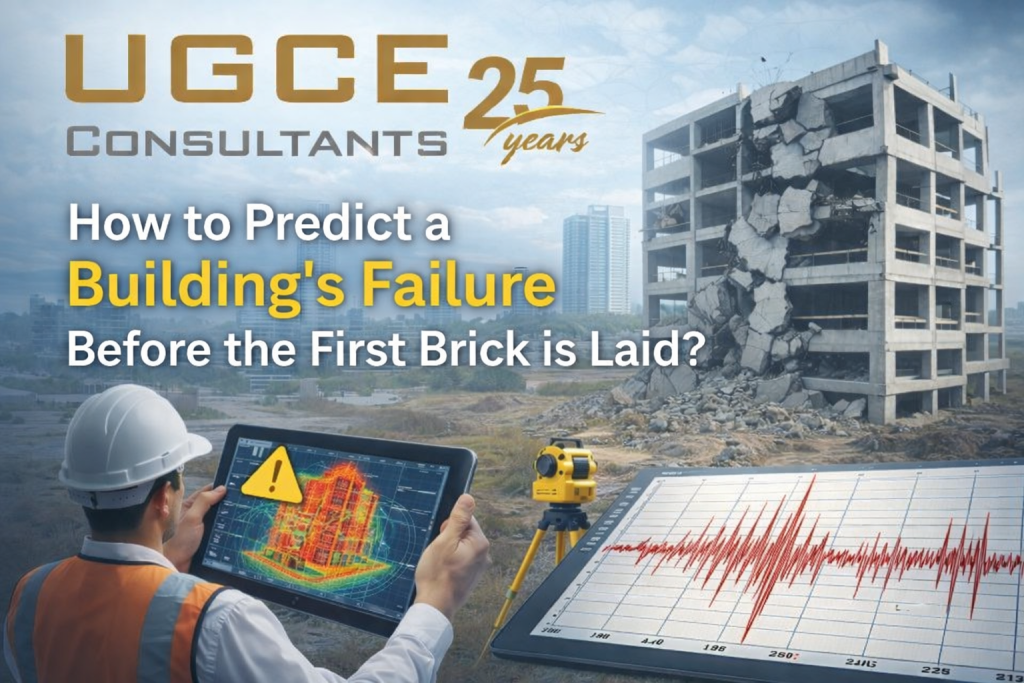
When we hear of building failure, we often blame the construction site—crumbling concrete or cut corners. Yet, the unsettling truth is that most disasters are scripted long before the ground is broken. Failure is rarely born in the physical world; it originates in the theoretical realm of calculations and design. By prioritizing structural risk assessment and pre-construction analysis, developers can identify engineering design mistakes before they become physical tragedies. This article explores how to predict these invisible threats while they are still just lines on paper.
- Can a Building Really Fail Before Construction Even Starts?
The short answer is yes. In fact, this is where the most catastrophic failures originate.
To understand this, we must distinguish between visible failure and hidden technical failure. Visible failure is what ends up on the news—cracks, tilts, and collapses.
- Hidden technical failure occurs when projects lack adequate redundancy, proper soil investigation or accurate load calculations.
- A “failed” project can exist from day one, even if it stands for years before a stressor exposes its inherent weaknesses.
- The pre-construction analysis serves as the blueprint for survival; if assumptions about loads, soil, or materials are wrong, physical execution merely realizes a pre-existing error.
- Building failure causes are rarely isolated incidents on-site; they are often the inevitable result of decisions made months or years prior in an office.
- What Are the Most Common Hidden Causes of Building Failure?
If failures start on paper, what exactly are we looking for? The root causes are often buried in dense reports or missing entirely from the documentation. Here are the most frequent culprits responsible for construction failure reasons:
- 1. Poor Feasibility Studies
Skipping a detailed analysis of the site and project viability is the primary cause of project abandonment. A generic study that doesn’t account for specific site constraints sets the project up for financial ruin.
- 2. Inaccurate Load Assumptions
Engineers must predict how much weight a building will hold (Dead & live loads) and the forces it will endure from wind or earthquakes (environmental loads). Underestimating these leads to structural failure in buildings once the facility is in use.
- 3. Ignoring Soil Conditions
The ground is part of the structure. If the soil investigation importance is downplayed, the foundation may settle unevenly, causing cracks or total collapse.
- 4. Design Coordination Gaps
Modern buildings are complex machines. If the structural design conflicts with the Mechanical, Electrical, and Plumbing (MEP) systems, such as a duct cutting through a critical beam, the structural integrity is compromised. This is often the result of siloed teams failing to communicate.
- How Do Engineering Design Mistakes Lead to Structural Failure?
It is terrifyingly easy for engineering design mistakes to compound. A minor calculation error at the beginning of a project can escalate into a massive safety risk by the end.
For example, consider load calculation errors. If an engineer miscalculates the “load path”—the route forces take to get from the roof to the foundation—elements of the building may be subjected to stress they were never designed to handle.
- Wrong Load Paths: If a column is placed incorrectly in the model, the beam resting on it may shear off.
- Underestimated Live Loads: Assuming a library floor will only hold the weight of an office can lead to disaster when heavy bookshelves are installed.
- Incompatible Materials: Specifying materials that react chemically with one another can cause rapid degradation of the structure.
These are design errors in construction documents. They are invisible to the naked eye until the structure is under stress, emphasizing that responsibility often lies in the design stage, not just with the execution team.
- Why Is a Feasibility Study the First Line of Defense Against Failure?
Many developers view feasibility studies as a bureaucratic hurdle or a “nice-to-have.” In reality, a comprehensive feasibility study for construction is the single most effective tool for risk mitigation.
A proper engineering feasibility study goes beyond simple economics. It assesses:
- Technical Viability: Can this actually be built given the technology and materials available?
- Cost Realism: Are the budget estimates based on current market rates and actual material quantities?
- Site Constraints: Does the site have drainage issues, seismic activity, or zoning restrictions?
- Regulatory Risks: Will the design pass municipal safety codes?
Skipping this stage creates a “zombie project”—one that looks alive but is technically dead. It leads to structural risk assessment failures where the project runs out of money halfway through or requires expensive retrofitting to prevent collapse.
- What Warning Signs Engineers Look for Before Construction Begins?
Expert engineers and project managers perform construction project risk analysis to spot red flags early. If you are a decision-maker, look out for these warning signs:
- Unrealistic Budgets: If the cost estimation is significantly lower than industry standards without a clear reason (like value engineering construction), corners are likely being cut in the design or material quality.
- Aggressive Timelines: “Fast-tracking” without adequate time for design review is a major cause of early design stage risks.
- Missing Technical Reports: If there is no geotechnical report or wind tunnel test for a high-rise, the design is based on guesses, not data.
- Incomplete Design Coordination: If the architectural drawings don’t match the structural drawings, the project is heading for clashes on-site.
Identifying these signs allows for building collapse prevention strategies to be implemented before the stakes become physical.
- Why Predicting Failure Early Saves Millions Later?
There is a famous concept in engineering: the “1:10:100 rule.”
- Fixing an error during the design phase costs $1.
- Fixing that same error during construction costs $10.
- Fixing the failure after the building is finished costs $100 (or significantly more if litigation is involved).
Investing in infrastructure design risks assessment and rigorous pre-construction analysis is not an expense; it is insurance. For investors and developers, the cost of early studies is negligible compared to the cost of redesigns, construction delays, legal battles, or the total loss of an asset.
- How Does UGCE Help Predict and Prevent Building Failure?
At UGCE, we provide trusted engineering consultancy that helps predict risks before construction begins.
We do not just “draw plans.” We provide integrated engineering design where structural, architectural, and MEP teams work in unison to close coordination gaps. Our rigorous feasibility studies and structural risk assessments ensure that every load is calculated, every soil condition is analyzed, and every dollar in the budget is accounted for technically.
From early design stage risks analysis to comprehensive construction project risk analysis, UGCE provides the technical foresight needed to ensure that your building is as sound financially as it is structurally. We don’t just design buildings; we engineer certainty in an uncertain world.
- FAQs
Q: What are signs of structural failure?
While this article focuses on prevention, common visible signs include diagonal cracks in walls (indicating shear stress), sagging floors or beams, sticking doors and windows (indicating foundation shifting), and dampness or water leakage which can rust steel reinforcement.
Q: Why is soil investigation critical before construction?
Soil investigation importance cannot be overstated because the soil supports the entire weight of the building. Without knowing the soil’s bearing capacity, composition, and water table level, engineers cannot design a safe foundation. This often leads to differential settlement, where one part of the building sinks faster than another, causing major structural damage.