
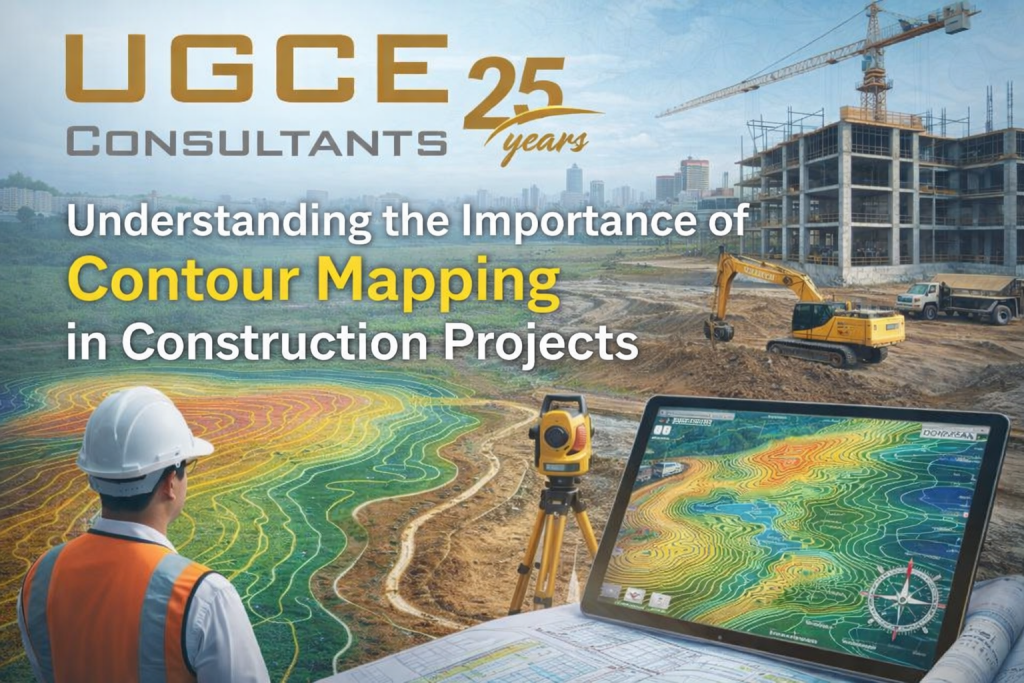
The success of any construction project is built long before ground is broken. It begins with a deep, precise understanding of the land itself. This foundational knowledge is captured and communicated through contour mapping, a non-negotiable process that translates the 3D reality of a site into actionable intelligence. For professionals in planning, engineering, and construction, ignoring the importance of contour mapping is a high-risk gamble. This article details why accurate topographic mapping construction is essential, how it’s done with modern technology, and the severe consequences of getting it wrong.
What Is Contour Mapping in Construction Projects?
At its core, contour mapping in construction projects is the process of creating a detailed graphical representation of a land surface’s topography. It depicts the shape and elevation of the terrain through contour lines—imaginary lines that connect points of equal elevation above a specified reference level, typically sea level.
On a contour map, each line represents a consistent elevation. When these lines are spaced closely together, they indicate a steep slope. When they are widely spaced, they represent gentle or flat terrain. A simple circle might indicate a hilltop or a depression, depending on the accompanying elevation labels.
This is a stark departure from a flat, two-dimensional plot plan. A standard site plan might show boundaries and structures but reveals nothing about the land’s vertical character. A contour map in construction, however, provides a complete, three-dimensional understanding on paper or screen. It answers the essential questions: Where are the high points and low points? What is the slope and direction of drainage? This nuanced understanding is the bedrock of intelligent construction planning.
Why Is Contour Mapping Essential Before Starting Construction?
Contour mapping in construction projects is a foundational requirement, not an optional step. It is the primary tool for preventing costly errors and making informed go/no-go decisions. Skipping a proper topographic survey for construction means designing in the dark, leading to unbuildable plans and budget overruns.
The essentiality is driven by two primary needs:
- To Understand Site Elevations Quantitatively:
Design must conform to the land. A foundation or road designed for a flat site will fail on a slope without accurate elevation data.
- To Support Feasibility & Planning:
A contour map answers fundamental questions: Can the proposed structure fit here? Where will water flow? Is the site suitable, or is grading cost-prohibitive? This upfront analysis is the best investment in risk mitigation a project can make.
How Does Contour Mapping Support Site Analysis and Planning?
Engineers and planners use contour maps as their primary tool for systematic site analysis. The map allows them to:
- Analyze Slopes & Gradients: Calculating precise slopes is crucial for stability, accessibility, and regulatory compliance.
- Identify High & Low Points: This determines natural watersheds, potential ponding areas, and optimal spots for structures or water management features.
- Assess Site Suitability: The map shows if extensive grading is needed, if there are unstable slopes, or if the site is appropriate for the intended use.
- Plan Building Orientation & Access Roads: Orientation can be optimized for drainage, sun exposure, and views, while access roads can be routed along the most economical and stable gradients.
This analysis forms the basis of a rational, integrated site plan that works with the land, not against it.
How Does Contour Mapping Impact Earthwork and Excavation Planning?
This is where contour mapping translates directly into cost control and efficiency. The map provides the data for precise earthwork planning using contour maps, which involves calculating the volumes of soil to be moved.
- Core Process: Cut & Fill Calculations. “Cut” is soil removed from high areas; “Fill” is soil placed in low areas to create a level building pad.
- Primary Goal: Balance Earthworks. The ideal aim is to balance cut and fill volumes on-site, minimizing the costly import of new material (borrow) and export of waste soil (spoil).
- Result: Accurate contour mapping services enable this optimization, directly reducing unnecessary excavation, hauling costs, and project budgets.
How Is Contour Mapping Used in Road and Infrastructure Design?
Infrastructure development relies fundamentally on understanding terrain characteristics, making contour mapping services indispensable for road and utility design.
| Infrastructure Element | How Contour Mapping is Used |
| Road alignment | Finding the most efficient, stable route that balances cut/fill and maintains safe, buildable grades. |
| Slope stability | Analyzing embankments and cuttings to prevent landslides and failures. |
| Utility routing | Designing gravity-fed sewer and stormwater systems that follow precise, continuous downhill gradients. |
| Environmental Integration | Minimizing disturbance by routing infrastructure along natural contours, preserving existing drainage and ecosystems. |
What Technologies Are Used to Create Accurate Contour Maps Today?
Modern contour mapping services rely on integrated technologies to create the precise topographic survey for construction needed for planning and design.
- Total stations remain a cornerstone technology, combining electronic distance measurement with angular measurements to precisely determine point coordinates. These instruments capture exact spot elevations and details, providing the control framework for all other survey data in topographic mapping construction.
- GPS and GNSS (Global Navigation Satellite System) technology has revolutionized land surveying for construction projects. These systems provide highly accurate positioning data, particularly when using real-time kinematic (RTK) corrections. Surveyors can quickly establish control networks and collect topographic data over large areas with centimeter-level accuracy.
- Drones equipped with photogrammetry capabilities have transformed topographic survey for construction site applications. UAV surveys capture thousands of overlapping aerial images that are processed into detailed 3D models and contour maps. This approach is particularly valuable for large-scale land surveying for construction projects.
- LiDAR (Light Detection and Ranging) technology represents the cutting edge of contour mapping services. LiDAR emits laser pulses that measure distances to surface points, creating extremely dense and accurate elevation datasets. This technology can even penetrate vegetation to reveal ground surfaces beneath tree canopy.
- Digital terrain models (DTM) is an intelligent, 3D digital representation of the bare-earth terrain. All data from the technologies above is processed to create this model, from which accurate contour lines are automatically generated for engineering software, directly enabling earthwork planning using contour maps and stable infrastructure design.
What Risks Can Occur If Contour Mapping Is Ignored or Inaccurate?
The consequences of poor or absent topographic mapping construction are severe and costly:
- Design Clashes: Structures designed for flat land may not fit or function on the actual slope.
- Drainage Failures: The most common risk. Without understanding contours, drainage design using contour mapping is impossible, leading to flooding, ponding, and property damage.
- Cost Overruns: Unforeseen earthworks, redesign fees, and material delays can devastate a project budget.
- Construction Delays: Solving on-site surprises halts work and pushes out schedules.
- Structural Instability: Building on unassessed slopes can lead to settlement issues or even catastrophic failures.
How Does UGCE Apply Contour Mapping in Construction Projects?
At UGCE, we treat contour mapping as the non-negotiable first chapter of every project story. Our philosophy is detail-driven and data-accurate, ensuring that mapping is fully integrated with downstream design and feasibility studies.
Our survey & mapping workflow begins with selecting the optimal technology—whether ground-based GPS, drone LiDAR, or a hybrid approach—to capture the most faithful representation of the site. We enforce rigorous quality control & validation through ground-truthing and data cross-checks.
This high-integrity topographic data is then seamlessly integrated with engineering design decisions for earthworks, drainage, and layout. We adhere to both local & international standards, ensuring our deliverables provide a reliable foundation for projects anywhere in the world, enabling confident decision-making from the start.
FAQs
How accurate should contour maps be for construction?
Accuracy requirements vary by project phase and type. For master planning, a 0.5-1 foot contour interval may suffice. For detailed engineering, earthwork, and drainage design, intervals of 0.5 feet or less are typically required, with tight horizontal and vertical tolerances often specified by the civil engineer.
Can drones be used for contour mapping?
Absolutely. Drones are now a standard, highly efficient tool for land surveying for construction projects. They excel at collecting vast topographic data quickly over large or difficult terrain, especially when equipped with LiDAR, which penetrates vegetation to map the ground surface.
Is contour mapping required for small projects?
Yes, almost invariably. Even on small residential projects, understanding slope and drainage is critical for siting a house, designing a driveway, and ensuring proper yard drainage. The scale and cost of the survey will be smaller, but the importance of contour mapping remains to prevent costly mistakes like basement flooding or improper foundation grades.