
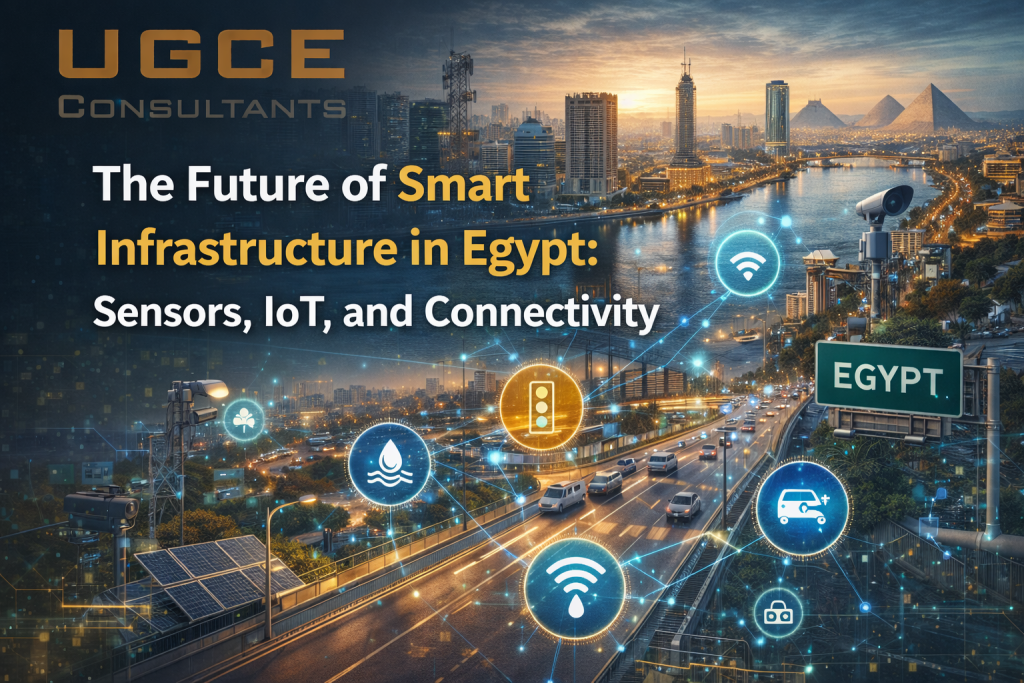
Egypt is standing at the precipice of a digital revolution. From the sprawling metropolis of Cairo to the futuristic skyline of the New Administrative Capital, the nation is undergoing a profound transformation. At the heart of this change lies a powerful concept: smart infrastructure. As urbanization accelerates and the demand for efficient, sustainable services grows, the integration of physical assets with digital technologies is no longer a luxury—it is a necessity.
In this deep dive, we will explore how sensors, the Internet of Things (IoT), and connectivity are reshaping Egypt’s urban landscape, driving economic growth, and redefining the quality of life for millions.
What Is Smart Infrastructure and Why Is It Important in Egypt?
Smart infrastructure can be defined as the integration of physical infrastructure—such as roads, bridges, power grids, and water pipes—with digital technologies like sensors, data analytics, and automated control systems. Unlike traditional infrastructure, which is static and reactive, smart infrastructure is dynamic, responsive, and predictive. It creates a “nervous system” for a city, allowing it to sense, analyze, and act on data in real time.
- The Shift from Traditional to Smart
Traditional infrastructure relies on manual inspections and scheduled maintenance. A bridge is repaired when a crack is visible; a traffic light operates on a fixed timer regardless of congestion. In contrast, smart infrastructure solutions utilize a feedback loop of data. A smart bridge monitors its own structural integrity through vibration sensors; a smart traffic light adjusts its timing based on real-time vehicle flow. This shift moves us from a “fix-it-when-it-breaks” mentality to a predictive, efficient, and user-centric model.
- Why Egypt? Why Now?
For Egypt, the relevance of this shift cannot be overstated. The country faces a unique “trilemma” of challenges that smart infrastructure developments are uniquely positioned to solve:
- Population Growth: With a population exceeding 105 million, the strain on existing utilities and transportation networks is immense. Smart systems can squeeze more efficiency out of existing assets.
- Rapid Urbanization: As new cities like the New Administrative Capital and New Alamein rise, there is a golden opportunity to bake “intelligence” into the foundations rather than retrofitting it later.
- Sustainability & Resource Scarcity: Water scarcity and energy efficiency are critical national security issues. Smart water networks and grids are essential for minimizing waste and ensuring a sustainable future.
How Sensors Are Transforming Smart City Infrastructure?
If data is the fuel of the smart city, sensors are the engines that generate it. Sensors act as the eyes and ears of smart cities infrastructure, collecting vast amounts of granular data that was previously invisible to city planners.
- Real-Time Monitoring and Optimization
The primary role of sensors is real-time monitoring. In a smart city infrastructure project, thousands of discrete sensors capture data points every second.
- Traffic Management: Inductive loop sensors embedded in asphalt or overhead infrared cameras detect vehicle speed and density. This data feeds into central control systems to optimize traffic light phasing, reducing congestion without laying a single meter of new tarmac.
- Water Management: Acoustic and pressure sensors inside pipelines can detect minute leaks that would otherwise go unnoticed for months. In a country where water conservation is paramount, this technology prevents the loss of millions of cubic meters of water.
- Structural Health: Civil engineers are increasingly using fiber-optic sensors embedded in concrete to monitor the stress, strain, and tilt of critical structures like bridges and tunnels. This ensures safety and enables “predictive maintenance”—fixing issues before they become catastrophes.
- Efficiency and Cost Reduction
The deployment of sensors in smart cities directly translates to cost efficiency. By monitoring energy usage in public buildings or streetlights, authorities can reduce waste. For instance, smart streetlights equipped with motion sensors can dim when no cars or pedestrians are around, saving up to 40% on energy bills. This reduces the operational expenditure (OPEX) for municipalities, freeing up budget for other critical social services.
The Role of IoT in Building Connected Infrastructure Networks
While sensors collect data, the IoT infrastructure (Internet of Things) is the network that transports that data and makes it actionable. IoT serves as the connective tissue that turns isolated smart devices into a cohesive, intelligent ecosystem.
- Connecting the Dots: Automation and Interoperability
In a truly smart environment, systems do not operate in silos. IoT enables interoperability, where a sensor in one system can trigger an action in another.
- Example: A fire alarm (building sensor) triggers. Via the IoT network, it instantly notifies the fire department, adjusts the building’s HVAC system to contain smoke, and changes traffic lights to green along the route for the emergency vehicle.
- This level of automation requires robust connectivity, often utilizing Low Power Wide Area Networks (LPWAN) or 5G, which is currently being rolled out in key Egyptian hubs.
- Economic and Operational Advantages
The smart infrastructure market is booming because of the clear economic value IoT brings. For Egypt, investing in IoT-enabled infrastructure attracts foreign direct investment (FDI). Global companies prefer operating in cities with reliable, data-driven utilities and logistics. Furthermore, IoT platforms allow for “Digital Twins”—virtual replicas of physical infrastructure. Egyptian city planners can use these twins to simulate scenarios (e.g., “What happens to traffic if we close this road?”) before making physical changes, saving millions in potential planning errors.
Smart Infrastructure Applications Across Key Sectors in Egypt
The application of smart infrastructure in smart city contexts is revolutionizing four key pillars of the Egyptian economy: Transportation, Utilities, Buildings, and Environmental Monitoring.
- Transportation: The End of Gridlock?
Egypt is heavily investing in digital infrastructure for smart cities to tackle its notorious traffic challenges.
- Intelligent Transport Systems (ITS): On major highways like the Cairo-Alexandria Desert Road and the new regional ring roads, ITS uses cameras and radar to detect accidents, enforce speed limits automatically, and inform drivers of delays via digital signage.
- Public Transport: The new Monorail and Electric Light Rail Transit (LRT) systems are designed as connected ecosystems. IoT sensors track train health, passenger load, and precise arrival times, accessible to commuters via mobile apps.
- Utilities: The Smart Grid and Water Networks
- Electricity: The shift toward smart grids involves replacing mechanical meters with smart meters. These allow for two-way communication between the utility company and the consumer. The grid can self-heal during power outages by rerouting electricity, and consumers can track their usage in real-time to lower bills.
- Water & Wastewater: Smart infrastructure examples in the water sector include automated sluice gates in irrigation canals that adjust water flow based on soil moisture sensors, drastically improving agricultural water efficiency.
- Buildings: Energy and Comfort
Modern construction in Egypt, particularly in the “fourth-generation cities,” mandates smart building management systems (BMS).
- Smart Energy Management: Skyscrapers in the Central Business District of the New Administrative Capital utilize occupancy sensors to control lighting and HVAC (heating, ventilation, and air conditioning). If a meeting room is empty, the AC turns off automatically.
- Access and Security: Biometric integration and facial recognition secure access to sensitive infrastructure, managed via a centralized IoT platform.
- Environmental Monitoring: Protecting the Future
Smart infrastructure developments extend to protecting Egypt’s natural assets.
- Coastal Protection: Sensors along the Mediterranean coast monitor sea-level rise and wave patterns, providing early warnings for flooding and informing the construction of sea walls.
- Air Quality: IoT-connected air quality monitors in Greater Cairo measure pollution levels real-time, helping authorities identify hotspots and enforce industrial regulations.
Challenges Facing Smart Infrastructure Development in Egypt
Despite the immense potential, the road to a fully connected Egypt is not without obstacles. Realizing the vision of smart city infrastructure requires navigating complex technical and economic hurdles.
- Integration with Legacy Systems
One of the biggest smart city challenges is the “Brownfield” problem. Cairo possesses infrastructure that is decades, sometimes centuries, old. Integrating modern IoT sensors with aging water pipes or analog electrical substations is significantly more complex and costly than building from scratch in a “Greenfield” site like the New Capital.
- Data Governance and Cybersecurity
As infrastructure becomes digital, it becomes a target. A cyberattack on a traditional power plant might cause local disruption; a cyberattack on a smart grid could paralyze a nation. Ensuring robust cybersecurity protocols and data sovereignty is critical. Egypt must develop strict frameworks to govern who owns the data generated by smart infrastructure solutions and how it is protected.
- Capital Investment and ROI
High initial costs are a barrier. Smart infrastructure projects require significant upfront capital for hardware (sensors), connectivity (fiber/5G), and software (analytics platforms). While the long-term Return on Investment (ROI) is positive via efficiency gains, securing the initial funding—whether through public budgets or Public-Private Partnerships (PPPs)—remains a challenge.
- Skills Gap and Operational Readiness
Building smart infrastructure is one thing; operating it is another. There is a pressing need for a workforce skilled in data science, IoT architecture, and cybersecurity. Overcoming this requires a focus on multidisciplinary engineering—teams where civil engineers understand coding, and IT specialists understand structural loads.
The Role and Strategy of UGCE in Egypt’s Smart Infrastructure Landscape
As Egypt rapidly accelerates its transition toward these highly connected urban environments, specialized engineering consultancy firms play a highly critical role in bridging the gap between grand digital visions and poured-concrete realities. A prime example of this is UGCE, a prominent multi-disciplinary engineering firm established in 1999 that has become a foundational pillar of infrastructure development in the region.
The Crucial Role of UGCE
UGCE acts as the essential architectural and engineering link necessary for integrating cutting-edge digital technologies with traditional civil foundations. Their role spans comprehensive, large-scale infrastructure design, encompassing everything from expansive road and bridge networks to highly complex water supply systems and municipal electrical grids. By actively participating in landmark national initiatives—such as expansive developments in New Alamein City, vital coastal protection projects, and critical regional water treatment stations—UGCE literally lays down the robust, future-ready physical framework that is absolutely required to support a complex overlay of sensors and IoT networks. Without this meticulously engineered physical base, smart technologies simply cannot function.
The Forward-Looking Strategy
UGCE’s operational strategy for advancing the baseline of smart city infrastructure revolves around three core, defining pillars:
- Multidisciplinary Integration: Recognizing that smart infrastructure cannot be successfully built in isolated silos, UGCE seamlessly integrates civil, structural, mechanical, and electrical engineering from the very first day of planning. This integrated approach ensures that a newly designed water drainage network is already physically optimized for future leak-detection sensors, and electrical grids are pre-configured to easily transition into smart grids.
- Sustainability and Environmental Resilience: Aligning closely with the national objectives of Egypt Vision 2030, UGCE places a heavy focus on sustainable, long-term engineering. Their specialized expertise in environmental engineering, wastewater treatment, and vital coastal protection is essential for building climate-resilient cities capable of adapting to environmental shifts.
- Future-Ready and Scalable Design: Rather than merely solving the engineering problems of today, UGCE’s infrastructure feasibility studies explicitly anticipate future technological demands. By preparing highly detailed blueprints that inherently accommodate future expansions in municipal digital infrastructure, they successfully mitigate long-term risks and ensure that cities can easily upgrade their operational systems as AI and edge computing technologies continue to evolve.
The Future Outlook of Smart Infrastructure in Egypt
The future of smart infrastructure in Egypt is bright, driven by government will and technological inevitability.
Trends to Watch
- AI-Driven Maintenance: We will move from predictive maintenance to prescriptive maintenance, where AI not only predicts a failure but suggests the optimal fix and schedules the repair crew automatically.
- Climate-Resilient Systems: As climate change impacts the Nile Delta, smart infrastructure examples will increasingly focus on resilience—drainage systems that adapt to flash floods and grids that handle extreme heat waves.
- Edge Computing: Processing data closer to where it is created (at the sensor level) rather than sending it all to the cloud will make Egyptian smart cities faster and more responsive.
- Opportunities for Investors and Planners
For investors, the smart infrastructure market in Egypt offers diverse opportunities, from manufacturing sensors locally to developing software platforms for utility management. For planners, the focus must shift from “technology first” to “citizen first”—ensuring that these technologies actually solve daily problems for the average Egyptian.
The trajectory is clear: Egypt is moving toward a future where infrastructure is not just concrete and steel, but code and connectivity.
FAQs
Which sectors benefit most from smart city infrastructure?
While all sectors benefit, the Transportation and Utilities (Energy and Water) sectors see the most immediate and high-impact benefits.
- Transportation: Benefits from immediate congestion relief, improved safety, and lower carbon emissions through optimized traffic flow.
- Utilities: Benefits from drastic reductions in waste (leak detection) and improved billing accuracy (smart metering), which directly improves financial sustainability for the providers.
- Public Safety: Also gains significantly through connected surveillance and faster emergency response times.