
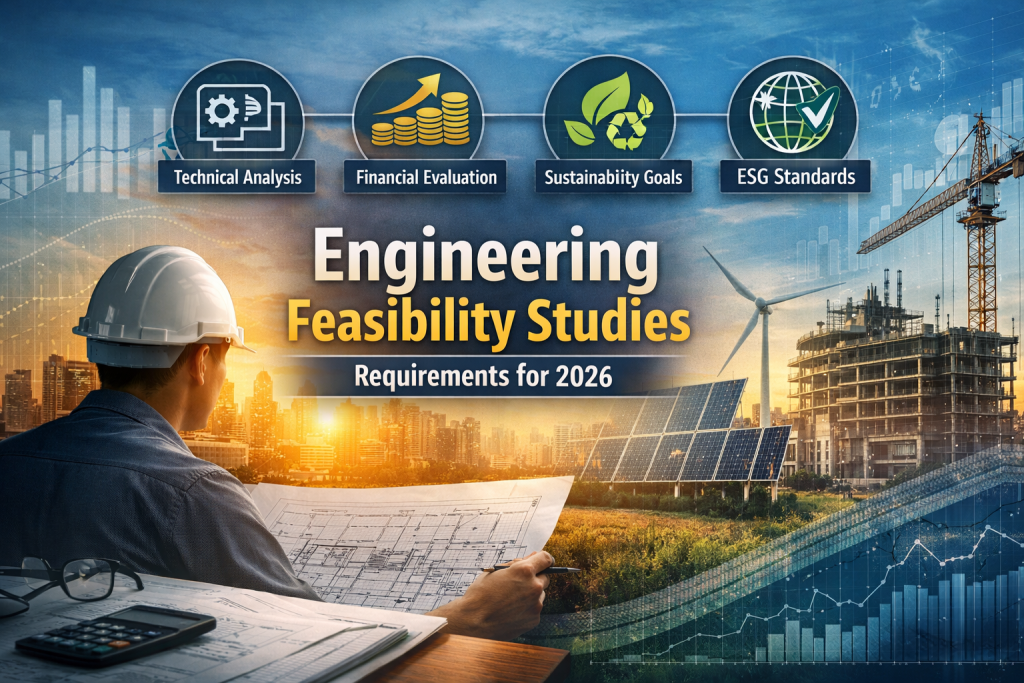
In 2026, engineering feasibility studies requirements go far beyond traditional cost checks and basic site reviews. With rising construction complexity, stricter regulations, and increased investor scrutiny, feasibility studies have become a strategic decision-making tool rather than a preliminary formality.
What Is an Engineering Feasibility Study and Why Is It Critical in 2026?
An engineering feasibility study is a structured technical and economic evaluation that determines whether a proposed project can be realistically designed, built, operated, and sustained over time. In simple terms, it answers one critical question before major investments are made.
Before any detailed design or construction begins, engineering feasibility studies requirements help stakeholders:
- Identify technical constraints early
- Compare engineering system alternatives
- Understand infrastructure readiness
- Anticipate risks that could derail timelines or budgets
For feasibility study for construction projects, the study is no longer optional—it is the foundation that protects capital, reputation, and long-term performance.
How Are Engineering Feasibility Study Requirements Changing by 2026?
Traditional engineering feasibility studies requirements focused mainly on technical possibility and rough cost estimates. By 2026, the scope has expanded significantly due to several global and regional pressures.
Higher Risk Awareness
Modern engineering projects operate in an environment of uncertainty—supply chain disruptions, labor shortages, and geopolitical instability. Technical feasibility study engineering now requires structured risk identification and mitigation strategies.
Climate Change Considerations
Environmental conditions are no longer static assumptions. Flood risk, heat stress, water scarcity, and extreme weather events must be evaluated during infrastructure feasibility study stages.
Cost Volatility
Material prices, energy costs, and logistics expenses fluctuate rapidly. Feasibility study engineering must include scenario modelling rather than fixed estimates.
Regulatory Scrutiny
Permitting, zoning, environmental approvals, and safety compliance timelines are becoming longer and more complex, especially in regions like the Middle East and engineering feasibility study Egypt contexts.
Investor-Driven Accountability
Investors and lenders increasingly require transparent, data-backed feasibility reports that demonstrate long-term resilience and ESG alignment.
What Technical Requirements Must Engineering Feasibility Studies Meet in 2026?
To meet engineering feasibility studies requirements in 2026, feasibility reports must address core technical elements with greater depth and accuracy.
Site & Geotechnical Assessment
A comprehensive evaluation of soil conditions, groundwater levels, seismic risk, and site constraints is essential. Inadequate geotechnical analysis remains one of the most expensive mistakes in construction projects.
Infrastructure Capacity Analysis
Engineering feasibility studies must assess the availability and reliability of utilities such as power, water, wastewater, roads, and digital infrastructure—especially for large-scale or mixed-use developments.
Engineering System Options Comparison
Rather than proposing a single solution, feasibility studies should compare multiple engineering systems (structural, MEP, energy, and materials), evaluating performance, cost, and lifecycle implications.
Constructability Assessment
This step evaluates whether the project can be realistically built within site constraints, local labor capabilities, equipment availability, and logistics conditions.
Phasing & Scalability Evaluation
Modern projects must be flexible. A strong engineering feasibility study checklist includes phased development options and future expansion potential without major redesign.
What Financial and Economic Factors Are Now Essential in Feasibility Studies?
Engineering feasibility studies requirements are inseparable from financial performance. In 2026, feasibility studies must integrate engineering and economics seamlessly.
CAPEX vs OPEX Considerations: Beyond upfront construction costs, feasibility study for construction projects must analyze long-term operational and maintenance expenses.
Lifecycle Cost Analysis: Decisions made during feasibility directly impact costs over 20–40 years. Energy efficiency, system durability, and maintenance strategies are now core evaluation criteria.
Sensitivity & Scenario Modelling: Feasibility study engineering must test how changes in material prices, interest rates, demand, or regulations affect project viability.
Risk-Adjusted Cost Forecasting: Modern feasibility studies incorporate contingency planning, probabilistic cost ranges, and quantified risk allowances rather than optimistic fixed budgets.
How Do Sustainability and ESG Requirements Impact Engineering Feasibility Studies?
Sustainable feasibility studies are no longer “nice to have.” They are often mandatory for funding approval for engineering feasibility studies requirements.
- Environmental Impact Considerations: Feasibility studies must evaluate land use, emissions, water consumption, and ecological impact early in the project lifecycle.
- Carbon Footprint & Energy Efficiency: Energy modeling and carbon assessments are now part of digital engineering feasibility processes, influencing system selection and material choices.
- Resource Optimization: Efficient use of materials, water, and energy improves both sustainability performance and long-term operating costs.
- ESG Compliance for Investors & Lenders: ESG requirements engineering projects are increasingly enforced by financial institutions. Feasibility studies must demonstrate alignment with environmental, social, and governance standards to unlock funding.
What Common Mistakes Make Engineering Feasibility Studies Fail?
Despite their importance, many feasibility studies fail to deliver real value due to avoidable errors.
- Over-Optimistic Assumptions: Unrealistic schedules, underestimated costs, or idealized site conditions can render a feasibility study unreliable.
- Ignoring Long-Term Operational Risks: Projects that focus only on construction feasibility often struggle during operation due to energy inefficiency or high maintenance costs.
- Underestimating Regulatory Timelines: Delays in approvals can significantly impact project economics if not properly assessed during feasibility.
- Treating Feasibility as a Formality: A feasibility study should inform go/no-go decisions—not simply justify a pre-decided project.
- Lack of Multidisciplinary Integration: Engineering feasibility studies require coordination between engineers, planners, financial analysts, sustainability experts, and regulatory advisors.
How Does UGCE Deliver Engineering Feasibility Studies Aligned with 2026 Requirements?
UGCE approaches feasibility as a strategic engineering exercise, not a checklist document.
UGCE delivers:
- Data-driven engineering feasibility studies using advanced analysis tools
- Multidisciplinary integration across engineering, finance, and sustainability
- Risk-aware assessments that anticipate future challenges
- Future-focused solutions aligned with ESG, regulatory, and market realities
By combining technical rigor with business insight, UGCE ensures that engineering feasibility studies requirements support confident decision-making and long-term project success.
Conclusion
By 2026, engineering feasibility studies requirements will define whether projects attract investment, secure approvals, and succeed operationally. A modern feasibility study must integrate technical analysis, financial modelling, sustainability criteria, and ESG compliance into a single, coherent decision framework.
Organizations that treat feasibility studies as strategic tools—rather than procedural steps—will be better positioned to deliver resilient, efficient, and future-ready engineering projects.
FAQs
How long does an engineering feasibility study take?
Depending on project size and complexity, an engineering feasibility study typically takes 4 to 12 weeks, including data collection, analysis, and reporting.
Is a feasibility study mandatory before design?
In many jurisdictions and for most financed projects, a feasibility study is either mandatory or strongly required before proceeding to detailed design.
How accurate are feasibility cost estimates?
Modern feasibility studies typically achieve ±10–20% accuracy, provided assumptions are clearly defined and risk-adjusted methodologies are applied.