
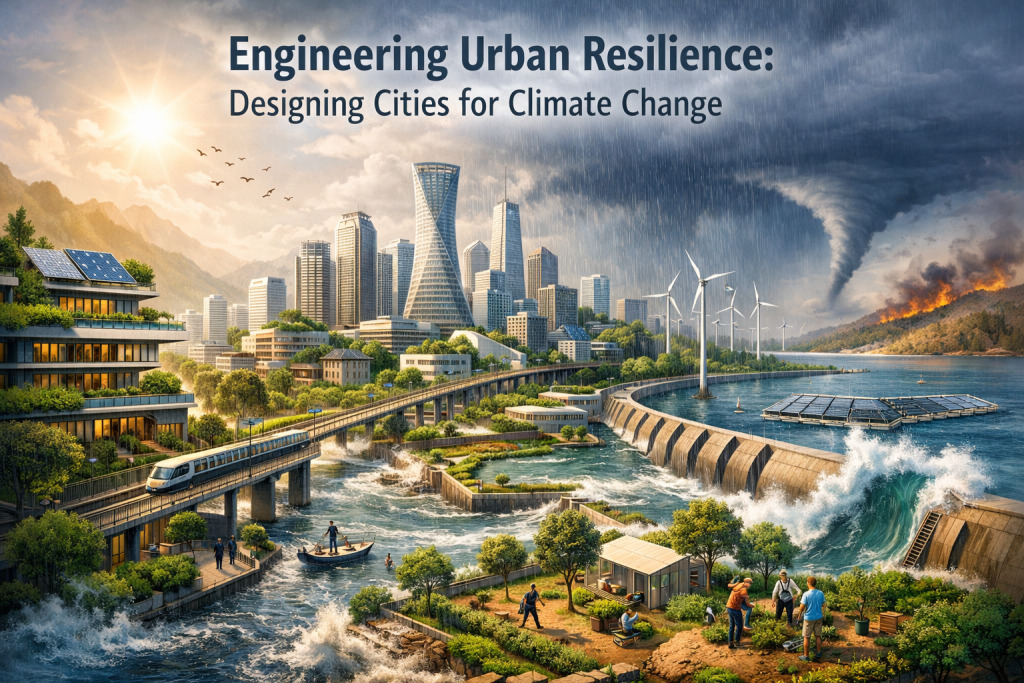
In an era defined by rapid environmental shifts, the traditional approach to city building is no longer sufficient. As urbanization accelerates globally, our metropolitan hubs face a dual challenge: accommodating growing populations while withstanding increasingly volatile weather patterns. This is where urban resilience becomes the cornerstone of modern engineering. It is not merely a buzzword; it is a critical survival strategy, shifting the focus from simply reacting to disasters to proactively designing cities that can absorb, recover from, and adapt to climate shocks.
Whether it is the sweltering heat of a Cairo summer or the rising tides threatening coastal metropolises, climate change and urban resilience are now inextricably linked. This article explores how engineers and planners are rewriting the rulebook on urban development, transforming vulnerabilities into strengths through sustainable city engineering.
What Is Urban Resilience and Why It Matters
Urban resilience is defined as the measurable ability of any urban system—including its inhabitants, infrastructure, and economy—to maintain continuity through all shocks and stresses, while positively adapting and transforming toward sustainability. In the context of engineering, it moves beyond the concept of “robustness” (strength) to include “adaptability” (flexibility).
Modern city planning cannot afford to ignore this. We are witnessing a dramatic escalation in climate-related threats that demand immediate attention:
- Intense Heatwaves: Record-breaking temperatures that strain energy grids and threaten public health.
- Flash Flooding: Sudden, heavy rainfall that overwhelms antiquated drainage systems.
- Sea-Level Rise: encroaching tides that endanger trillions of dollars in coastal assets.
- Extreme Storms: Increased frequency of cyclonic events causing structural damage.
The cost of inaction is staggering. Cities that lack comprehensive urban resilience planning face catastrophic economic losses.
- Example: The 2011 floods in Bangkok paralyzed a global hub.
- Example: Hurricane Sandy in New York demonstrated how fragile non-resilient infrastructure is.
Conversely, urban planning for resilience ensures that when disaster strikes, the city doesn’t just survive—it evolves, minimizing downtime and protecting its citizens.
How Climate Change Impacts Urban Areas
Urban areas are uniquely vulnerable to climate change due to their high population density and reliance on complex, interconnected infrastructure networks. When we discuss climate resilience in urban areas, we must identify the specific mechanisms of failure:
- Flooding from Heavy Rainfall (Pluvial Flooding):
Unlike riverine flooding, this occurs when urban drainage systems cannot handle intense precipitation. Traditional concrete surfaces prevent water absorption, turning streets into fast-moving rivers.
- Rising Urban Heat Islands (UHI):
Cities are significantly warmer than rural areas because concrete and asphalt absorb heat during the day and release it at night. This effect amplifies global temperature rises, leading to skyrocketing cooling demands.
- Water Scarcity and Supply Challenges:
Paradoxically, climate change causes both floods and droughts. Disrupted hydrological cycles threaten water security, necessitating urban planning for climate resilience that focuses on leak-proof and efficient supply systems.
- Coastal Erosion in Urban Waterfronts:
For cities like Alexandria, rising sea levels and storm surges accelerate erosion. This threatens waterfront districts, tourism, and port logistics, requiring urgent climate-adaptive infrastructure interventions.
Key Strategies for Urban Resilience Planning
To combat these threats, engineers and planners are deploying a suite of urban climate resilience strategies. These interventions range from nature-based solutions to high-tech monitoring:
- Green Infrastructure:
Integrating nature into the city (parks, green roofs, permeable surfaces) acts as a sponge for stormwater and combats the heat island effect through evapotranspiration.
- Flood-Resistant City Design:
- Stormwater Drainage: Expanding capacity to handle “100-year” storm events.
- Flood Barriers: Physical defenses against storm surges.
- Raised Foundations: Elevating critical infrastructure in low-lying zones.
- Smart City Solutions:
Using real-time monitoring and sensors to predict stress points. Early warning systems can alert residents to floods or heat risks, allowing for timely responses.
- Climate-Resilient Buildings:
Prioritizing sustainable city engineering through materials with lower thermal mass, advanced insulation, and passive cooling techniques to reduce reliance on the grid.
- Urban Mobility Planning:
Designing resilient transport routes ensures evacuation capabilities and prevents gridlock during disasters.
At UGCE, we specialize in integrating these complex systems. Our expertise covers:
- Urban Planning
- Infrastructure Design
- Project Management
Examples of Successful Urban Resilience Projects
Analyzing an urban resilience project in action provides the best roadmap for future developments. Globally and regionally, cities are proving that adaptation is possible.
- Global Case Study: Rotterdam, The Netherlands
Rotterdam is the gold standard for flood-resistant city design.
- The Solution: “Water Squares”—public plazas that serve as playgrounds in dry weather but fill up as retention basins during heavy rains.
- The Benefit: Solves space constraints in dense areas while managing water effectively.
- Regional Focus: Egypt’s Coastal Defense and Smart Cities
In Egypt, the challenge of climate change and urban resilience is being met with ambitious projects.
- Coastal Protection: Submerged breakwaters and sand nourishment in the Nile Delta and Alexandria to combat erosion.
- 4th Generation Cities: New cities (like the New Administrative Capital) are built with urban planning for resilience at their core, featuring centralized control centers and massive green spines (the Green River).
These urban resilience examples highlight measurable benefits:
- Reduced flood damage costs.
- Significant energy savings through smarter grids.
- Increased community safety during extreme weather events.
The Role of Engineers in Building Climate-Resilient Cities
Building a resilient city is a team sport, but engineers are the captains of the physical strategy. The role of engineers in sustainable city engineering requires deep collaboration:
- Civil Engineers:
They are responsible for the “hard” defense. From designing levee systems to calculating the hydraulic capacity of new sewage networks, civil engineers ensure the city’s skeleton can bear the weight of climate stress. - Structural Engineers:
They focus on individual assets, ensuring that bridges, roads, and skyscrapers can withstand higher wind loads from extreme storms or thermal expansion from record heat. - Mechanical & Electrical Engineers:
Their role is critical in maintaining the city’s nervous system—energy and communication networks. They design decentralized energy grids (microgrids) that can operate independently during blackouts, ensuring hospitals and emergency centers remain powered.
This multidisciplinary coordination is vital to prevent silos. A climate-adaptive infrastructure project fails if the drainage designed by civil engineers conflicts with the green spaces designed by landscape architects.
Best Practices for Implementing Climate-Adaptive Urban Planning
For city officials and developers, implementing urban climate resilience strategies requires a structured approach. Here are actionable best practices:
- Conduct Vulnerability Assessments:
Before development begins, engineers must model scenarios: what happens if sea levels rise by 50cm? What if rainfall increases by 20%? Understanding these risks allows for targeted interventions.
- Integrate Resilience into Master Plans:
Resilience cannot be an afterthought; it must be baked into the master plan. This means zoning high-risk flood areas as non-buildable green belts rather than residential zones and mandating specific resilience codes for new developments.
- Continuous Monitoring & Adaptation:
Climate change is dynamic, and so must be our planning. Urban resilience is an iterative process. Cities must install monitoring systems to track the performance of their infrastructure and adapt their strategies as new climate data becomes available.
- Community Engagement:
Hard engineering is not enough; social resilience is equally important. Engaging the community ensures that residents understand risks and know how to respond. A truly resilient city is one where the citizens are active participants in their own safety.
We recommend aligning all projects with international frameworks such as the UN Sustainable Development Goals (SDG 11: Sustainable Cities and Communities) to ensure global standards of safety and sustainability.
FAQs
Q: How do smart cities integrate technology for climate adaptation?
Smart cities utilize Internet of Things (IoT) sensors to collect real-time data on environmental conditions (temperature, air quality, water levels). This data feeds into AI-driven analytics that optimize energy usage, manage traffic flow to reduce emissions, and trigger automated flood defenses, making urban planning for climate resilience data-driven and responsive.
Q: Which urban areas in Egypt are most vulnerable to climate risks?
The Nile Delta region, particularly Alexandria and Damietta, is most vulnerable to sea-level rise and coastal erosion. Additionally, dense urban centers like Greater Cairo face significant risks from the Urban Heat Island effect and flash flooding due to rapid urbanization and surface impermeability.
Q: What metrics determine if a city is “climate-resilient”?
A city is considered climate-resilient based on metrics such as:
- Recovery Time: How quickly services (power, water, transport) return to normal after a disaster.
- Redundancy: The presence of backup systems for critical infrastructure.
- Absorption Capacity: The volume of stormwater the city can manage without flooding.
- Social Equity: The ability of vulnerable populations to access safe shelter and resources during climate events.