
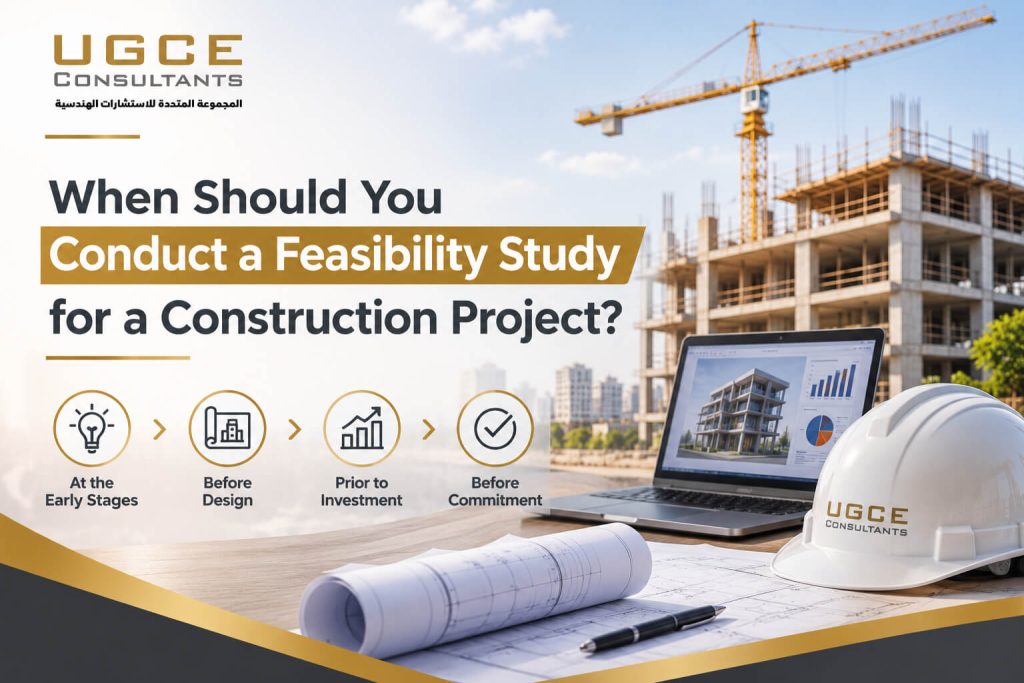
Starting a construction project involves more than developing an architectural concept or estimating the construction budget.
Before significant resources are committed, developers need to understand whether the proposed project can realistically be delivered within the site’s limitations, technical requirements, financial expectations, and regulatory framework.
What Is a Feasibility Study in Construction?
A construction feasibility study is an early-stage assessment that evaluates whether a proposed development can realistically move forward based on its technical, physical, regulatory, financial, and operational requirements.
Depending on the project, the assessment may consider:
- Site conditions: Plot dimensions, ground conditions, topography, access, and surrounding development.
- Technical requirements: Structural systems, foundations, MEP systems, and construction methods.
- Project scope: Proposed building use, approximate size, functional requirements, and development objectives.
- Regulatory requirements: Planning restrictions, applicable building regulations, and approval requirements.
- Infrastructure: Utility connections, drainage, roads, and any additional infrastructure needed.
- Costs: Preliminary construction costs, design fees, infrastructure expenses, and potential contingencies.
- Risks: Technical uncertainties, site limitations, regulatory challenges, and schedule dependencies.
- Timeline: The likely duration of design, approvals, procurement, and construction.
- Intended use: Whether the proposed development can accommodate the operational and functional needs of its users.
- Potential constraints: Conditions that may require changes to the concept, additional investigations, or alternative solutions.
A feasibility study and detailed engineering design are not the same thing. The purpose of a feasibility study is to assess whether the project is actually viable and to surface the issues that matter most, before significant commitments to design and construction are made.
Read more about: Financial vs Technical Feasibility: What’s the Difference?
When Should a Feasibility Study Be Conducted?
As a general rule, the most useful time to carry out a feasibility study is before the project team starts making major commitments on the back of assumptions that haven’t been tested yet.
Before Purchasing or Acquiring a Development Site
One of the most valuable moments to carry out a feasibility assessment is before land is purchased or acquired for development.
A preliminary assessment can help developers investigate:
- Site size, shape, and available development area.
- Potential building footprint and development capacity.
- Access and surrounding infrastructure.
- Ground conditions and potential foundation challenges.
- Planning restrictions and applicable land-use requirements.
- Existing utilities and possible connection limitations.
- Potential constraints affecting the proposed development.
For example, a plot may appear large enough for a proposed commercial building, but setbacks, access requirements, or infrastructure limitations could reduce the practical development area.
Before Finalizing the Project Concept
If the site has already been acquired, the next important stage is before committing to a specific development concept.
The assessment may consider:
- Proposed building use and operational requirements.
- Approximate building size and number of floors.
- Required spaces and functional relationships.
- Site utilization and circulation.
- Access, parking, and service requirements.
- Infrastructure capacity and connection needs.
- Potential technical or regulatory limitations.
This stage also gives developers the opportunity to weigh up alternative concepts against each other.
Before Starting Detailed Engineering Design
A feasibility study should generally be completed to an appropriate level before detailed engineering design begins.Key considerations may include:
- Structural requirements and preliminary system options.
- Foundation requirements and geotechnical information.
- Site constraints and potential excavation challenges.
- Existing infrastructure and utility connections.
- Access and circulation requirements.
- Drainage and water management.
- Applicable regulatory and planning conditions.
These findings help the design team understand which assumptions are reasonably supported by available information and which require further investigation..
When Project Scope or Requirements Change
A project that was feasible under its original assumptions may require a new assessment when its scope changes significantly.
Examples include:
- Increasing the proposed building size.
- Adding additional floors.
- Changing the building’s intended use.
- Expanding the development area.
- Introducing new functional requirements.
- Adding infrastructure or specialised building systems.
- Changing the expected project budget or delivery timeline.
The impact of these changes often goes well beyond how the building looks or how its internal spaces are arranged. Additional structural loads, increased utility demand,
Before Major Investment Commitments
A construction project feasibility assessment is also valuable before stakeholders commit substantial resources to detailed design, procurement, construction, financing, major equipment, or infrastructure works.
This is particularly important when a project depends on costly foundations, extensive site preparation, specialised equipment, utility upgrades, or complex approval processes.
What Does a Construction Feasibility Study Assess?
A comprehensive construction feasibility study brings together several assessment areas to develop a clearer picture of whether the proposed project can move forward.
The exact scope depends on the development, but the following areas are commonly relevant.
Site Feasibility
It examines whether the proposed development can reasonably be accommodated on the available land.
Engineers and other relevant specialists may review:
- Site dimensions and boundaries.
- Topography and ground levels.
- Access and circulation.
- Existing buildings and structures.
- Underground and above-ground utilities.
- Drainage and stormwater conditions.
- Surrounding developments.
- Planning restrictions and other site constraints.
The purpose is to identify conditions that may affect building placement, site utilization, foundations, infrastructure, or construction activities.
Technical Feasibility
It is about getting an honest answer to a straightforward question — can the proposed development actually be engineered and built?
The assessment typically covers structural requirements, foundation considerations, MEP systems, infrastructure connections, construction methods, and whatever limitations the specific site brings with it.
Regulatory and Planning Feasibility
It examines whether the proposed development aligns with the applicable planning framework, building regulations, and approval requirements.
Depending on the jurisdiction and project type, this may involve reviewing:
- Permitted land use.
- Planning and development requirements.
- Building setbacks.
- Height restrictions.
- Plot coverage.
- Access and accessibility provisions.
- Fire and life-safety considerations.
- Environmental requirements and relevant permits.
These conditions may affect the size, configuration, use, or location of the proposed building.
The assessment should be based on the requirements applicable to the specific project location.
Financial Feasibility
It examines whether the proposed project appears financially realistic based on its expected costs, available resources, and intended outcomes.
Depending on the project, the assessment may consider:
- Preliminary construction costs.
- Site preparation and earthworks.
- Foundation and structural requirements.
- Infrastructure and utility costs.
- Design and consultancy fees.
- Operational and maintenance considerations.
- Contingencies for identified risks and uncertainties.
- Potential revenue or project value, where relevant.
At this stage, cost estimates are generally preliminary. Their reliability depends on the available design information, local market conditions, project assumptions, and the extent of technical investigation completed.
Schedule Feasibility
It examines whether the proposed project timeline is realistic given its scope, approval requirements, technical complexity, and anticipated construction activities.
Relevant considerations include:
- Feasibility and investigation duration.
- Design and coordination time.
- Approval processes.
- Procurement lead times.
- Construction duration.
- Site access and logistical constraints.
- Dependencies between project stages.
- Potential delays and other schedule risks.
For example, a project that requires extensive ground investigations, infrastructure upgrades, or specialised equipment may need more time than a preliminary schedule suggests.
Risk Assessment
Its job is to bring the right conditions to the surface — the ones that could determine whether the project is viable, shape what it costs, influence how safely it can be built, and affect how well the finished development performs once it’s in use.
Common areas of concern include:
- Uncertain ground conditions.
- Regulatory or approval limitations.
- Construction cost variability.
- Technical design challenges.
- Utility and infrastructure constraints.
- Schedule dependencies.
- Incomplete project requirements.
- Market or operational uncertainties, where relevant.
Engineers and project stakeholders work through the risks that carry the most weight — assessing how likely they are and what the impact could be, then working out what needs to be investigated further, mitigated, or kept under monitoring as the project moves forward.
What Questions Can a Feasibility Study Answer?
A useful feasibility study should address the specific questions that determine whether a project can move forward.
Depending on the scope of the assessment, it can help answer questions such as:
- Can the proposed development realistically be built on the selected site?
- Is the proposed building compatible with the site’s physical and regulatory constraints?
- What technical challenges could affect the design or construction process?
- Are existing utilities and infrastructure sufficient for the proposed development?
- What additional infrastructure or site preparation may be required?
- Are there planning restrictions that could affect the building’s size, use, or configuration?
- Does the preliminary budget account for the major known cost drivers?
- What significant risks could affect project cost, safety, or delivery?
- Is the proposed timeline realistic given the expected approvals, procurement, and construction activities?
- What additional surveys, technical investigations, or specialist studies are needed?
- Should the project proceed as currently planned, be modified, or be investigated further?
The answers should be proportionate to the information available. Some questions can be resolved through existing records and preliminary analysis, while others may require specialist studies or confirmation from relevant authorities.
What Happens If a Feasibility Study Is Conducted Too Late?
When a feasibility study only happens after major design decisions or investment commitments are already in place, the project team’s ability to respond to newly identified constraints is significantly reduced.
Some of the consequences that can follow include:
- Discovering site constraints after design has started
- Major redesign.
- Unexpected infrastructure requirements.
- Increased costs.
- Delayed approvals
- Unrealistic project timelines.
- Changes to the development concept.
- Construction complications.
These outcomes are not inevitable. Their likelihood and impact depend on the project and the nature of the constraints. However, early assessment generally gives the team more opportunity to compare alternatives before decisions become expensive or difficult to reverse.
Is a Feasibility Study Always Required Before Construction?
The need for a feasibility study, and the level of detail it should include, depends on the project.
Factors influencing the scope include:
- Project size: Larger developments may involve more technical systems, stakeholders, and cost exposure.
- Complexity: Unusual structural requirements, difficult ground conditions, or specialised uses may require additional investigation.
- Investment level: Significant financial commitments can increase the value of early assessment.
- Site conditions: Uncertain utilities, restricted access, environmental concerns, or challenging topography may require a broader review.
- Development type: Different building uses have different functional, technical, and operational requirements.
- Regulatory environment: Approval requirements and the complexity of compliance can affect the necessary assessment.
- Level of uncertainty: Limited information about the site, costs, or project requirements may justify further investigation.
The need for specific studies, reports, permits, or approvals should also be confirmed for the project’s location and development type.
What Is the Difference Between a Feasibility Study and a Technical Study?
A construction feasibility study evaluates the overall viability of a proposed development, while a technical study investigates a particular issue in greater depth.
| Feasibility study | Technical study |
| Evaluates overall project viability. | Examines a specific technical question or condition. |
| Often begins during the early project stages. | Can be conducted at different stages of the project. |
| Considers several factors, including technical, regulatory, financial, and schedule requirements. | Usually focuses on a narrower subject, such as geotechnical conditions or drainage. |
| Supports decisions about whether to proceed, revise, or investigate further. | Supports specific engineering or technical decisions. |
| May include preliminary technical assessments. | Provides more detailed investigation or analysis within its scope. |
For example, a feasibility study for a proposed building may identify uncertainty about soil conditions as a major risk. Technical studies can therefore form part of a broader feasibility assessment. The relationship between them depends on the project, the information already available, and the questions that must be resolved.
How Does a Feasibility Study Support Better Project Planning?
Construction project planning works better when it’s grounded in a realistic understanding of what the development actually requires and what constraints it’s working within — not built on assumptions that haven’t been tested.
Its benefits can include:
- Better understanding of project constraints: Site, technical, and regulatory limitations can be identified before they become major design issues.
- More realistic project scope: The proposed building size, use, and functional requirements can be evaluated against the site’s capabilities.
- Better-informed budget planning: Preliminary estimates can account for known cost drivers and highlight areas where further information is required.
- Early risk identification: Significant uncertainties can be documented and prioritized.
- More realistic scheduling: Approval requirements, investigations, procurement dependencies, and construction challenges can be considered.
- Better design decisions: Architects and engineers can develop concepts that respond to verified information and identified constraints.
- Improved stakeholder alignment: Developers, consultants, investors, and other stakeholders can work from a clearer understanding of the project’s objectives and limitations.
- A stronger basis for detailed design: The study can identify the information, technical investigations, and decisions needed to move into the next stage.
UGCE’s Project Management Services can work alongside this process to support coordination and planning as the development moves forward. What that support looks like in practice depends on what the project needs and what’s been agreed for the engagement.
What Should Developers Do After a Feasibility Study?
A feasibility study shouldn’t just generate findings — it should lead somewhere. That means either reaching a clear decision or laying out a defined plan for working through whatever issues are still outstanding.
- Proceed with the project as planned.
- Modify the project concept.
- Conduct additional technical investigations.
- Revise the budget or schedule.
- Change the proposed site use.
- Compare alternative design solutions.
- Delay the project until specific issues are resolved.
- Decide not to proceed
A feasibility study is therefore not simply a document prepared to approve a project. It is a decision-support tool that helps stakeholders understand their options and determine the most appropriate way forward.
Conclusion
A construction project feasibility study is most valuable when it takes place early enough to influence important decisions.
Whether the starting point is evaluating a potential site, refining a concept, preparing for detailed engineering design, or considering a significant change in scope, feasibility assessment is what helps establish whether what’s being proposed is actually realistic.
At UGCE, Feasibility Studies, Engineering Design, and Project Management services are there to help developers work through project requirements, get a proper handle on technical constraints, and prepare for what comes next. Getting engineering involved early is what gives planning, design, and project delivery a clearer and more reliable foundation to build from.