
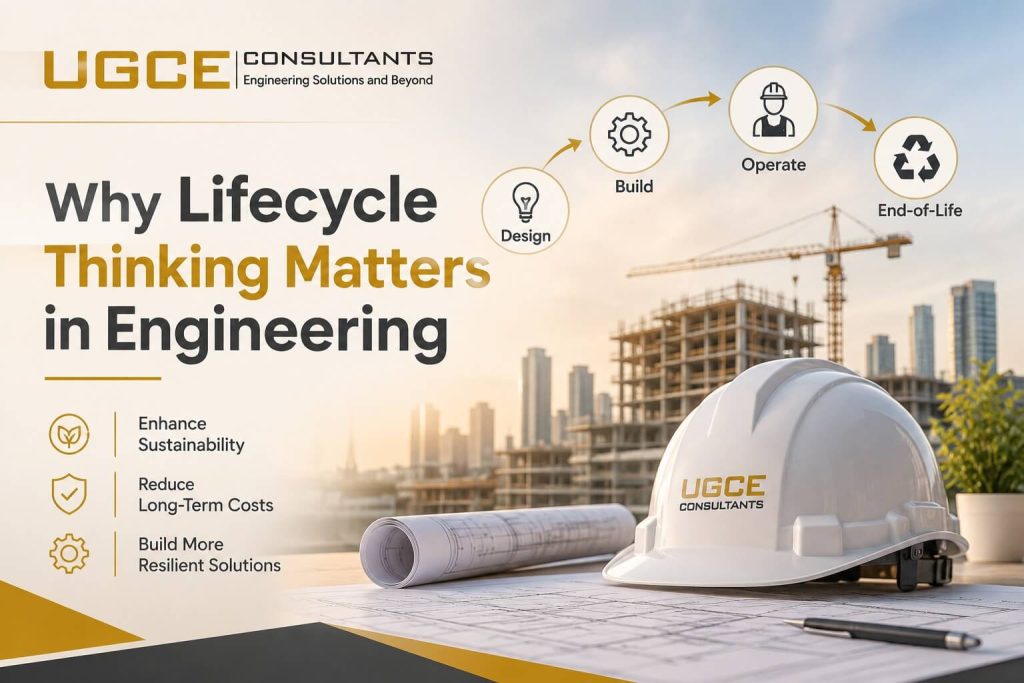
The engineering decisions made early in a project have a way of reaching much further than the design and construction phases. The materials chosen, the structural systems developed, the equipment installed, and how well maintenance access is built in — all of it shapes how the building performs, what it costs to run, and how readily it can adapt as requirements change down the line.
Lifecycle thinking in engineering is the approach that takes all of this into account — looking at an asset’s entire useful life from the beginning, covering initial planning and design through to construction, operation, maintenance, renovation, and whatever comes at the end of that lifecycle.
What Is Lifecycle Thinking in Engineering?
Lifecycle thinking in engineering means looking beyond the initial design and construction phases to understand how an asset will perform throughout its useful life.
A lifecycle approach in engineering considers several connected stages:
- Planning and feasibility.
- Design and material selection.
- Construction and quality control.
- Operation and maintenance.
- Upgrades, renovation, and adaptation.
- Replacement or end-of-life considerations.
These stages are interconnected. Decisions made during design can influence construction complexity, maintenance access, energy consumption, and the feasibility of future upgrades.
Why Does Lifecycle Thinking Matter in Engineering?
A building is a long-term asset, and its initial construction cost represents only one part of the resources required throughout its life.
Better Long-Term Decision-Making
Comparing design alternatives based only on initial cost can overlook important differences in durability, energy consumption, repair requirements, and expected service life.
Improved Asset Performance
Engineering systems must perform under real operating conditions, not simply satisfy design calculations at the time of handover.
More Predictable Maintenance Requirements
Maintenance needs are influenced by equipment selection, material durability, system accessibility, and operating conditions.
Potentially Lower Lifecycle Costs
A solution with a lower initial cost is not necessarily the most economical option over the building’s entire lifecycle.
Longer Service Life
Appropriate material selection, construction quality, protective measures, and maintenance planning can help preserve an asset’s functionality over time.
Reduced Need for Premature Replacement
Equipment and building components that are selected and maintained appropriately may remain serviceable for longer, reducing the likelihood of unnecessary early replacement.
Better Resource Efficiency
Considering energy, water, materials, and waste over time can help engineers identify opportunities to improve resource efficiency throughout the asset’s life.
Improved Resilience and Adaptability
Buildings may need to respond to changing operating requirements, new technologies, or different patterns of use. Lifecycle thinking encourages engineers to consider whether systems can be upgraded or spaces adapted without extensive reconstruction.
What Stages Are Considered in an Engineering Lifecycle?
The engineering lifecycle can be divided into several stages, each with its own decisions and implications for long-term performance.
Planning and Feasibility
Lifecycle considerations should begin before detailed design.
This is the stage where project teams set the direction — defining the objectives, constraints, and expected operating requirements that everything else will be built around.
Important considerations include:
- Project objectives.
- Site conditions.
- Future requirements.
- Initial feasibility.
- Budget considerations.
- Expected service life.
Early planning helps establish a realistic basis for evaluating design alternatives.
Design
The design stage is where many decisions affecting the asset’s long-term performance are made.
Engineers may evaluate:
- Material selection.
- Structural durability.
- Energy performance.
- Maintainability.
- Accessibility.
- Future modifications.
- Building services.
- Expected operating conditions.
The structural system needs to be matched to what the building will actually face — the loads it’s expected to carry and the environmental conditions it will be exposed to over its life.
Construction
Construction is where the approved design stops being a set of drawings and becomes a physical reality.
Key considerations include:
- Quality of materials.
- Construction methods.
- Compliance with the design.
- Workmanship.
- Documentation.
- Quality control.
Even a well-developed engineering design may not achieve its intended performance if materials are unsuitable, installation quality is inadequate, or critical details are not implemented correctly.
Operation and Maintenance
Once a building becomes operational, engineering decisions continue to influence its performance.
This stage may involve:
- Routine maintenance.
- Equipment performance.
- Inspections.
- Repairs.
- Energy consumption.
- Replacement planning.
- Facility operations.
Equipment that is difficult to access can make routine servicing more complicated. Poorly coordinated systems may also require more extensive intervention when repairs are needed.
Renovation, Adaptation, or Replacement
No building stays the same forever — over time, changes become necessary, whether to meet new requirements or to address the effects of deterioration.
Possible interventions include:
- Upgrading systems.
- Expanding the building.
- Repurposing spaces.
- Renovating existing areas.
- Repairing components.
- Replacing systems or structures where necessary.
An office building might need its internal layout reworked to reflect how the business now operates, while an industrial facility could find itself needing more capacity or upgraded building services to keep pace with demand.
How Does Lifecycle Thinking Affect Engineering Design?
Lifecycle considerations influence individual engineering decisions as well as the coordination of the building as a whole.
Material Selection
Materials should be evaluated according to more than their purchase price or initial appearance.
Relevant factors include:
- Durability under expected environmental conditions.
- Maintenance and repair requirements.
- Environmental impact.
- Availability and replacement options.
- Expected service life.
A material exposed to high humidity, aggressive chemicals, or other demanding conditions may require different durability considerations from one used in a protected internal environment.
Structural Design
Should consider the building’s intended use, expected loads, environmental conditions, and long-term performance requirements.
MEP Systems
Mechanical, electrical, and plumbing systems can significantly influence a building’s operating costs and maintenance needs.
Lifecycle-oriented MEP design may consider:
- Energy efficiency.
- Equipment accessibility.
- Ease of servicing.
- Replacement requirements.
- System reliability.
- Potential future capacity.
- Compatibility with future upgrades.
Equipment selection should reflect the building’s operating conditions and maintenance capabilities.
Accessibility for Maintenance
Maintenance access might seem like a detail during the design stage, but the decisions made around it have implications that play out over the full life of the building.
Flexibility and Adaptability
Over time, buildings often have to adapt to shifts in occupancy, changes in technology, evolving business operations, or space requirements that look very different from what was originally anticipated.
What Is Lifecycle Costing in Engineering?
Lifecycle costing in engineering is the process of evaluating the costs associated with an asset over a defined period, rather than comparing alternatives only by their initial construction costs.
Depending on the project scope, lifecycle costs may include:
- Initial design and construction.
- Energy consumption.
- Routine maintenance.
- Repairs.
- Equipment replacement.
- Renovation.
- Operational costs.
- End-of-life costs.
The analysis may also account for the timing of future expenditures, the evaluation period, and the assumptions used to estimate future costs.
A Simple Example
Consider two materials being evaluated for the same application.
Option A: Lower initial cost
May require more frequent maintenance or earlier replacement, depending on the material and operating conditions.
Option B: Higher initial cost
Greater durability or lower maintenance requirements can translate into better long-term value, even when the upfront cost is higher.
Which option actually works out to be more economical depends on a range of factors — expected service life, how often maintenance will be needed, what replacement costs look like, performance requirements, and anything else specific to the project.
How Does Lifecycle Thinking Support Sustainable Engineering?
Lifecycle thinking and sustainable engineering go hand in hand — because a building’s environmental performance doesn’t stop being relevant once construction is finished.
A lifecycle approach can support sustainability by considering:
- Reducing unnecessary material replacement. Durable materials and appropriate maintenance strategies can help avoid premature replacement where technically and economically justified.
- Improving energy efficiency. Looking at how a building performs over time gives engineers a clearer basis for comparing systems and spotting where energy consumption can realistically be brought down.
- Extending asset lifespan. Appropriate design, construction quality, and maintenance can help preserve functionality and reduce the need for premature redevelopment.
- Reducing waste. Repair, refurbishment, and adaptation may offer alternatives to replacing entire systems or structures, depending on their condition and feasibility.
- Considering resource consumption over time. Water, energy, materials, and maintenance resources should be considered alongside initial construction requirements.
- Supporting durable and adaptable designs. Buildings that can accommodate reasonable changes may remain useful for longer without requiring extensive reconstruction.
- Evaluating environmental impacts beyond construction. Where it makes sense to do so, lifecycle assessments can bring a much clearer picture of the environmental implications of different materials, systems, and design alternatives — not just during construction, but across multiple stages of the asset’s life.
In the UAE, buildings are operating in climatic conditions that make resource efficiency, energy performance, and long-term resilience genuinely important considerations rather than optional extras.
What Are the Challenges of Applying Lifecycle Thinking?
Although lifecycle thinking can improve decision-making, applying it consistently requires careful planning and realistic assumptions.
Higher Upfront Planning Effort
Getting a proper handle on long-term performance, maintenance needs, and future requirements often means putting in more analytical work during the early stages of a project — but it’s work that tends to pay off.
Limited Information About Future Operating Conditions
Occupancy patterns, business requirements, operating schedules, and environmental conditions may change.
Engineers therefore need to develop reasonable scenarios rather than assume that current conditions will remain unchanged.
Difficulty Predicting Future Costs
Energy prices, labor costs, material prices, maintenance requirements, and replacement costs can change over time.
Lifecycle costing is most useful when assumptions are transparent and uncertainty is acknowledged.
Changing Technology
Building systems and engineering technologies evolve. A system selected today may eventually become less suitable or more difficult to support.
Considering accessibility, compatibility, and realistic upgrade pathways can help address some of this uncertainty.
Changing Client Requirements
A building may be used differently from what was originally intended. Adaptability can help, but not every future change can be accommodated without significant modifications.
Regulatory Changes
Applicable requirements may change during the asset’s useful life. Future upgrades or changes in use may therefore require additional technical assessments and approvals.
Different Stakeholders Across the Lifecycle
Developers, designers, contractors, operators, and maintenance teams may have different priorities and may not remain involved throughout the same stages.
Clear documentation and coordination help preserve important design assumptions and maintenance information after handover.
Difficulty Comparing Initial and Long-Term Costs
A low initial cost is straightforward to identify — it’s right there in front of you.
Using consistent evaluation periods, clearly defined cost categories, and transparent assumptions is what makes those comparisons more meaningful and easier to stand behind.
How Can Engineering Teams Apply Lifecycle Thinking to a Project?
Lifecycle thinking can be integrated into the engineering process through a structured series of steps.
1. Define the expected lifecycle and project objectives. Establish the intended use, anticipated service life, performance requirements, and project constraints.
2. Identify likely future operational requirements. Consider possible changes in occupancy, equipment, capacity, or building use.
3. Assess site and environmental conditions.Work through the factors that are likely to affect durability, maintenance demands, energy consumption, and how the structure performs over time.
4.Evaluate design alternatives based on long-term performance. Look at materials, systems, and layouts side by side, measuring them against the technical requirements and the operating conditions the building will actually face over time.
5. Compare initial and lifecycle costs. Consider construction, energy, maintenance, repairs, replacement, and other relevant expenditures over an appropriate evaluation period.
6. Select durable and maintainable materials and systems. Choose solutions that suit the intended application and available maintenance capabilities.
7. Plan for inspection and maintenance. Provide appropriate access to serviceable components and establish the information needed for ongoing maintenance.
8. Consider future adaptation or expansion. Assess realistic scenarios that may influence the structural system, service capacity, and building layout.
9. Document assumptions and maintenance requirements. Record design criteria, relevant limitations, equipment information, and maintenance recommendations.
10. Review lifecycle performance throughout the project. Use design reviews, construction quality control, commissioning, and operational feedback to verify that the asset meets its intended objectives.
This process benefits from multidisciplinary coordination .Structural, civil, architectural, and MEP teams all need to stay aware of how the decisions they make in their own discipline ripple out to affect other systems and the way the building operates over the long term.
What Questions Should Engineers Ask Before Finalizing a Design?
Before approving a design, project teams should consider the following questions:
- How long is the asset expected to remain operational?
- What maintenance will the design require?
- How easy will it be to access systems for inspection and repair?
- How frequently will major components need replacement?
- Could the building’s use change in the future?
- Can systems be upgraded without major reconstruction?
- What are the long-term energy requirements?
- What environmental conditions could affect durability?
- What are the likely lifecycle costs?
- Can the design be adapted as future requirements change?
Questions like these shift the conversation in an important direction — away from whether a design works for today and toward whether it will keep working as the building’s needs evolve over time.
Conclusion
Lifecycle thinking in engineering comes down to recognizing something straightforward but easy to overlook — a building’s performance is shaped by decisions that start well before construction begins and keep mattering long after the keys have been handed over.
A well-coordinated lifecycle approach considers:
- Long-term performance and durability.
- Construction quality.
- Operating and maintenance requirements.
- Energy and resource efficiency.
- Repair and replacement needs.
- Future adaptation and expansion.
- Lifecycle costs and environmental impact.
The goal is not to eliminate every future problem or maximize the initial specification of every system. It is to make informed engineering decisions that balance immediate project requirements with long-term value.
For developers and project owners, involving multidisciplinary engineering consultants early can help identify these considerations while design options are still being evaluated.
UGCE works with building projects across multidisciplinary engineering design, technical analysis, and coordinated engineering consultancy. When durability, operational performance, maintainability, and future requirements are brought into the design conversation early, project teams are in a much stronger position to make informed decisions and deliver buildings that are genuinely prepared for the demands of their intended lifecycle.
Find out how lifecycle thinking in engineering leads to better long-term building performance, lower maintenance costs, stronger sustainability outcomes, and design decisions that are grounded in the full picture of how a building will perform over time.