
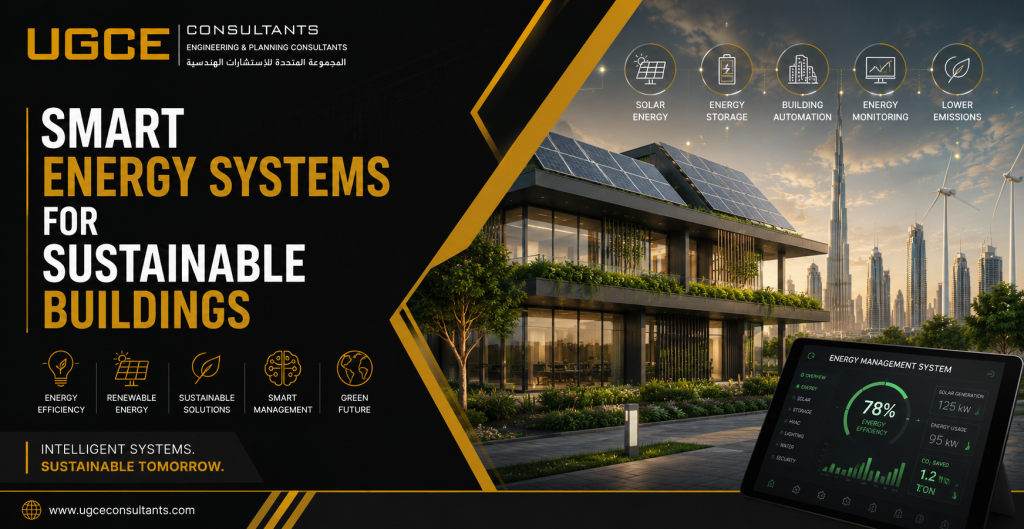
Across the UAE, governments and developers are increasingly investing in smart energy systems that align with national sustainability strategies, smart city initiatives, and long-term environmental goals.
From intelligent HVAC controls to Building Energy Management Systems (BEMS), the engineering solutions available today are doing real work on operational costs while pushing built environments toward something healthier and more sustainable than what older approaches could deliver.
What Are Smart Energy Systems?
Smart energy systems are integrated engineering solutions that use digital technologies, automation, real-time monitoring, and intelligent controls to manage a building’s energy consumption more efficiently.
Definition
A smart energy system brings hardware, software, sensors, communication networks, and intelligent control platforms together into one integrated ecosystem — managing how energy gets generated, distributed, consumed, and monitored across a building without those functions operating in isolation from each other.
Core Technologies
Modern smart building technology relies on several interconnected technologies working together to improve efficiency.
These typically include:
- Building automation platforms
- IoT sensors
- Smart meters
- Intelligent HVAC controls
- Energy monitoring software
- Renewable energy systems
- Battery storage
- Cloud-based analytics
When integrated effectively, these technologies enable continuous optimization of building performance while reducing energy waste.
Difference Between Conventional and Smart Energy Management
Traditional building energy systems generally operate according to predetermined schedules with limited feedback regarding actual performance.
By contrast, intelligent building systems respond dynamically to changing conditions.
They can automatically:
- Adjust lighting based on occupancy.
- Optimize HVAC performance according to indoor temperatures.
- Reduce energy demand during peak periods.
- Detect equipment faults before failures occur.
- Monitor renewable energy production.
- Analyze historical energy trends.
Running a building on real data rather than assumptions is what lets it operate more efficiently.
Why Smart Energy Systems Are Essential for Sustainable Buildings
With energy prices climbing and environmental regulations tightening up on multiple fronts, smart energy systems have gone from a premium add-on to a core part of what sustainable building design actually looks like today.
Rising Energy Demand
Large commercial developments, luxury residential towers, healthcare facilities, and industrial buildings are serious energy consumers — lighting, cooling, ventilation, elevators, and equipment all pulling from the same grid in ways that add up fast.
Carbon Reduction
Cutting greenhouse gas emissions has moved to the top of the agenda for governments and businesses across the board — it’s no longer a conversation happening on the sidelines.
Operational Efficiency
When energy systems are constantly keeping tabs on performance and making adjustments in real time, the efficiency gains across building operations are hard to ignore.
Supporting ESG Goals
Environmental, Social, and Governance (ESG) performance has stopped being a box that gets checked for appearances — investors, developers, and corporate organizations are treating it as a serious factor in how they evaluate and make decisions.
UAE Sustainability Initiatives
The UAE isn’t easing up on its commitment to sustainable construction — national initiatives focused on energy efficiency, carbon reduction, renewable energy, and smart city development continue to draw serious investment.
Key Components of Smart Energy Systems
A smart energy system that actually works isn’t built on a single technology — it pulls multiple components together into one coordinated platform, with each piece doing its part to lift building performance, keep energy efficiency on track, maintain occupant comfort, and hold up operationally over the long run.
Building Energy Management Systems (BEMS)
A Building Energy Management System (BEMS) serves as the central control platform for building energy operations.
Typical functions include:
- HVAC scheduling
- Lighting control
- Energy monitoring
- Equipment performance analysis
- Fault detection
- Energy reporting
Through centralized management, Building energy management systems (BEMS) provide facility managers with detailed insight into building operations while supporting better decision-making.
Smart HVAC Controls
Smart HVAC systems optimize indoor comfort while minimizing electricity use by continuously adjusting equipment based on occupancy, outdoor temperatures, humidity levels, and indoor air quality.
Advanced HVAC controls can automatically regulate:
- Cooling capacity.
- Airflow rates.
- Ventilation schedules.
- Temperature zones.
- Equipment operating hours.
These intelligent adjustments improve occupant comfort while significantly reducing operating costs.
Smart Lighting Systems
Modern smart lighting systems don’t wait to be told what to do — they read occupancy, take stock of how much natural daylight is coming in, and follow predefined operational schedules to adjust illumination levels automatically.
Additional features may include:
- Daylight harvesting.
- Motion detection.
- Automatic dimming.
- Remote lighting control.
- Scheduling.
These capabilities improve energy efficiency while extending lighting equipment lifespan.
IoT Sensors and Automation
The Internet of Things has become one of the most important technologies supporting IoT in smart buildings.
Connected sensors continuously collect information regarding:
- Temperature.
- Occupancy.
- Air quality.
- Humidity.
- Energy consumption.
- Equipment performance.
- Lighting conditions.
Automation platforms analyze this data in real time and automatically adjust building systems to improve efficiency without requiring manual intervention.
Smart Meters
Unlike conventional meters, they continuously transmit operational data that allows building managers to identify energy trends, detect abnormal usage, and evaluate opportunities for improved efficiency.
Renewable Energy Integration
Modern buildings increasingly combine renewable energy integration with intelligent control systems.
Solar photovoltaic systems, renewable-powered equipment, and distributed energy resources can be monitored alongside conventional utility supplies through centralized energy management platforms.
Battery Energy Storage Systems
Battery storage technologies enhance the flexibility and reliability of smart energy systems.
Stored electricity generated during periods of low demand or high renewable production can be used later during peak consumption periods.
Battery Energy Storage Systems support:
- Peak demand reduction.
- Renewable energy optimization.
- Backup power.
- Grid stability.
- Energy cost reduction.
When integrated with intelligent building controls, battery storage further improves operational efficiency while supporting the transition toward net-zero buildings.
Benefits of Smart Energy Systems
Implementing smart energy systems provides measurable benefits for developers, facility managers, tenants, and investors alike.
Lower Operating Costs
One of the strongest arguments for smart energy systems is what they do to the bottom line over time. When a building is constantly tracking its own energy consumption and automatically dialing equipment performanc.
Improved Occupant Comfort
Smart buildings don’t just perform better on paper — they create indoor environments that people actually feel the difference in. Intelligent control systems are constantly keeping tabs on temperature, humidity, ventilation, lighting levels, and air quality.
Reduced Carbon Emissions
Smart energy systems pulling electricity demand down, bringing renewable energy sources into the mix, and squeezing more efficiency out of equipment — all of which translates into lower carbon emissions and meaningful progress toward broader environmental goals.
Real-Time Monitoring
Continuous monitoring provides facility managers with immediate visibility into building performance.
Through advanced energy monitoring systems, operators can:
- Track electricity consumption.
- Identify abnormal energy usage.
- Monitor equipment performance.
- Detect system faults.
- Compare operational trends.
- Generate performance reports.
Access to real-time data enables faster decision-making while improving overall operational efficiency.
Predictive Maintenance
Traditional maintenance often relies on fixed schedules or reactive repairs after equipment failures occur.
Smart buildings instead use operational data to predict maintenance requirements before problems develop.
Predictive maintenance reduces:
- Equipment downtime.
- Emergency repairs.
- Operational disruptions.
- Maintenance costs.
This proactive approach improves building reliability while extending equipment lifespan.
Better Equipment Lifespan
Mechanical and electrical equipment operates more efficiently when continuously monitored and properly controlled.
Smart systems prevent unnecessary operating hours, excessive cycling, and inefficient operating conditions that accelerate equipment wear.
Regulatory Compliance
Smart energy systems simplify compliance by providing accurate operational data, energy reporting, and performance monitoring that demonstrate adherence to applicable environmental standards and green building requirements.
Higher Property Value
Buildings equipped with intelligent energy management systems often command higher market values due to lower operating costs, improved sustainability performance, enhanced occupant experience, and greater long-term operational resilience.
Smart Energy Technologies Used in Modern Buildings
Modern smart energy systems rely on advanced digital technologies that transform how buildings consume, monitor, and manage energy.
Artificial Intelligence
Artificial Intelligence (AI) enables buildings to learn from historical operating data and automatically optimize system performance.
Internet of Things (IoT)
IoT in smart buildings is what ties sensors, equipment, and control systems together into a single integrated digital ecosystem rather than leaving them operating as disconnected pieces.
Machine Learning
Instead of relying solely on predefined rules, machine learning algorithms continuously refine operational strategies based on historical building performance.
Applications include:
- Energy forecasting.
- Equipment optimization.
- Fault detection.
- Occupancy prediction.
- Maintenance planning.
These capabilities improve both efficiency and long-term operational reliability.
Digital Twins
By integrating real-time operational data with engineering models, digital twins allow facility managers to simulate system performance, evaluate proposed modifications, and optimize operations before implementing changes in the physical building.
Building Analytics
These systems evaluate trends, compare equipment performance, identify inefficiencies, and generate recommendations for improving energy efficiency.
Cloud Monitoring Platforms
These platforms allow engineers, facility managers, and property owners to monitor multiple buildings simultaneously while receiving automated alerts regarding equipment performance, energy consumption, and maintenance requirements.
Renewable Energy Integration in Smart Buildings
Renewable energy has become an essential component of smart energy systems, allowing buildings to reduce dependence on conventional electricity while supporting sustainability objectives and long-term operational resilience.
Solar PV Systems
With the amount of sunlight the UAE gets year-round, solar energy for buildings isn’t just a viable option — it’s one of the most practical renewable energy solutions available in the region.
Energy Storage
Battery storage systems improve renewable energy utilization by storing excess electricity generated during periods of high solar production.
Stored energy can later be used during peak demand periods or when renewable generation decreases.
EV Charging Infrastructure
Smart charging systems balance electricity demand by scheduling charging during periods of lower consumption or higher renewable energy availability.
Grid Interaction
Buildings may reduce consumption during peak demand periods, export surplus renewable energy, or optimize electricity use according to dynamic utility pricing.
Demand Response
Demand response programs encourage buildings to temporarily reduce energy consumption during periods of peak electricity demand.
Challenges When Implementing Smart Energy Systems
Although smart energy systems offer significant advantages, successful implementation requires careful planning, technical expertise, and effective project coordination.
Initial Investment
Advanced building technologies often require higher upfront investment compared with conventional systems.
System Integration
Integrating HVAC, lighting, renewable energy, automation platforms, and security systems requires careful engineering coordination to ensure seamless operation.
Cybersecurity
Secure communication networks, access controls, and cybersecurity strategies help safeguard intelligent building systems from potential threats.
Legacy Buildings
Older facilities may require equipment upgrades, new communication networks, or phased implementation strategies before advanced smart technologies can be fully integrated.
Data Management
Organizations must establish effective data management strategies to store, analyze, and interpret this information while protecting data integrity and supporting informed decision-making.
Smart Energy Systems in the UAE
As the UAE cements its position as a regional leader in sustainable construction and intelligent infrastructure, smart energy systems have become less of a differentiator and more of an expected part of what modern building design looks like
UAE Net Zero 2050 Strategy
The UAE’s Net Zero 2050 Strategy encourages the development of energy-efficient buildings, renewable energy integration, and low-carbon infrastructure to support long-term environmental sustainability.
Dubai Clean Energy Strategy
Dubai’s Clean Energy Strategy is pushing on multiple fronts at once — growing renewable energy generation, tightening up energy efficiency, and bringing in smart city technologies that chip away at the region’s dependence on conventional energy sources.
Estidama
Estidama pushes Abu Dhabi developments toward sustainable building practices by weaving together integrated design, resource conservation, and environmental responsibility into how projects get planned and delivered
LEED Certification
Many commercial and residential projects pursue LEED certification to demonstrate high standards of environmental performance, energy efficiency, and sustainable building design.
Green Building Regulations
UAE green building regulations continue encouraging higher energy performance, efficient building systems, and environmentally responsible engineering practices.
Smart Cities Initiatives
Smart city programs throughout the UAE integrate digital infrastructure, intelligent transportation, connected utilities, and advanced building technologies to improve urban efficiency and quality of life.
How UGCE Designs Energy-Efficient Buildings
At UGCE, we believe that exceptional engineering goes beyond meeting technical requirements—it creates buildings that are intelligent, efficient, and prepared for the future.
Engineering Design
Our engineering teams bring structural, civil, architectural, and MEP solutions together in a coordinated way — keeping energy efficiency, operational performance, and long-term building value at the center of every decision rather than treating them as secondary considerations.
MEP Design
Our MEP systems are designed to get the most out of HVAC performance, electrical distribution, plumbing efficiency, lighting, and building automation — producing facilities that run at a high level and keep energy consumption where it needs to be
Infrastructure Design
Our infrastructure engineers develop resilient utility networks and energy-efficient infrastructure that support sustainable urban developments and future expansion.
Project Management
UGCE provides comprehensive project management services that coordinate engineering disciplines, schedules, quality assurance, procurement, and stakeholder communication throughout project delivery.
Technical Consultancy
Our consultants support clients through feasibility studies, energy assessments, technical reviews, regulatory compliance, and engineering optimization to ensure every project achieves its performance objectives.
Sustainable Engineering Solutions
From renewable energy integration and intelligent building controls to energy optimization and smart building technologies, UGCE delivers practical engineering solutions tailored to each project’s operational and sustainability goals.
Ready to Build a Smarter, More Sustainable Building?
Whether the project on the table is a commercial development, residential tower, healthcare facility, or industrial build, UGCE has the capability to bring advanced smart energy technologies into the mix in a way that genuinely moves the needle on efficiency, keeps operating costs from climbing, and sets the building up for strong long-term performance.
Reach out to UGCE and find out how our engineering team can get behind your next smart building project with solutions that are innovative, sustainable, and built with the future in mind .
Conclusion
Buildings are becoming more connected by the day, and smart energy systems are reshaping what sustainable construction actually means in practice.
Through intelligent automation, real-time monitoring, renewable energy integration, and advanced analytics, these systems give buildings the ability to run more efficiently.
Bringing in experienced engineering consultants like UGCE is what makes sure smart energy solutions get built into every aspect of the design from the ground up, rather than patched in later — resulting in high-performance facilities that deliver on both business objectives and environmental responsibility without having to choose between the two.
Frequently Asked Questions
What are smart energy systems?
Smart energy systems are integrated technologies that bring automation, sensors, intelligent software, and real-time data together to keep a constant eye on how a building consumes energy — adjusting and optimizing on the fly to push efficiency and sustainability further than manual management ever could.
How do Building Energy Management Systems (BEMS) improve building performance?
BEMS pull HVAC, lighting, electrical systems, and other building services into one centralized platform where everything can be monitored and controlled together — cutting energy consumption, bringing operating costs down, and keeping equipment performing the way it should.
Why are smart energy systems important for sustainable buildings?
The benefits stack up across the board — energy efficiency goes up, carbon emissions come down, renewable energy integration becomes more manageable, occupant comfort improves, regulatory compliance gets easier to maintain, and the savings on operational costs keep building over the long run
Can existing buildings be upgraded with smart energy systems?
Yes. Many existing buildings can be retrofitted with smart technologies such as BEMS, IoT sensors, smart lighting, HVAC controls, and energy monitoring systems, although implementation requirements vary depending on the building’s existing infrastructure.