
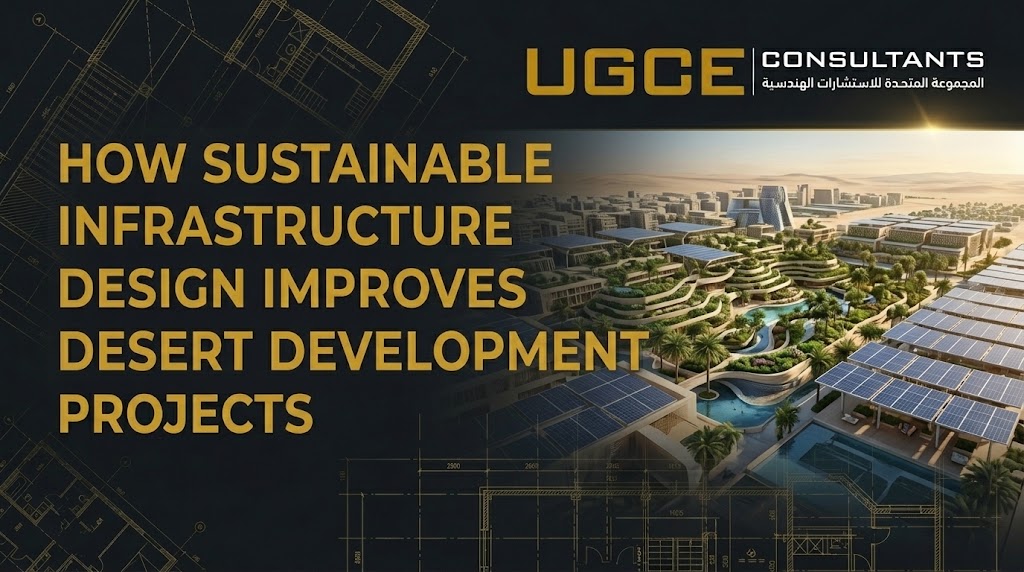
Getting sustainable infrastructure design right in this part of the world means pulling together climate-responsive planning, materials built to last, advanced engineering technologies, and environmentally responsible practices — all working together to create infrastructure that can take what the desert throws at it while still leaving room for future development to build on.
When sustainability gets woven into every stage of planning and engineering rather than treated as an afterthought, what gets built stays efficient, resilient, and adaptable for decades instead of showing its age before its time
Why Desert Environments Require Specialized Infrastructure Design
Unlike projects in temperate climates, sustainable infrastructure design for desert environments must account for environmental conditions that continuously affect structural performance, utility networks, transportation systems, and long-term maintenance.
Extreme Temperatures
Heat affects nearly every aspect of infrastructure performance, including pavement behavior, structural materials, utility systems, and mechanical equipment.
Sand Movement and Wind Erosion
Effective desert infrastructure design includes erosion control measures, protective barriers, optimized landscaping, and strategic site planning that minimize the long-term effects of sand movement on critical infrastructure.
Limited Water Resources
Modern sustainable engineering solutions incorporate water reuse systems, efficient distribution networks, leak detection technologies, and intelligent irrigation strategies that significantly reduce overall water consumption.
High Solar Exposure
Engineers increasingly integrate solar technologies into infrastructure planning to support lighting systems, utility networks, public facilities, and transportation infrastructure while reducing dependence on conventional energy sources.
Soil Conditions
Desert soils often present complex engineering challenges.
Loose sands, variable bearing capacity, expansive soils, and groundwater conditions influence foundation design, pavement performance, and utility installation.
Long-Term Operational Costs
Infrastructure that wasn’t designed with sustainability in mind has a way of making that known over time — through maintenance that never seems to end, repairs that keep coming back, energy consumption that runs higher than it should, and a service life that falls well short of what was projected.
Key Principles of Sustainable Infrastructure Design
Successful sustainable infrastructure design requires a comprehensive engineering approach that balances environmental responsibility, technical performance, economic efficiency, and long-term resilience.
Climate-Responsive Planning
Engineers evaluate local environmental conditions—including temperature, solar exposure, prevailing winds, rainfall patterns, and terrain—to develop infrastructure solutions tailored to the surrounding climate.
Water Conservation and Efficient Drainage
Effective water management is essential for infrastructure projects in arid regions.
Although rainfall is limited, stormwater events can occur suddenly and generate significant runoff. Infrastructure systems must therefore accommodate both water scarcity and occasional extreme weather events.
Modern water management strategies include:
- Stormwater management systems that safely collect and control runoff.
- Water reuse technologies that reduce potable water consumption.
- Smart irrigation systems that optimize landscape watering through automated monitoring and control.
Efficient drainage networks also help protect transportation corridors, utility systems, and surrounding developments from localized flooding while improving overall infrastructure performance.
Energy-Efficient Infrastructure
Energy efficiency sits at the heart of what sustainable civil engineering is trying to achieve.
Examples include:
- Renewable energy integration into public infrastructure.
- Solar-powered lighting systems.
- Energy-efficient pumping stations.
- Smart electrical distribution.
- High-efficiency street lighting.
These solutions reduce operating costs while supporting broader sustainability objectives throughout urban developments.
Durable Materials for Harsh Climates
Material selection significantly influences infrastructure lifespan.
Common strategies include:
- Heat-resistant materials capable of withstanding prolonged high temperatures.
- Corrosion protection systems for exposed infrastructure.
- Long-life pavement systems designed to resist cracking, rutting, and thermal deformation.
Choosing durable materials improves infrastructure resilience while lowering lifecycle costs.
Smart Infrastructure Technologies
Digital technologies have fundamentally changed what designing, monitoring, and maintaining infrastructure actually looks like — and the transformation is still picking up pace.
Examples include:
- IoT sensors for continuous infrastructure monitoring.
- Predictive maintenance systems that identify potential failures before they occur.
- Digital asset management platforms that improve lifecycle planning and maintenance scheduling.
These technologies enhance infrastructure reliability while reducing operational disruptions and maintenance expenses.
Common Engineering Challenges in Desert Infrastructure Projects
Despite advances in engineering technology, sustainable infrastructure design must address numerous technical challenges unique to desert environments. Successfully overcoming these challenges requires multidisciplinary collaboration, detailed planning, and careful consideration of long-term operational performance.
Thermal Expansion
Extreme daily and seasonal temperature variations cause infrastructure materials to expand and contract repeatedly.
Without appropriate expansion joints, flexible connections, and material selection, thermal movement may result in cracking, pavement distress, structural deformation, and utility failures.
Sand Accumulation
Sand buildup is more disruptive than it might seem — it chips away at roadway capacity, blocks drainage systems, wears down moving equipment, and keeps maintenance teams busier than they need to be.
Utility Protection
Utility networks installed beneath or above ground remain vulnerable to harsh environmental conditions.
Engineers must protect:
- Water pipelines.
- Electrical cables.
- Telecommunications systems.
- Sewer infrastructure.
- District cooling networks.
Proper routing, insulation, protective enclosures, and coordinated utility planning improve long-term system reliability.
Pavement Deterioration
High temperatures accelerate pavement aging, while heavy traffic and thermal expansion contribute to cracking, rutting, and surface deterioration.
Modern pavement engineering focuses on durable materials and optimized pavement structures capable of withstanding demanding environmental conditions.
Dust Impacts
Airborne dust affects both infrastructure performance and maintenance operations.
Dust accumulation can reduce the efficiency of:
- Solar panels.
- Mechanical equipment.
- Electrical systems.
- Air filtration units.
- Intelligent transportation systems.
Engineering teams consider maintenance accessibility and equipment protection during design to reduce operational disruptions.
Maintenance Costs
During the design stage, engineers think through equipment accessibility, replacement strategies, inspection requirements, and asset management with one eye firmly on the future — keeping long-term maintenance costs from climbing while getting as much service life out of the infrastructure as possible
Sustainable Infrastructure Solutions Used in the UAE
As cities continue to expand, sustainable infrastructure design has become essential for creating resilient communities that can thrive in demanding desert environments while supporting long-term economic growth.
Green Mobility Infrastructure
Across the UAE, infrastructure projects increasingly prioritize mobility solutions that reduce congestion, lower emissions, and improve connectivity between residential, commercial, and industrial districts.
Water-Efficient Utility Networks
Modern utility networks are designed to minimize losses while maximizing efficiency through advanced monitoring technologies, optimized distribution systems, and intelligent pressure management.
Smart Road Systems
Smart road systems utilize sensors, intelligent traffic management platforms, communication technologies, and real-time monitoring to improve safety, optimize traffic flow, and support more efficient transportation networks.
Renewable-Powered Public Infrastructure
Solar-powered street lighting, renewable-powered utility facilities, and energy-efficient public amenities reduce reliance on conventional electricity while supporting national sustainability objectives.
Sustainable Drainage Systems
Sustainable drainage systems help manage stormwater by slowing runoff, reducing flood risks, and improving water quality before discharge.
Urban Landscaping with Native Vegetation
Native and drought-tolerant plant species require significantly less irrigation while improving biodiversity, reducing maintenance requirements, and enhancing public spaces.
Benefits of Sustainable Infrastructure for Developers and Governments
The payoff from investing in sustainable infrastructure design goes well beyond environmental performance — it reaches into territory that developers, municipalities, investors, and public authorities are paying close attention to.
Lower Lifecycle Costs
Infrastructure designed with sustainability in mind generally requires fewer repairs, consumes less energy, and experiences lower operating expenses throughout its service life.
Reduced Maintenance Requirements
Designing infrastructure that performs reliably under harsh environmental conditions minimizes operational disruptions while extending asset lifespan.
Improved Environmental Performance
Sustainable infrastructure minimizes environmental impacts by reducing energy consumption, conserving water resources, limiting emissions, and encouraging responsible material selection.
Greater Infrastructure Resilience
Resilient infrastructure is better equipped to withstand environmental challenges, changing climate conditions, and increasing urban demands.
Regulatory Compliance
Environmental regulations continue to evolve across the UAE as sustainability becomes a greater priority.
Enhanced ESG Performance
Environmental, Social, and Governance (ESG) performance has become an important consideration for investors, developers, and financial institutions.
Better Investment Value
Infrastructure that performs efficiently, requires less maintenance, and remains adaptable to future demands generally delivers stronger long-term investment returns.
How Engineering Consultants Support Sustainable Infrastructure Projects
Getting sustainable infrastructure design right isn’t something that falls within one engineering discipline — it draws on expertise across multiple fields working in sync.
Engineering consultants carry a lot of that weight throughout the project lifecycle, bringing together technical knowledge, environmental planning, digital technologies, and project coordination.
Feasibility Studies
UGCE evaluates environmental conditions, site constraints, utility requirements, regulatory considerations, and long-term project viability to support informed investment decisions before design begins.
Infrastructure Master Planning
Our infrastructure planning services coordinate transportation systems, utility corridors, drainage networks, public spaces, and future expansion strategies to create integrated developments that remain efficient throughout their lifecycle.
Utility Design
UGCE designs integrated utility systems covering water supply, wastewater, stormwater, electrical distribution, telecommunications, and district cooling while prioritizing efficiency, resilience, and long-term maintainability.
Technical Reports
Our specialists prepare engineering reports, feasibility studies, environmental assessments, technical specifications, and supporting documentation that demonstrate project compliance while improving stakeholder confidence.
Value Engineering
By evaluating alternative materials, construction methods, system configurations, and lifecycle costs, UGCE helps clients optimize project value while supporting sustainability objectives.
Sustainability-Focused Design
Our teams evaluate energy efficiency, water conservation, durable materials, renewable energy opportunities, climate adaptation strategies, and smart technologies to deliver practical and resilient engineering solutions.
Project Management
UGCE provides project management services that oversee schedules, engineering disciplines, procurement, quality assurance, and communication to ensure projects remain aligned with sustainability objectives throughout implementation.
Technical Support
Our teams assist clients during construction by responding to technical queries, reviewing design modifications, coordinating with contractors, and helping resolve engineering challenges while maintaining project quality and compliance.
Why Choose UGCE for Sustainable Infrastructure Design
Building resilient infrastructure in a desert environment isn’t something that happens without the right combination of engineering expertise, technical innovation, and teams from different disciplines.
UGCE brings all of that together to deliver integrated engineering solutions that support sustainable growth across the UAE in a meaningful, lasting way.
Extensive Infrastructure Engineering Experience
Our experience across transportation, utilities, industrial developments, and urban infrastructure enables us to develop practical engineering solutions tailored to the unique requirements of desert environments.
Multidisciplinary Engineering Expertise
Our integrated teams include specialists in civil engineering, structural engineering, infrastructure planning, utility design, environmental engineering, and project management, ensuring coordinated solutions across every project phase.
Cost-Efficient Design Approach
Through value engineering, optimized system design, and durable material selection, we help clients reduce operational expenses while maximizing long-term infrastructure performance.
Compliance with International and UAE Standards
Our engineering solutions are developed in accordance with applicable UAE regulations, international engineering standards, and sustainability best practices, supporting efficient project approvals and reliable long-term performance.
End-to-End Engineering Services
From the earliest feasibility studies and infrastructure master planning right through to detailed engineering, BIM coordination, construction support, and project management, UGCE stays in it for the full run — not just the parts that are easy.
Conclusion
Sustainable infrastructure design used to be the mark of a team thinking ahead — now, with development pushing further across the UAE and other arid regions, it’s simply what responsible building looks like when the environment demands it.
Partnering with experienced infrastructure design consultants like UGCE means projects get planned, designed, and delivered with technical excellence, sustainability, and long-term success driving every decision rather than being treated as secondary considerations.
Frequently Asked Questions
Why is sustainable infrastructure design important in desert environments?
Desert environments don’t make things easy — extreme temperatures, scarce water resources, difficult soil conditions, and wind erosion all come with the territory.
What are the main challenges of desert infrastructure projects?
Thermal expansion, sand accumulation, water scarcity, pavement deterioration, utility protection, dust impacts, and long-term maintenance all sit at the top of the list when it comes to what these environments throw at infrastructure.
How does sustainable infrastructure benefit developers?
Sustainability in infrastructure has a much wider reach than most people initially think — yes, it’s better for the environment, but it also means less money going out the door on operations and maintenance.
How do engineering consultants contribute to sustainable infrastructure projects?
Engineering consultants support projects through feasibility studies, infrastructure master planning, utility design, sustainability-focused engineering, value engineering, project management, technical documentation, and construction support.