
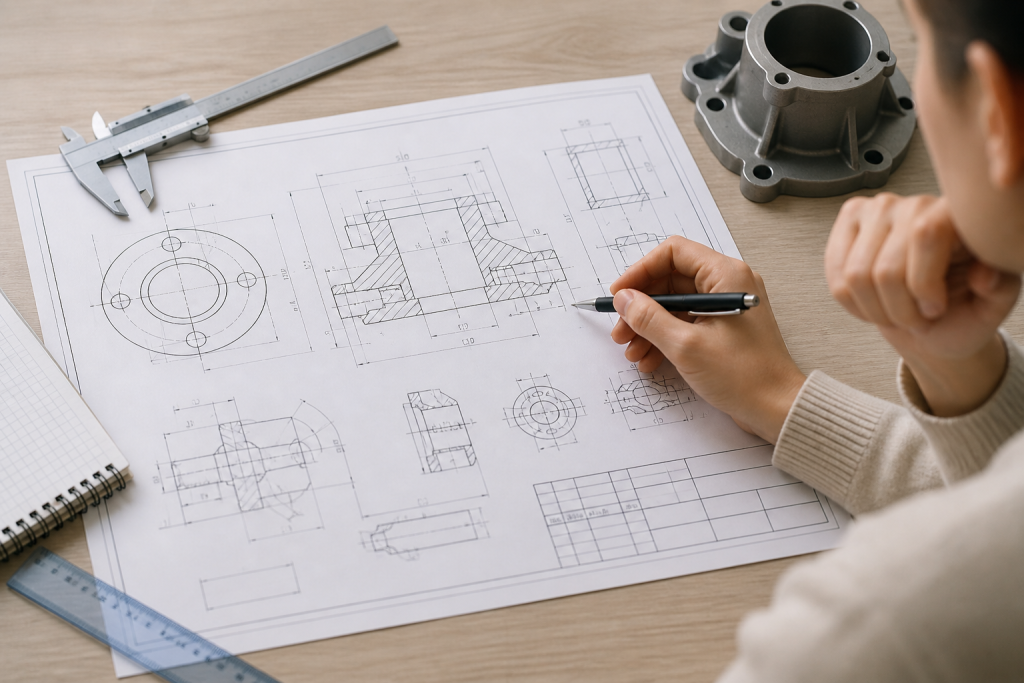
Construction and infrastructure projects rely heavily on drawings long before physical work begins on site.
These documents are essentially the common language that keeps architects, engineers, contractors, and project owners all on the same page — everyone working off the same understanding of how something is supposed to come together.
For people who didn’t come up through engineering, staring at a technical drawing for the first time can feel like looking at something written in a foreign language, but once you start to see the logic and structure behind how drawings are put together, it stops feeling that way pretty quickly
That’s exactly what this guide is here for, breaking down the key concepts in straightforward language so anyone can start making sense of technical information without feeling lost.
What Are Engineering Drawings?
To properly read engineering drawings, it is important to begin by understanding what these documents represent and why they play such a central role in construction and infrastructure development. In simple terms, engineering drawings explained in the context of technical drawings are standardized visual documents that communicate detailed instructions about how a structure or system should be designed, constructed, and maintained.
Definition
Engineering drawings aren’t just sketches — they’re carefully put-together visuals that communicate critical technical information often supported by detailed technical reports and engineering documentation. On a construction site, they’re the official word — contractors and engineers both work off the same set of drawings so nobody’s guessing or going off something someone said in a meeting.
Why They Are Essential in Construction & Infrastructure
Engineering drawings matter because they take what exists only as a design idea and turn it into something concrete — real, measurable instructions that a team can actually build from, safely and without cutting corners. When those drawings aren’t accurate, different people on the same construction team start reading requirements in different ways, and that’s usually where delays creep in and work gets redone.
For example:
- Accurate planning ensures that materials are ordered correctly, because the drawings specify exact quantities and dimensions needed for the project.
- Regulatory compliance becomes easier to achieve, since authorities rely on drawings to confirm that the design meets building codes and safety standards.
- Construction coordination improves significantly, as different trades such as structural, electrical, and mechanical teams can follow the same documented layout.
Who Uses Them
Engineering drawings are used by a wide range of professionals who depend on clear technical information to perform their responsibilities effectively.
Common users include:
- Project managers, who review drawings to monitor progress and verify that construction activities follow the approved design.
- Contractors and subcontractors, who rely on drawings to guide installation, construction sequencing, and material placement.
- Inspectors and regulators, who examine drawings to confirm compliance with safety and environmental requirements.
Why Non-Engineers Need to Understand Drawings
In modern construction environments, the ability to read engineering drawings is not limited to engineers alone. Business owners, developers, and project managers are constantly being asked to make calls on budgets, timelines, and technical changes — and a lot of those calls depend on being able to look at a drawing and actually understand what it’s showing.
Knowing how to read blueprints and getting a grip on construction drawings basics pays off in a real, measurable way, because it means problems get spotted early and conversations with technical teams don’t get lost in translation
Avoid Costly Mistakes
Misinterpreting a drawing can lead to significant financial consequences, particularly when errors are discovered after construction has already started.
For instance:
- Installing equipment in the wrong location may require demolition and reconstruction, increasing both cost and schedule duration.
- Ordering incorrect materials can delay project progress and create unnecessary waste.
- Misjudging structural requirements may compromise safety and require redesign.
Each of these situations illustrates how basic drawing literacy can protect project investments.
Better Communication with Contractors
When stakeholders understand drawings, conversations with contractors become more precise and productive. Instead of discussing problems in general terms, teams can refer directly to specific drawing details and resolve issues quickly.
Faster Project Decisions
Construction projects move fast, and decisions around design tweaks, procurement, or scheduling often can’t wait. When the people making those calls actually understand what they’re looking at on a drawing, they can weigh their options without second-guessing.
Types of Engineering Drawings You Should Know
To successfully read engineering drawings, it is necessary to recognize the main types of engineering drawings used in construction projects, because each drawing provides different information about the structure or system.
Architectural Drawings
Architectural drawings describe the physical layout and appearance of a building, helping stakeholders understand how spaces are organized and how people will interact with the environment.
For example:
- Floor plans show room layouts and circulation paths, allowing planners to evaluate functionality and accessibility.
- Elevations illustrate the exterior appearance of the building, helping clients visualize the final design.
Structural Drawings
Structural drawings focus on the strength and stability of the building, ensuring that the structure can safely support loads and environmental forces.
Typical elements include:
- Foundation layouts, which define how the building transfers loads to the ground.
- Reinforcement details, which specify steel placement inside concrete components.
Electrical Drawings
Electrical drawings provide information about power distribution and lighting systems, supporting safe and efficient electrical installation.
These drawings commonly include:
- Circuit diagrams, which show how electrical components are connected.
- Lighting layouts, which indicate the position of fixtures and switches.
Mechanical Drawings
Mechanical drawings illustrate systems that control temperature, airflow, and water supply, ensuring that the building operates comfortably and efficiently.
These drawings typically show:
- HVAC layouts, which define heating and cooling equipment placement.
- Plumbing networks, which indicate pipe routes and fixture locations.
Key Elements of Engineering Drawings
Every engineering drawing has the same core pieces built into it — and once you know what those pieces are, reading technical information becomes a whole lot less intimidating. Whether you’re jumping into an unfamiliar project or going through documentation you’ve never seen before, recognizing these standard elements is really where the ability to read engineering drawings starts
Core Drawing Components
| Element | What It Means | Why It Matters |
| Title Block | Identifies the drawing and project details | Ensures the correct document is being used |
| Legends & Symbols | Explains visual symbols used in the drawing | Prevents misinterpretation of components |
| Dimensions & Units | Shows exact measurements | Guides construction accuracy |
| Scales | Defines size relationship | Enables correct measurement interpretation |
Title Block
The title block contains critical information about the drawing, including project name, drawing number, revision history, and design team details. Reviewing this section first helps confirm that the correct version of the drawing is being used.
Legends & Symbols
Understanding engineering drawing symbols is essential because these symbols replace lengthy descriptions with simple visual icons that represent equipment, materials, or systems.
Dimensions & Units
Dimensions are what tell construction teams exactly how big something is and where it sits — get those wrong, and materials end up in the wrong place or the whole structure starts to compromise
Scales
Scale is what bridges the gap between what’s on the drawing and what gets built in real life — without it, there’s no reliable way to know what size anything actually is
How to Read Engineering Drawings Step by Step
Learning how to read technical drawings becomes easier when the process is broken into a structured sequence that beginners can follow consistently.
Step 1: Start with the Title Block
The first step is to confirm the project name, drawing number, and revision date, because outdated drawings can lead to construction errors.
Step 2: Understand the Scale
Checking the scale helps determine the relationship between drawing measurements and real-world dimensions, preventing incorrect size assumptions.
Step 3: Review Symbols & Legends
Examining the legend section ensures that readers understand the meaning of symbols before interpreting the rest of the drawing.
Step 4: Read Dimensions Carefully
Dimensions provide precise measurements that guide installation and construction activities.
Step 5: Identify Views (Plan, Section, Elevation)
Recognizing drawing views helps readers visualize the structure from different perspectives.
Understanding Different Drawing Views
To effectively read engineering drawings, readers must understand the difference between plan, section, and elevation views, because each view provides a unique perspective of the structure.
| View | Description | Purpose |
| Plan View | Top-down layout | Shows room arrangement |
| Section View | Vertical cut-through | Shows internal structure |
| Elevation View | Side view | Shows external appearance |
Common Mistakes Beginners Make
When learning civil engineering drawings basics, beginners often encounter challenges that can lead to misinterpretation if not addressed early.
Ignoring Scale
Failing to check the drawing scale can result in incorrect measurements, causing installation errors and delays.
Misreading Dimensions
Misinterpreting measurement units or decimal placement can lead to costly rework.
Overlooking Notes
Important instructions often appear in notes sections, and ignoring these details can create misunderstandings.
When Should You Consult Engineering Experts?
Even experienced project teams may encounter situations where professional guidance is necessary. Knowing when to seek expert support is an important part of learning to read engineering drawings responsibly.
Complex Projects
Large developments involve multiple technical systems that require coordination between engineering disciplines.
Large Infrastructure
Infrastructure projects such as transportation networks or utilities require specialized design expertise and regulatory compliance.
Compliance & Safety
Engineering consultants are the ones who make sure a design actually holds up — checking that it meets safety standards and will work the way it’s supposed to once built.
Bringing in a team that offers professional engineering technical support services is one of the more straightforward ways to take risk off the table and know that a project is going to land where it needs to.
Conclusion
In real construction environments, drawings are more than technical documents. They are the foundation of coordination, safety, and project success. Once non-engineers can look at a drawing and actually make sense of it — and know when to pick up the phone and call in an expert — they stop being on the outside of project planning and start being a real part of it. And the more that skill gets used, the more valuable it becomes, leading to projects that come together better and a construction team that actually works as one.