
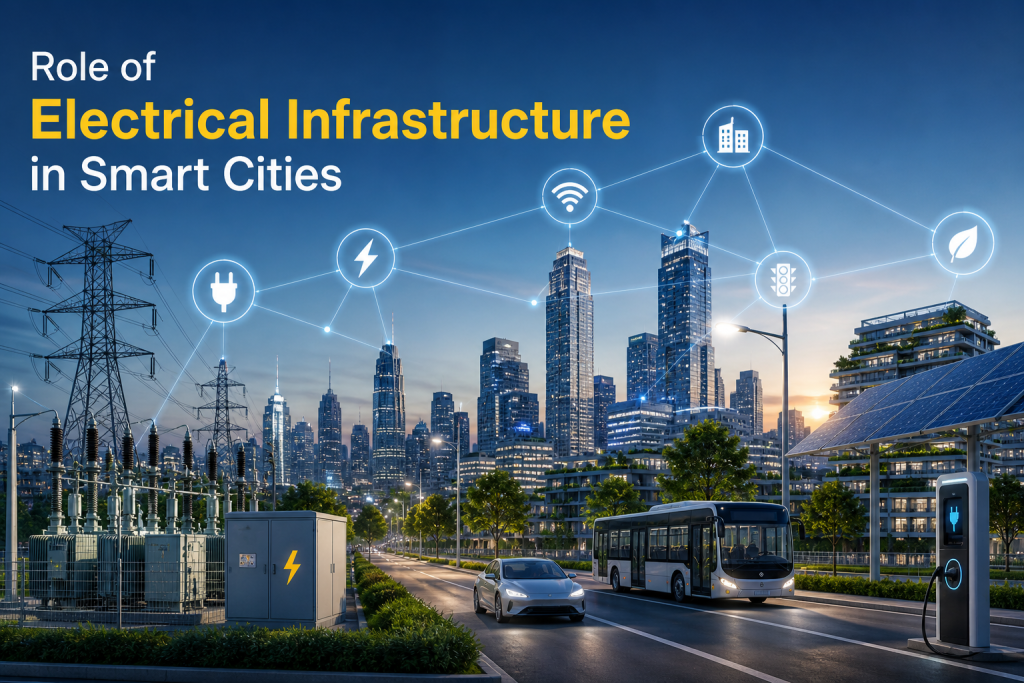
Smart cities depend on interconnected systems: transportation, communication, water supply, and public services, all of which rely on stable and intelligent power networks. Without reliable electrical infrastructure in smart cities and well-planned distribution networks, even the most advanced digital technologies cannot function effectively. This is why governments, planners, and developers are investing heavily in modern smart cities infrastructure systems that integrate power, data, and automation into a single coordinated framework.
What Is Electrical Infrastructure in Smart Cities?
Electrical infrastructure in smart cities is essentially the backbone that keeps a modern urban environment running, it covers everything from how power is generated and moved across transmission lines, to how it’s distributed to homes and businesses, to how it’s tracked and managed in real time. What sets smart city electrical infrastructure apart from older, conventional setups is that it doesn’t just deliver power passively, it responds, adapts, and learns.
Think of it as old-school electrical engineering getting a serious upgrade, automation, live sensors, and digital monitoring platforms are all thrown into the mix, giving the grid the ability to actually respond when demand shifts rather than just sitting there passively delivering power.
This infrastructure typically includes:
- Power generation facilities
These may involve conventional power plants, renewable energy sources, or hybrid energy systems that supply electricity to the urban network. - Transmission and distribution networks
High-voltage lines and local distribution systems deliver electricity safely and efficiently to homes, businesses, and public facilities. - Digital control and monitoring systems
These systems provide real-time visibility into energy usage and network performance. - Backup and resilience systems
Emergency power solutions ensure uninterrupted service during outages or peak demand periods.
Designing electrical systems for cities has grown into something far bigger than just keeping the lights on. It’s now just as much about managing how and when energy gets used, keeping communication networks up and running, and making sure the smart technologies scattered across urban environments actually have what they need to function.
Why Electrical Infrastructure Is the Backbone of Smart Cities
Every smart city function depends on reliable energy supply. Transportation systems, hospitals, water treatment plants, and digital communication networks all require stable power to operate safely and continuously.
Strong energy infrastructure in smart cities supports:
- Continuous operation of essential public services
- Reliable communication and data systems
- Efficient transportation networks
- Sustainable urban growth
- Emergency response and safety systems
Take traffic management systems for example — they run on sensors and communication devices that simply cannot afford to go down, not even briefly. Public lighting tells the same story — without a consistent power supply behind it, residential and commercial areas quickly become unsafe, and that’s a risk no city can afford to take.
Key Components of Smart City Electrical Infrastructure
Putting together a modern electrical infrastructure design means pulling from a wide range of technologies and engineering disciplines all at once, it’s never just one thing. Every single component has a job to do, whether that’s keeping energy flowing consistently or making sure the urban services people rely on daily don’t skip a beat.
Power Generation and Distribution Systems
Power generation and distribution form the foundation of power distribution in smart cities. These systems exist to make sure electricity actually gets where it needs to go — every building, every facility, every service running inside the urban network depends on that.
Grid systems and substations
Substations are essentially the city’s power checkpoints, they step voltage up or down depending on what’s needed and push electricity out to different parts of the city. Without them the whole thing would fall apart pretty quickly
High and low voltage distribution
High-voltage transmission lines handle the heavy lifting moving electricity across long distances, while low-voltage networks take over at the other end, bringing that power directly to the people and businesses using it.
Efficient distribution systems reduce energy loss, improve reliability, and support future urban expansion.
Smart Grids and Digital Monitoring Systems
Today’s cities have moved well beyond basic power grids, what they run on now are smart grid systems that blend electrical infrastructure with digital technology in a way that actually makes the whole network smarter.
Important features include:
Real-time energy monitoring
Sensors collect data on electricity consumption and system performance, allowing operators to identify potential problems early.
Automated load management
A smart grid keeps a constant eye on where demand is building up across the network, shifting things around before any part gets overwhelmed, which goes a long way toward cutting down on outages
The integration of smart grid technology in cities improves efficiency, reduces operating costs, and enhances service reliability.
IoT and Sensor Integration
IoT in electrical infrastructure has genuinely changed the game when it comes to how cities handle their power systems, it’s not even close to how things used to be done. Sensors planted all across the network are constantly pulling in data, and that information is what lets engineers make faster calls and stay ahead of maintenance issues before something actually breaks down.
Common applications include:
Smart meters
These devices measure electricity consumption in real time, helping utilities manage demand and detect irregular usage patterns.
Infrastructure monitoring systems
Sensors track equipment performance, temperature levels, and energy flow to identify maintenance needs before failures occur.
IoT integration allows engineers to move from reactive maintenance to proactive system management.
Energy Storage and Backup Systems
Reliable energy infrastructure in smart cities requires backup systems that maintain service during emergencies or peak demand periods.
Typical solutions include:
Battery systems
Energy storage units store excess electricity and release it when demand increases or supply decreases.
Emergency power planning
Backup generators and redundant power sources ensure critical facilities remain operational during outages.
These systems strengthen network resilience and protect essential services.
How Smart Grids Improve Urban Efficiency
Smart grids have become a core part of how modern cities are built and managed — mostly because they give cities a real handle on energy efficiency that older systems just couldn’t offer. Rather than sticking to rigid, fixed distribution patterns, they read what’s actually happening with demand at any given moment and adjust the power supply on the fly to match it.
Benefits of smart grids include:
- Reduced energy losses during transmission
- Faster detection of system faults
- Improved reliability of power supply
- Better integration of renewable energy sources
- Enhanced control over electricity consumption
By using advanced monitoring and automation tools, smart grids help cities operate more efficiently while reducing environmental impact.
Role of Electrical Infrastructure in Sustainable Urban Development
Sustainability isn’t just a word in urban planning anymore, it’s something cities are genuinely being pushed to deliver on. The pressure to cut carbon emissions, squeeze more out of every unit of energy, and actually make room for renewable sources in the grid has never been higher.
Modern electrical infrastructure services contribute to sustainability in several ways:
Energy efficiency
Advanced distribution systems reduce energy waste and improve operational performance.
Renewable energy integration
Smart grids allow cities to connect solar panels, wind turbines, and other renewable sources to the main power network.
Reduced environmental impact
Efficient energy management lowers greenhouse gas emissions and supports environmental goals.
Sustainable infrastructure is not only environmentally responsible, it also improves long-term economic stability.
Challenges in Electrical Infrastructure for Smart Cities
Despite technological progress, developing reliable electrical infrastructure in smart cities presents several challenges.
Common issues include:
Rapid urban growth
Increasing population density places additional pressure on power networks.
Complex infrastructure coordination
Smart city systems require collaboration between multiple engineering disciplines.
High initial investment costs
Advanced technologies and digital systems require significant upfront funding.
Cybersecurity risks
Digital networks must be protected from unauthorized access and system failures.
Addressing these challenges requires careful planning, strong technical expertise, and coordinated project management.
How UGCE Supports Smart City Electrical Infrastructure
Through careful planning and teams that bring different engineering disciplines together, UGCE takes that same approach with its smart city engineering services keeping the focus on building electrical infrastructure in smart cities that hold up over the long haul and run as efficiently as possible day to day.
Key areas of support include:
Urban electrical network planning
Designing distribution systems that accommodate population growth and infrastructure expansion.
Integrated infrastructure design
Coordinating electrical systems with transportation, water, and communication networks.
Technical feasibility studies
Evaluating project requirements, site conditions, and regulatory compliance before construction begins.
Infrastructure resilience planning
Part of that work means building out backup systems and redundancy strategies so that when emergencies hit, services keep running without skipping a beat.
Taken together, this kind of coordinated effort is what keeps electrical systems dependable, able to grow with the city, and actually in sync with where urban development is headed.
Future of Electrical Infrastructure in Smart Cities
The future of electrical infrastructure in smart cities will be shaped by rapid technological innovation and increasing demand for sustainable energy solutions.
Emerging trends include:
Decentralized energy systems
Cities are moving toward distributed power generation, where energy is produced closer to where it is used.
Artificial intelligence integration
AI-powered systems are moving toward a place where crunching energy data and keeping network performance in check will just happen on their own, no one needing to step in and do it manually
Advanced energy storage technologies
Better battery systems are on the way, and when they land, they’ll give the grid a much steadier foundation while making it a whole lot easier for cities to actually commit to renewable energy rather than just talking about it
Fully connected infrastructure networks
Electrical systems are heading toward a future where they’re deeply tied into transportation, communication, and public safety, all working together rather than operating in their own separate lanes.
When that shift fully takes hold, the way cities handle energy and get services out to the people living in them is going to look completely different from how it works today.
Conclusion
Reliable electrical systems are at the center of every successful smart city. Whether it’s keeping transportation networks moving or holding up the digital communication systems people depend on daily, electrical infrastructure in smart cities is really what makes modern urban life work the way it does smoothly and without constant disruption.
Strong electrical infrastructure does not simply supply power, it supports the future of cities.