
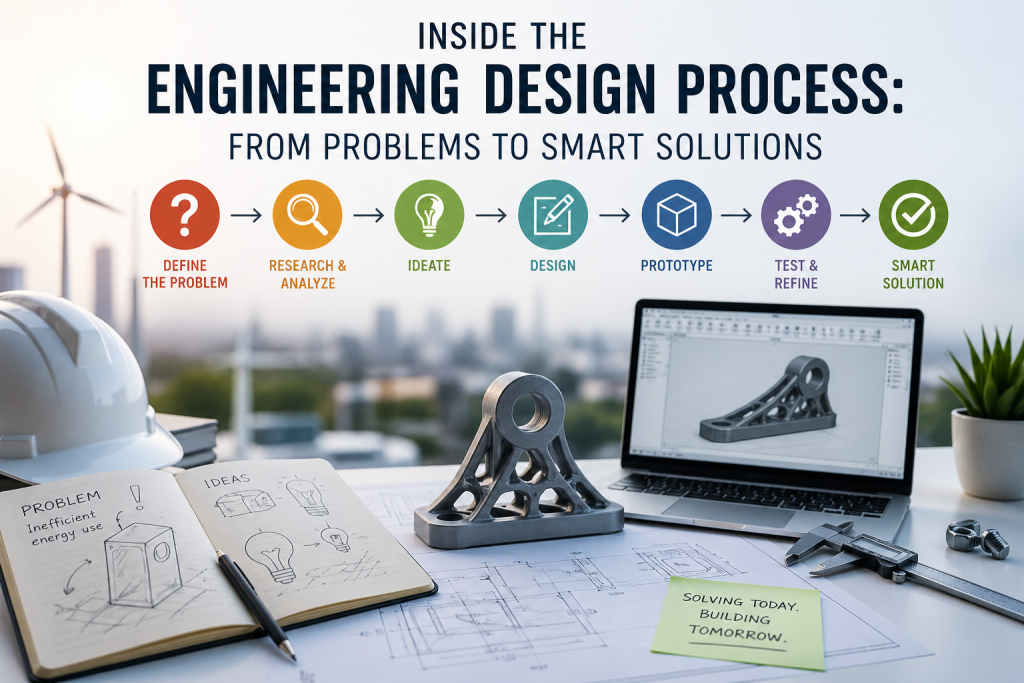
In modern construction environments, engineering is not only about calculations or drawings. It is about coordination, risk management, and informed decision-making. The stronger the design process, the fewer surprises appear during construction.
According to industry engineering references, the engineering design process is fundamentally a structured method used to define problems, collect data, test solutions, and refine designs until the most reliable outcome is achieved.
This structured approach is what allows engineering teams to move from uncertainty to clarity and from concept to execution.
What Is the Engineering Design Process in Construction?
Rather than being a single step, the process is iterative. The engineering design process continuously reviews and refine decisions as new information becomes available. This flexibility is essential when dealing with changing site conditions, regulatory requirements, or evolving client needs.
At its core, the process usually includes:
- Understanding the project challenge: Engineers begin by defining the exact problem that needs to be solved whether it relates to structural stability, infrastructure capacity, or building performance.
- Evaluating technical and financial constraints: Budget, materials, site limitations, and regulatory requirements all influence the final design.
- Developing coordinated engineering solutions: Teams align architectural, structural, and building systems to ensure compatibility and efficiency.
- Testing and refining the design: Adjustments are made until the design meets performance, safety, and cost expectations.
Key Stages of the Engineering Design Process
Although every project has unique characteristics, most construction design process workflows follow a consistent sequence of stages.
These stages allow the engineering design process to move from initial planning to construction-ready documentation in a controlled and coordinated manner.
1. Problem Identification and Project Understanding
The first stage focuses on fully understanding the project before design begins. Many design failures originate from incomplete or inaccurate early information.
Key elements evaluated during this phase include:
Client requirements
Engineers work closely with project stakeholders to define functional needs, performance expectations, and operational objectives. These requirements establish the foundation for all design decisions.
Site constraints
Physical conditions such as soil properties, topography, climate exposure, and surrounding infrastructure can significantly influence the design approach.
Budget and feasibility
Cost expectations are analyzed alongside technical requirements to determine whether the proposed concept can be realistically delivered.
Strong project understanding at this stage reduces the likelihood of redesign later in the project lifecycle.
2. Conceptual Engineering Design
Once the project requirements are clear, engineers begin developing early design concepts. This stage focuses on exploring possible solutions before committing to a final direction.
Typical activities include:
Early-stage ideas
Engineering teams generate multiple technical approaches to address the project challenge.
Feasibility studies
Engineers evaluate technical performance, construction methods, and cost implications for each design option.
Initial sketches and modeling
Conceptual drawings and digital models help visualize the project and identify potential constraints early.
3. Detailed Engineering Design Development
At this stage, the project transitions from concept to technical precision. Engineers develop comprehensive documentation that defines exactly how the project will be built.
This phase includes:
Structural engineering design process
Structural engineers determine load paths, material specifications, and structural systems required to ensure safety and durability.
MEP engineering design process
Mechanical, electrical, and plumbing systems are coordinated to ensure compatibility with the structural and architectural layout.
Technical drawings and specifications
Detailed documentation is produced to guide contractors during construction.
The quality of this stage directly influences construction efficiency, safety performance, and long-term building reliability.
4. Design Review and Optimization
After the initial design is completed, engineers evaluate the solution to identify opportunities for improvement.
Key optimization activities include:
Value engineering
Engineers assess whether alternative materials or construction methods can achieve the same performance at a lower cost.
Cost reduction strategies
Design adjustments are introduced to reduce unnecessary expenses without compromising safety or functionality.
Risk reduction
Potential design conflicts are identified and resolved before construction begins.
Research shows that a significant portion of total project cost is determined during the design phase, making early design optimization in construction one of the most effective ways to control project budgets.
5. Final Design Approval and Documentation
The final stage prepares the project for construction. All technical decisions are finalized, reviewed, and approved by relevant authorities.
This phase typically includes:
Regulatory approvals
Design documentation is submitted to regulatory bodies to confirm compliance with building codes and safety standards.
Compliance checks
Engineers verify that the design meets environmental, structural, and operational requirements.
Construction-ready documents
Final drawings and technical specifications are issued to contractors for implementation.
Once this stage is completed, the project can proceed confidently into construction.
How Engineering Design Solves Complex Construction Problems
Modern construction projects involve multiple technical challenges that must be resolved before construction begins. The engineering design process provides the structured framework needed to address these challenges systematically.
Common problem solving in engineering design include:
- Conflicts between structural and building systems
- Inefficient material usage
- Construction sequencing challenges
- Safety and regulatory compliance issues
- Infrastructure capacity limitations
Through structured engineering problem solving, engineers analyze these challenges, test alternative solutions, and refine the design until the most reliable approach is identified.
This systematic process prevents costly rework and ensures construction progresses smoothly.
Role of Multidisciplinary Engineering in the Design Process
Large-scale construction projects require collaboration between multiple engineering disciplines. Structural engineers, architects, infrastructure planners, and building systems specialists must coordinate their work within a single design framework.
This integrated approach is known as:
multidisciplinary engineering design
It provides several practical advantages:
- Improved coordination between engineering systems
- Faster problem resolution
- Reduced design conflicts
- More efficient construction sequencing
- Better long-term building performance
Without multidisciplinary coordination, individual systems may be technically sound but operationally incompatible.
Why Engineering Design Services Are Critical for Project Success
Professional engineering design services play a central role in project performance because they influence nearly every aspect of construction.
Effective design services contribute to:
- Predictable project timelines
- Controlled construction costs
- Improved safety performance
- Efficient resource utilization
- Long-term infrastructure reliability
In contrast, weak design coordination often leads to:
- Construction delays
- Budget overruns
- Design conflicts
- Operational inefficiencies
This is why developers and project owners invest heavily in experienced engineering teams before construction begins.
Common Mistakes in Engineering Design That Lead to Project Failure
Even well-funded projects can encounter difficulties if the engineering design process is not properly managed. Several recurring mistakes appear across construction projects.
Common design risks include:
Incomplete project requirements
Design decisions based on incomplete information often require costly revisions later.
Poor coordination between disciplines
Misalignment between structural, architectural, and building systems can create conflicts during construction.
Ignoring site conditions
Design solutions that do not account for real site conditions may fail to perform as expected.
Insufficient design review
Skipping quality checks increases the likelihood of technical errors.
Avoiding these mistakes requires structured workflows and experienced engineering leadership.
How UGCE Applies the Engineering Design Process
UGCE applies a structured and coordination-driven engineering design process across all project types.
Key characteristics of UGCE’s approach include:
Integrated engineering teams
Architecture, structural engineering, infrastructure planning, and MEP specialists work within the same project environment.
Data-driven decision-making
Design strategies are based on technical analysis, site data, and performance modeling.
Risk-focused design management
Potential challenges are identified early to reduce construction delays.
Regional project experience
UGCE has delivered projects across residential, infrastructure, and mixed-use sectors throughout Egypt and the GCC.
Conclusion
Most construction challenges don’t start on site — they start much earlier, during design.
The way a project is planned, coordinated, and documented often determines whether construction runs smoothly or becomes difficult to manage later.
That is why the engineering design process matters so much. It gives teams a clear path to understand problems, test solutions, and make practical decisions before work begins.
In real projects, good design is rarely about complexity.
It is about clarity. When engineers, architects, and planners work together from the beginning, many risks can be addressed early.
FAQs
What strategies do engineers use to develop solutions to a problem?
Engineers typically rely on structured problem-solving strategies such as:
- Defining the problem clearly
- Collecting technical data
- Evaluating alternative solutions
- Testing performance assumptions
- Refining the design based on results
These engineering design solutions strategies ensure that engineering decisions are based on evidence rather than assumptions.