
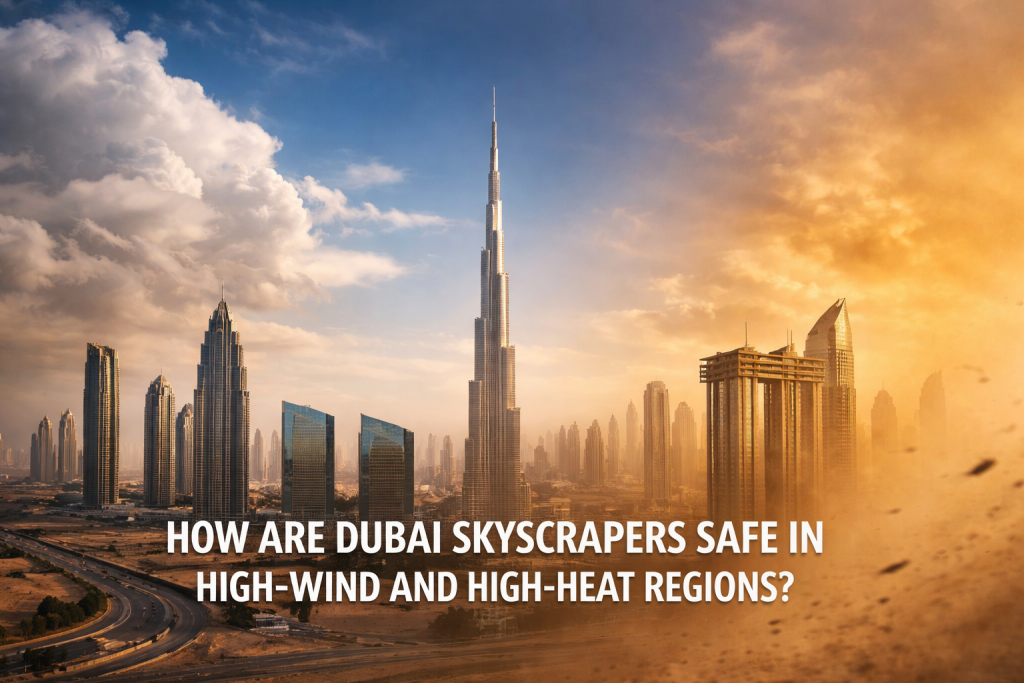
When you gaze up at the awe-inspiring skyline of the UAE, the sheer scale of Dubai skyscrapers can leave you breathless. From the needle-like spire of the Burj Khalifa to the twisted silhouette of the Cayan Tower, these megastructures represent the pinnacle of human ingenuity. However, designing these soaring monoliths is not merely an exercise in aesthetics; it is an ongoing battle against some of the harshest environmental conditions on the planet.
In the Arabian Gulf, architects and engineers face two invisible but immensely powerful adversaries: relentless high-altitude winds and blistering desert temperatures. Successfully erecting a building that reaches into the clouds requires overcoming massive structural hurdles. This article dives deep into the fascinating world of tall building engineering, exploring the innovative structural systems, aerodynamic designs, and advanced testing methods that keep these urban giants standing tall, safe, and secure.
Why Are Wind Forces a Major Challenge for Skyscrapers?
When we stand on the street, we only experience a fraction of the wind’s true power. However, for towering structures, wind forces are arguably the most critical environmental challenge. To understand how skyscrapers withstand wind, we first need to look at how wind behaves at extreme altitudes.
- How Wind Pressure Increases with Height
Because of the friction caused by the earth’s surface, trees, and other buildings, wind speeds at ground level are relatively slow. However, as you move higher into the atmosphere, this friction disappears. This phenomenon, known as the boundary layer effect, means that the high rise building wind load increases exponentially with height. A gentle breeze at the lobby level can translate into a howling gale at the 100th floor, exerting immense pressure on the building’s facade.
- Aerodynamic Forces on Buildings
The most dangerous wind effect is not the direct push against the face of the building, but a phenomenon called “vortex shedding.” As wind hits a flat-faced tower, it cannot easily flow around the rigid corners. Instead, it breaks off into swirling vortices of air on alternating sides of the building. These vortices create alternating low-pressure suction zones that pull the building from side to side, perpendicular to the wind direction. If these rhythmic pulls match the building’s natural resonant frequency, the resulting vibrations can be catastrophic.
- Lateral Movement and Sway
All tall buildings are designed to be flexible; a rigid skyscraper would snap under intense pressure. However, this flexibility leads to lateral movement, or sway. While the building itself might be perfectly safe, excessive sway creates severe safety and comfort concerns for occupants.
- Safety Concerns for Occupants
If a building moves too much, the people inside will experience motion sickness, dizziness, and unease. Water in toilets might slosh, doors could swing shut, and elevators might jam. Therefore, skyscraper safety engineering is as much about human comfort as it is about structural survival. Engineers must limit acceleration—the rate at which the building sways back and forth—to ensure occupants don’t even realize the building is moving.
How Engineers Design Skyscrapers to Resist Strong Winds
To combat the massive forces of nature, engineers rely on sophisticated wind resistant skyscraper design. The goal is not just to build a stronger tower, but a smarter one. Engineers employ a variety of architectural and structural strategies to “confuse” the wind and disrupt organized vortex shedding.
- Aerodynamic Building Shapes
The shape of a building is its first line of defense. A simple rectangular box is highly susceptible to wind forces. To counter this, architects design skyscrapers with softened, rounded corners, chamfered edges, or strategically placed notches. Some buildings even feature “wind holes”—large openings near the top that allow wind to pass directly through the structure, relieving pressure.
- Tapered Towers
Many of the world’s tallest buildings, including iconic Dubai skyscrapers, utilize a tapered or stepped design. By changing the cross-sectional shape and size of the building as it rises, the wind is prevented from organizing into coherent, powerful vortices. The wind behaves differently at each level, breaking up the rhythmic forces that cause dangerous sway.
- Structural Core Systems
The heart of wind resistant skyscraper design is the structural core. Think of it as the spine of the building. This massive, reinforced concrete and steel shaft runs up the center of the tower, housing elevators and stairwells. It provides immense stiffness, resisting the bending and twisting forces applied by the wind.
- Outriggers and Bracing Systems
To further assist the core, engineers use outriggers and cross-bracing. Some buildings also incorporate Tuned Mass Dampers (TMDs)—massive steel or concrete pendulums suspended near the top of the tower. When the wind pushes the building one way, the damper swings the opposite way, absorbing the kinetic energy and significantly reducing lateral sway.
What Structural Systems Keep Tall Buildings Stable?
The sheer weight of a skyscraper, combined with lateral wind loads, demands an incredibly robust framework. Structural engineering for tall buildings relies on a hierarchy of load-bearing systems working in unison to achieve absolute high rise building stability.
- Central Reinforced Concrete Core
As mentioned, the central reinforced concrete core is the foundation of modern skyscraper stability. In ultra-tall buildings, this core is heavily reinforced with dense webs of steel rebar and poured with high-strength concrete to carry the bulk of the building’s gravitational load down to the foundation.
- Tube Structural Systems
Pioneered in the mid-20th century, the “tube” concept revolutionised skyscraper structural design. Instead of relying solely on internal columns, the exterior perimeter of the building is engineered with closely spaced columns and deep beams, acting like a hollow, rigid cylinder. Variations include the “bundled tube” design, where multiple tubes are clustered together to provide immense strength against both gravity and wind.
- Outrigger and Belt Trusses
When a central core alone is not enough to prevent sway in supertall structures, engineers employ outriggers. These are massive, rigid horizontal trusses that extend from the central core out to the perimeter columns, much like a skier using poles for balance. Belt trusses wrap around the exterior of the building at specific mechanical floors, tying all the perimeter columns together and forcing the entire building to act as a unified, stiff entity.
- Mega Columns
In many modern megastructures, standard perimeter columns are replaced by “mega columns.” These are gigantic, heavily reinforced structural pillars located at the corners or edges of the building. Working in tandem with outrigger trusses, these mega columns take on massive loads, freeing up valuable interior floor space and providing unparalleled stability.
How Do High Temperatures Affect Skyscraper Materials?
While wind is a primary focus, the blazing desert environment introduces another massive hurdle: extreme heat. During the peak of summer, ambient temperatures can exceed 50°C (122°F), with the surface temperature of building materials baking at much higher levels. Building design for extreme heat is critical to prevent structural failure.
- Concrete Expansion and Contraction
Concrete is fundamentally impacted by temperature changes. In extreme heat, concrete expands, and as it cools at night, it contracts. Over time, this thermal cycling can lead to micro-cracking and a loss of structural integrity. Furthermore, concrete performance in high temperatures during the actual construction phase is highly volatile. If concrete is poured when it is too hot, the water inside evaporates too quickly, disrupting the chemical curing process and resulting in a weak, brittle material. To combat this, construction crews in Dubai often pour concrete at night. They also mix the concrete with crushed ice or chilled water to keep the temperature perfectly regulated as it cures.
- Steel Thermal Expansion
Steel is highly conductive and prone to thermal expansion. A steel beam baking in the desert sun can elongate significantly. If this expansion is not accounted for in the skyscraper structural design, it can warp the building’s frame, shatter glass facade panels, and compromise the structural joints. Engineers design expansion joints into the building—small gaps that allow materials to expand and contract freely without damaging the overall structure.
- Material Durability in Hot Climates
Beyond structural steel and concrete, extreme heat degrades sealants, waterproofing membranes, and exterior cladding. High UV radiation combined with blowing sand acts like sandpaper, stripping away protective coatings. Therefore, materials used in hot climates must undergo rigorous testing to ensure long-term durability, utilizing specialized heat-reflective glass and UV-resistant compounds.
What Technologies Help Engineers Test Skyscraper Safety?
You cannot build a towering megastructure on guesswork. Before a single shovel hits the dirt, engineers utilize cutting-edge technology to predict exactly how the building will behave. Skyscraper safety engineering relies heavily on advanced testing and simulation.
- Wind Tunnel Testing
This is the gold standard for testing wind load on tall buildings. Engineers build highly detailed scale models of the proposed skyscraper, as well as the surrounding city blocks. They place the model in a wind tunnel and blast it with hurricane-force winds. Sensors measure the pressure on the facade and the structural sway, allowing engineers to tweak the aerodynamic shape before finalizing the design.
- Computer Simulations
Computational Fluid Dynamics (CFD) software creates virtual wind tunnels. Engineers can simulate complex environmental conditions, visualizing how airflows interact with the building’s geometry down to the microscopic level. This allows for rapid prototyping of different architectural features.
- Structural Modeling Software
Using Building Information Modeling (BIM) and Finite Element Analysis (FEA), engineers create a digital twin of the skyscraper. They can simulate earthquakes, extreme heat, and heavy wind loads to see exactly where the structural stress points will be, ensuring the concrete and steel are distributed perfectly.
- Real-Time Monitoring Systems
Testing doesn’t stop when the building opens. Modern skyscrapers are laced with thousands of sensors, including accelerometers, GPS trackers, and strain gauges. These systems monitor the building’s real-time health, tracking exactly how much it sways during a storm or how it reacts to thermal expansion, ensuring long-term safety.
Why Advanced Engineering Is Essential for Modern Skylines
The development of modern megacities relies entirely on the evolution of tall building engineering. Constructing a skyscraper is no longer just about going higher; it is about adapting to increasingly difficult environments.
- Complex Environmental Conditions
Cities in arid regions face a unique cocktail of environmental threats: blistering heat, sudden temperature drops, high-altitude winds, and abrasive sandstorms. Standard building practices are insufficient. Advanced engineering is required to create micro-environments within the building and protective shells on the outside.
- Urban Density
As cities grow denser, buildings are constructed closer together. This creates “wind canyons”—channels where wind is forced between buildings, increasing in speed and turbulence. Engineers must account not only for how the wind affects their building but how their building deflects wind onto neighboring structures or pedestrians below.
- Safety Regulations and Durability
Strict local and international building codes mandate incredibly high safety standards. Advanced engineering ensures that these buildings not only meet these codes but exceed them, offering a massive factor of safety. Furthermore, considering the multi-billion-dollar investments required for these projects, ensuring the long-term durability of the structure against the elements is an absolute necessity.
How UGCE Engineering Consultants Support Complex Construction Projects
Navigating the myriad challenges of extreme environments requires unparalleled expertise. This is where UGCE Engineering Consultants step in. As leaders in the field, UGCE plays a pivotal role in transforming ambitious architectural visions into safe, enduring realities.
- Structural Design Expertise
UGCE provides top-tier structural engineering solutions tailored for complex, large-scale projects. Their deep understanding of skyscraper structural design ensures that buildings are engineered to effortlessly handle extreme wind loads and seismic activity, utilizing the latest in core, tube, and outrigger methodologies.
- Infrastructure Engineering Solutions
Beyond the towers themselves, UGCE excels in infrastructure engineering. They design the vital systems that support massive urban developments, from robust foundation systems capable of supporting millions of tons, to intricate utility networks that keep modern megastructures running smoothly in blistering heat.
- Advanced Project Planning and Safety
UGCE’s approach integrates advanced project planning with rigorous safety standards. By utilizing state-of-the-art modeling and environmental testing, they anticipate challenges before they arise. Their commitment to ensuring durability and safety in challenging climates makes them an invaluable partner in shaping the skylines of tomorrow, ensuring that every project is built to stand the test of time.
FAQs
Q: How do skyscrapers withstand strong winds?
Skyscrapers withstand strong winds through a combination of aerodynamic architectural shaping (like tapered or stepped designs) that confuse wind patterns, and robust structural systems. Heavy reinforced concrete cores act as a rigid spine, while outriggers, perimeter tube systems, and tuned mass dampers absorb kinetic energy and stabilize the building against lateral forces.
Q: Do tall buildings sway in the wind?
Yes, all tall buildings are designed to sway. If a skyscraper were completely rigid, the immense force of the wind would cause the structural materials to snap and fail. By engineering controlled flexibility into the building, it can absorb and dissipate the wind’s energy. Advanced damping systems keep this sway within limits that are virtually imperceptible to the people inside.
Q: What prevents skyscrapers from collapsing?
Skyscrapers are prevented from collapsing by deep, massive foundations (often reaching deep into bedrock) and a hyper-strong internal skeleton. The combination of a central reinforced concrete core, high-strength steel columns, and cross-bracing distributes the immense gravitational weight of the building safely into the ground, while also providing the stiffness needed to resist external environmental forces.