
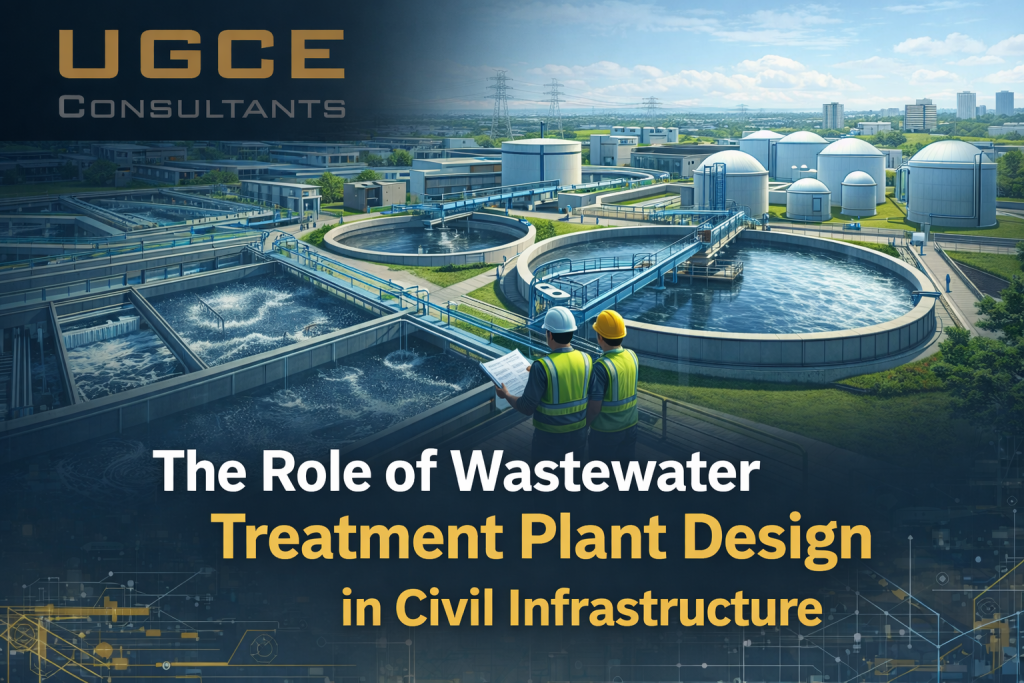
Civil infrastructure is the backbone of modern society, supporting everything from transportation to water supply. However, among the components of civil infrastructure engineering, the wastewater treatment plant is often overlooked.
As populations grow, effective wastewater treatment plant design is becoming critical. These facilities are the guardians of public health, serving as the bridge between human activity and environmental preservation.
Wastewater treatment is a sophisticated industrial process. A successful facility requires the seamless integration of biological science, hydraulic mechanics, and structural resilience.
In this article, we explore WWTP design, its components, and how specialized engineering ensures these civil engineering projects succeed.
What Is a Wastewater Treatment Plant and Why Is Its Design Important?
A Wastewater Treatment Plant (WWTP) is an industrial facility that processes sewage, industrial effluents, and stormwater. Its primary objective is to remove contaminants like organic matter, chemicals, and pathogens.
The Main Outputs:
- Treated Effluent: Safe fluid waste suitable for release or reuse.
- Treated Sludge: Solid waste suitable for disposal or agriculture.
The design is a cornerstone of environmental engineering. Without robust design, dangerous pathogens can contaminate drinking water, leading to public health crises.
From a regulatory standpoint, sewage treatment plant design must ensure strict compliance with environmental standards. Failure to meet these limits can result in legal penalties and ecosystem damage.
Furthermore, a well-designed WWTP supports sustainable urban growth. It ensures that civil engineering projects for housing and industry can proceed without overburdening the environment.
What Are the Key Components of Wastewater Treatment Plant Design?
To understand the complexity of wastewater engineering, one must examine the specific stages of the wastewater treatment process. A comprehensive design meticulously plans each phase to ensure operational efficiency and hydraulic stability.
- Preliminary Treatment
The first line of defense. Engineers design bar screens and grit chambers to remove large objects, sand, and gravel. This prevents wear on pumps and equipment.
- Primary Treatment
Uses sedimentation tanks to separate solids. Heavy raw sludge settles to the bottom, while grease floats to the top. Plant layout and design ensures enough retention time to reduce the organic load significantly.
- Secondary Treatment
This is the biological heart of the plant, typically using the activated sludge process.
- Aeration Tanks: Air is pumped in to stimulate bacteria that consume pollutants.
- Secondary Clarifiers: Bacteria settle out here, leaving clear treated water.
- Tertiary Treatment
Essential for effluent treatment intended for reuse. It involves advanced filtration, nutrient removal, and disinfection using chlorine or UV light.
- Sludge Management
Often the most challenging aspect of sewage treatment plant design is handling the solid byproducts. Sludge management systems include thickening, digestion (using bacteria to break down organic matter), and dewatering. The design must integrate these systems efficiently to minimize the volume of waste requiring transport, which is a major operational cost.
How Does Wastewater Treatment Plant Design Support Civil Infrastructure?
The integration of wastewater treatment facilities into the broader scope of civil infrastructure engineering is vital for the resilience of modern cities. These plants do not exist in isolation; they are connected to vast networks of sewers and drainage systems.
- Enhancing Urban Resilience
Effective WWTP design enables high-density development. Without centralized treatment, cities cannot grow vertically without sanitary collapse. Reliable water treatment systems allow cities to accommodate populations safely.
- Promoting Water Reuse and Circular Economy
Sustainable wastewater management turns waste into a resource.
- Irrigation: Recycled water for public parks.
- Industrial Use: Water for cooling processes.
- Aquifer Recharge: Replenishing groundwater.
This reduces strain on freshwater supplies, making the civil infrastructure grid more resilient to drought
- Environmental Protection
Pollution degrades natural infrastructure. Acidic or toxic effluent can erode riverbanks, damage concrete structures in waterways, and destroy natural bio-filters like wetlands. By ensuring high-quality effluent treatment, engineers protect the physical environment that supports roads, bridges, and housing developments. A well-functioning WWTP acts as a barrier, preventing the degradation of the region’s natural capital.
What Are the Challenges in Designing Wastewater Treatment Plants?
Designing a facility that operates continuously under varying conditions presents unique hurdles in wastewater engineering.
- Space Constraints and Land Availability
In dense urban environments, acquiring large tracts of land for sprawling tanks is often impossible. Engineers must innovate with vertical designs or compact technologies like Moving Bed Biofilm Reactors (MBBR) to fit high-capacity treatment into small footprints. This requires precise coordination of plant layout and design to ensure maintenance accessibility remains uncompromised despite the tight quarters.
- Variable Influent Loads
Unlike a factory that produces a consistent product, a WWTP receives a highly variable input. Flows change drastically between day and night, and storm events can overwhelm the system. The design must be flexible, incorporating flow equalization tanks to handle these fluctuations without washing out the biological media.
- Energy Efficiency and Operational Costs
Water treatment systems are energy-intensive, primarily due to the aeration blowers and massive pumps required. A major challenge is reducing the carbon footprint. This involves selecting high-efficiency equipment and designing hydraulic profiles that utilize gravity flow to minimize pumping requirements.
- Integration with Existing Infrastructure
Retrofitting or expanding an existing plant is often harder than building new. Engineers must maintain plant operations while constructing new phases, requiring complex staging. This highlights the importance of MEP in wastewater plants (Mechanical, Electrical, and Plumbing), where new power and control systems must integrate with legacy grids seamlessly.
What Technologies Are Used in Modern Wastewater Treatment Plant Design?
The field of wastewater treatment is undergoing a technological revolution, moving from passive concrete tanks to smart, automated systems.
- Automated Monitoring and SCADA
Modern plants rely heavily on SCADA (Supervisory Control and Data Acquisition) systems. These systems provide real-time data on flow rates, dissolved oxygen levels, and pH balance. Automated control loops can adjust aeration blower speeds instantly based on the oxygen demand, optimizing energy use and ensuring process stability.
- Membrane Bioreactors (MBR)
MBR technology replaces secondary clarifiers with microscopic membranes.
- High Quality: Filters out virtually all solids.
- Compact: Reduces tank volume by up to 50%.
- Ideal for Cities: Perfect for space-constrained civil engineering projects.
- Renewable Energy Integration
Sustainable wastewater management now often includes energy generation. Anaerobic digesters produce methane gas as a byproduct of sludge breakdown. In modern designs, this gas is captured and used to run Combined Heat and Power (CHP) generators, which can power a significant portion of the plant. Some designs also incorporate solar arrays to power auxiliary pumps.
- Advanced Filtration
To tackle emerging contaminants, designers are incorporating advanced filtration technologies. These ensure that the treated water meets the rigorous standards required for reuse applications, further integrating the WWTP into the sustainable water cycle of the city.
How UGCE Ensures High-Quality Wastewater Treatment Plant Design
At UGCE, top civil engineering consultancy, we understand that a wastewater treatment plant design is a legacy project that must serve the community for decades. Our approach blends deep technical expertise in civil infrastructure engineering with a commitment to environmental compliance.
- Comprehensive Site Investigation
We begin every project with rigorous site analysis. Understanding the geotechnical properties of the soil is crucial for the heavy foundations required by water-retaining structures. We also analyze the influent characteristics in detail to tailor the process design specifically to the local waste profile, ensuring the plant performs reliably.
- Hydraulic and Structural Precision
Our team excels in the complex hydraulic calculations required to move water efficiently through the plant. We pair this with advanced structural engineering to ensure tanks are resilient against corrosion and environmental stressors. Our integrated design approach ensures that the civil engineering projects we deliver are robust and long-lasting.
- Multidisciplinary Coordination
Successful WWTP design requires harmonizing civil, mechanical, and electrical engineering. We focus on optimizing plant layout and design to reduce construction risks and deliver long-term value.
FAQs
Q: What is the main purpose of a wastewater treatment plant?
The main purpose is to remove contaminants from sewage and industrial wastewater to produce an effluent that is safe to release into the environment or reuse, thereby protecting public health and preventing pollution.
Q: Can treated wastewater be reused in urban projects?
Yes, through advanced effluent treatment and filtration, wastewater can be recycled for various urban uses, including irrigation of public parks, industrial cooling processes, dust control on construction sites, and toilet flushing in commercial buildings.