
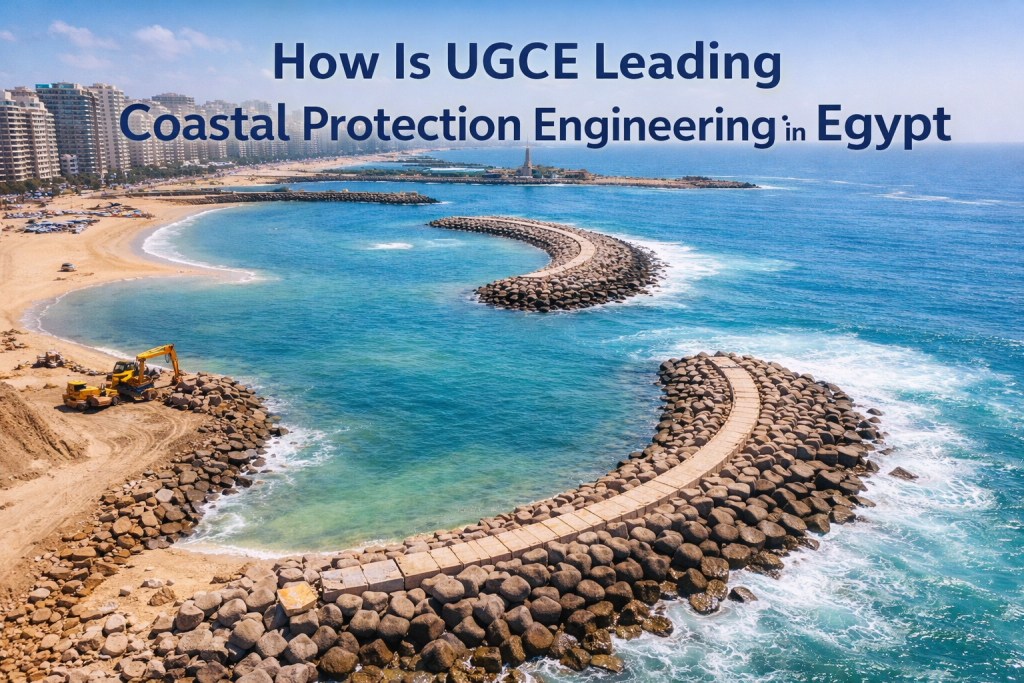
Egypt’s Mediterranean and Red Sea coastlines are taking a beating—from erosion, rising sea levels, and cities growing way too fast. All this puts roads, homes, natural habitats, and even the local economy at risk. That’s why coastal protection engineering isn’t just important for Egypt—it’s absolutely crucial. UGCE steps in here, offering smart coastal engineering consultancy solutions supported by comprehensive infrastructure design services that fit Egypt’s unique coastline. They focus on getting the technical details right and making sure their work stands up over time.
What Is Coastal Protection Engineering and How Does It Work?
Coastal protection engineering focuses on reducing shoreline erosion, flooding, and wave damage through engineered interventions. The goal is not to stop coastal change entirely, but to manage it in a controlled, sustainable way.
Two main approaches are used:
Hard coastal solutions, such as breakwaters, seawalls, revetments, and dikes, which physically block or dissipate wave energy. These are applied where direct protection of assets is critical.
Soft coastal solutions, including beach nourishment and sediment management, which work with natural processes to stabilize shorelines while preserving environmental value.
In Egypt, effective protection often requires combining both approaches within a single, site-specific strategy.
What Coastal Challenges Make Engineering Protection Essential in Egypt?
Egypt’s coastline is uniquely vulnerable due to natural and human-driven factors:
- Accelerated erosion along the Mediterranean coast, especially in the Nile Delta.
- Saltwater intrusion threatening groundwater and agricultural land.
- Rising sea levels require Nile Delta sea level rise solutions to protect low-lying areas.
- Increased development along the North Coast, intensifying risk exposure.
- Stronger wave conditions linked to climate change Egypt coast trends.
- These challenges demand engineering solutions that address shoreline dynamics at a system level rather than isolated points.
How Does UGCE Approach Coastal Protection Engineering Differently?
UGCE treats Coastal protection engineering as a strategic, long-term resilience challenge rather than a single construction task. Its approach is grounded in integrated coastal zone management (ICZM), ensuring that engineering decisions align with environmental processes, land use, and future climate risks.
This method emphasizes:
- Early risk assessment and shoreline behavior analysis
- System-wide sediment and wave interaction studies
- Designs that remain adaptable under future sea level scenarios
As a result, UGCE delivers solutions that remain effective beyond their initial design life.
What Coastal Protection Solutions Does UGCE Specialize In?
UGCE provides a full range of Coastal protection engineering solutions Egypt requires for varied shoreline conditions:
Breakwater & Seawall Design
Advanced breakwater design Egypt projects reduce incoming wave energy, while seawalls protect critical assets where retreat is not feasible.
Revetments & Groynes
Revetments stabilize eroding slopes, and groynes manage sediment transport as part of broader shore protection design Egypt strategies.
Beach Nourishment & Sediment Management
Beach nourishment restores lost shoreline material while improving natural wave buffering when integrated with sediment transport planning.
Hydrodynamic & Wave Modelling
Using advanced Hydrodynamic modeling, UGCE predicts wave behavior, currents, and storm impacts to optimize design performance.
Nature-Based & Sustainable Solutions
Where possible, UGCE incorporates hybrid and nature-based methods that support climate adaptation coastal infrastructure goals.
How Does UGCE Use Advanced Engineering and Technology in Coastal Protection?
UGCE applies numerical modeling, scenario testing, and risk-based design to ensure Coastal protection engineering performs under both current and future conditions. This includes:
- Numerical and hydrodynamic modeling, used to simulate wave propagation, current patterns, and shoreline response under normal and extreme conditions, allowing engineers to test multiple design options before construction.
- Scenario-based analysis, where different future conditions—such as increased storm intensity or gradual sea level rise—are evaluated to ensure structures remain effective beyond their initial design assumptions.
- Risk-based design optimization, which balances structural safety, durability, and cost by identifying the most critical failure modes and addressing them directly in the design stage.
- Adaptive design frameworks, allowing coastal structures to be modified or strengthened in the future without full reconstruction, reducing long-term maintenance and upgrade costs.
By integrating these technologies, UGCE reduces uncertainty in coastal projects and delivers solutions that are technically robust, economically efficient, and resilient to long-term environmental change.
What Types of Coastal Protection Projects Has UGCE Delivered in Egypt?
UGCE has delivered several distinct types of Coastal protection engineering projects in Egypt, each designed according to the physical behavior of the shoreline, wave climate, and level of risk to nearby assets. The projects differ by function, not by label, and are selected based on measurable coastal processes rather than generic design preferences.
The key project types include:
- Shoreline stabilization projects, where engineering solutions are used to slow or stop land loss in erosion-prone areas through structural support and sediment control measures tailored to local wave and current patterns.
- Wave energy reduction projects, focused on protecting harbors, coastal developments, and infrastructure by placing offshore or nearshore structures that reduce wave height before it reaches the coast.
- Sediment management and beach restoration projects, aimed at restoring natural beach profiles and maintaining sediment balance so that erosion is managed rather than transferred to adjacent areas.
- Flood protection and overtopping control projects, designed for low-lying coastal zones where rising sea levels and storm surges pose direct risks to buildings, roads, and utilities.
- Integrated coastal systems, where multiple protection methods are combined into a single coordinated design to ensure long-term performance under changing sea level and climate conditions.
These project types reflect UGCE’s focus on matching engineering interventions to real coastal behavior, ensuring protection measures remain effective over time rather than providing short-term fixes.
FAQs About Coastal Protection Engineering in Egypt
What is the best coastal protection solution for erosion?
The best solution depends on wave climate, sediment dynamics, land use, and environmental sensitivity, often requiring a combined hard–soft approach.
How long do coastal protection structures last?
Properly designed structures can last decades when maintenance and adaptive capacity are included.
Can coastal engineering reduce climate change risks?
Yes. Well-planned coastal engineering significantly reduces flooding, erosion, and long-term sea level rise impacts.